The Cold War was one of the most important periods of the 20th century. It was a long rivalry between the United States and the Soviet Union that began after World War II and lasted until the early 1990s. It was called “cold” because the two superpowers did not fight each other directly in a full-scale war, but their competition shaped world politics for decades.
The conflict began because the United States and the Soviet Union had very different political and economic systems. The United States supported democracy and capitalism, while the Soviet Union promoted communism and one-party rule. After World War II, both countries wanted influence over Europe and other parts of the world, creating deep mistrust between them.
Europe became one of the first major centers of Cold War tension. The Iron Curtain divided Western Europe, supported by the United States and its allies, from Eastern Europe, controlled or influenced by the Soviet Union. Berlin became a powerful symbol of this division, especially during the Berlin Blockade, the Berlin Airlift, and later the construction of the Berlin Wall.
Another major part of the Cold War was the arms race. Both sides built large numbers of nuclear weapons, creating fear that a future war could destroy entire cities or even much of the world. This danger affected governments, schools, families, and everyday life, as people learned about bomb shelters, emergency drills, and the possibility of nuclear conflict.
The rivalry also reached science and technology through the Space Race. The Soviet Union launched Sputnik, the first artificial satellite, in 1957. The United States responded with major investments in space exploration, eventually landing astronauts on the Moon in 1969. Space became another way for each side to show power and progress.
Although the United States and Soviet Union avoided direct war with each other, they supported opposite sides in conflicts around the world. The Korean War, the Vietnam War, and other proxy wars showed how Cold War tensions affected many countries beyond Europe. Spies, propaganda, alliances such as NATO and the Warsaw Pact, and political pressure were also part of the struggle.
The Cold War ended as reforms, economic problems, protests in Eastern Europe, the fall of the Berlin Wall in 1989, and the collapse of the Soviet Union in 1991 changed the world.
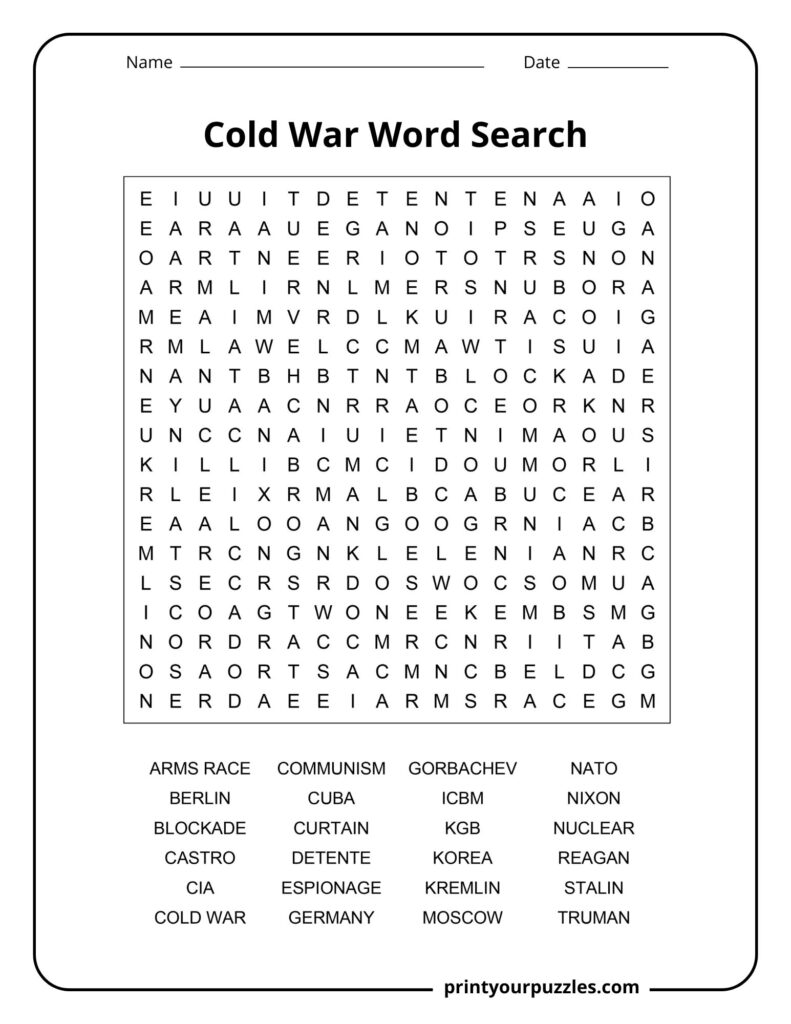
This Cold War word search helps students review vocabulary connected to superpowers, communism, capitalism, Berlin, missiles, spies, space, alliances, and global conflict. A Cold War word search can make this complex period easier to understand through key terms and historical connections.
Related Word Searches:
Cuban Missile Crisis | Vietnam War | Berlin Wall | Camp David Accords | John F. Kennedy | Ronald Reagan
ARMS RACE – Competitive military buildup between the United States and Soviet Union, focusing on nuclear weapons and delivery systems, driving technological advancement and escalating tensions throughout the conflict.
BERLIN – Divided German city symbolizing Cold War tensions; site of the 1948 blockade and the Berlin Wall, which physically separated communist East from democratic West Germany.
BLOCKADE – Soviet blockade of West Berlin in 1948-1949, attempting to force Western powers out by cutting supply routes, countered by the successful Allied airlift operation providing essential supplies.
CASTRO – Fidel Castro, Cuban revolutionary leader who established communist government in 1959, aligned with Soviet Union, and triggered the Cuban Missile Crisis through hosting Soviet nuclear weapons.
CIA – Central Intelligence Agency, United States foreign intelligence service conducting covert operations, espionage activities, and counterintelligence efforts against communist nations throughout
the Cold War era.
COLD WAR – Prolonged geopolitical tension between United States and Soviet Union from 1947-1991, characterized by ideological conflict, proxy wars, espionage, and nuclear arms race without direct military confrontation.
COMMUNISM – Political and economic ideology advocating collective ownership and centralized planning, championed by Soviet Union, contrasting with Western capitalism and democracy throughout the Cold War period.
CUBA – Caribbean island nation ninety miles from Florida, became communist under Castro in 1959, hosted Soviet missiles in 1962, creating dangerous nuclear crisis between superpowers.
CURTAIN – Iron Curtain, Winston Churchill’s metaphor describing the ideological and physical boundary dividing communist Eastern Europe from democratic Western Europe after World War Two.
DETENTE – Period of reduced Cold War tensions during the 1970s,
marked by diplomatic negotiations, arms limitation treaties, and increased cooperation between United States and Soviet Union.
ESPIONAGE – Spying activities conducted by both superpowers to gather intelligence, steal technology, and monitor enemy capabilities, involving agencies like CIA, KGB, and double agents worldwide.
GERMANY – Divided nation after World War Two, split into democratic West Germany and communist East Germany, representing broader ideological divide and serving as Cold War frontline.
GORBACHEV – Mikhail Gorbachev, last Soviet leader who introduced glasnost and perestroika reforms, reduced Cold War tensions, and presided over the peaceful dissolution of the Soviet Union.
ICBM – Intercontinental Ballistic Missile, long-range nuclear weapon delivery system capable of reaching targets thousands of miles away, creating mutually assured destruction deterrent between superpowers.
KGB – Committee for State Security, Soviet Union’s powerful intelligence and security agency conducting espionage, counterintelligence, and internal surveillance throughout the Cold War era.
KOREA – Korean War (1950-1953) was first major Cold War military conflict, pitting communist North Korea and China against South Korea and United Nations forces led by America.
KREMLIN – Moscow fortress housing Soviet government headquarters, became symbolic representation of Soviet power and communist leadership making critical Cold War decisions affecting global politics.
MOSCOW – Capital of Soviet Union and Russia, center of communist power where major Cold War policy decisions originated, hosting summits and negotiations between superpower leaders.
NATO – North Atlantic Treaty Organization, Western military alliance formed in 1949 for collective defense against Soviet aggression, counterbalancing Warsaw Pact throughout Cold War.
NIXON – Richard Nixon, United States president who pursued détente policy with Soviet Union and China, easing tensions through diplomatic engagement and strategic arms limitation agreements.
NUCLEAR – Nuclear weapons technology created unprecedented destructive power, drove arms race, established mutually assured destruction doctrine, and defined strategic thinking throughout entire Cold War.
REAGAN – Ronald Reagan, United States president during 1980s who challenged Soviet Union through military buildup, Strategic Defense Initiative, and strong anti-communist rhetoric before warming relations.
STALIN – Joseph Stalin, Soviet dictator whose aggressive expansionist policies and totalitarian control helped trigger Cold War tensions with Western democracies after World War Two.
TRUMAN – Harry Truman, United States president who established containment policy, implemented Marshall Plan, created NATO, and set foundation for America’s Cold War strategy.