Introduction to the Spanish-American War Word Search
The Spanish-American War was a brief but important conflict fought between the United States and Spain in 1898. Although the war lasted only a few months, it changed the balance of power in the Caribbean and the Pacific, weakened Spain’s remaining colonial empire, and increased American influence overseas.
During the late nineteenth century, Cuba was still controlled by Spain. Many Cubans wanted independence and had fought several rebellions against Spanish rule. Spanish authorities responded harshly, and reports of suffering among Cuban civilians reached the United States. American newspapers published dramatic stories about the conflict, increasing public sympathy for the Cuban independence movement. Some newspapers exaggerated events to attract readers, a practice that became known as yellow journalism.
Tensions grew further when the American battleship USS Maine exploded and sank in Havana Harbor on February 15, 1898. More than 260 American sailors died. The exact cause of the explosion was unclear, but many people in the United States immediately blamed Spain. Public pressure increased, and the United States declared war against Spain in April 1898.
Fighting took place in both the Caribbean and the Pacific. In Cuba, American troops fought alongside Cuban rebels in battles such as San Juan Hill. Theodore Roosevelt gained national attention while leading the Rough Riders, a volunteer cavalry unit. American forces also attacked Spanish positions in Puerto Rico.
The first major American victory occurred far from Cuba, in the Philippines. Commodore George Dewey destroyed the Spanish fleet at Manila Bay. American forces later captured Manila with help from Filipino revolutionaries who were also fighting against Spanish colonial rule.
Spain was unable to continue the war and agreed to an armistice in August 1898. The Treaty of Paris officially ended the conflict in December. Spain gave up control of Cuba and transferred Puerto Rico, Guam, and the Philippines to the United States. Cuba became formally independent, although the United States maintained strong political influence there.
A Spanish-American War word search can introduce students to important vocabulary such as Cuba, Maine, Manila, Spain, treaty, empire, Roosevelt, and independence. Understanding these terms helps explain how a short war transformed the United States into a growing international power while creating new debates about imperialism, colonial rule, and the rights of people living in newly controlled territories.
Related Word Searches:
Theodore Roosevelt | William McKinley | Monroe Doctrine | Progressive Era | Cuban Missile Crisis | Cold War
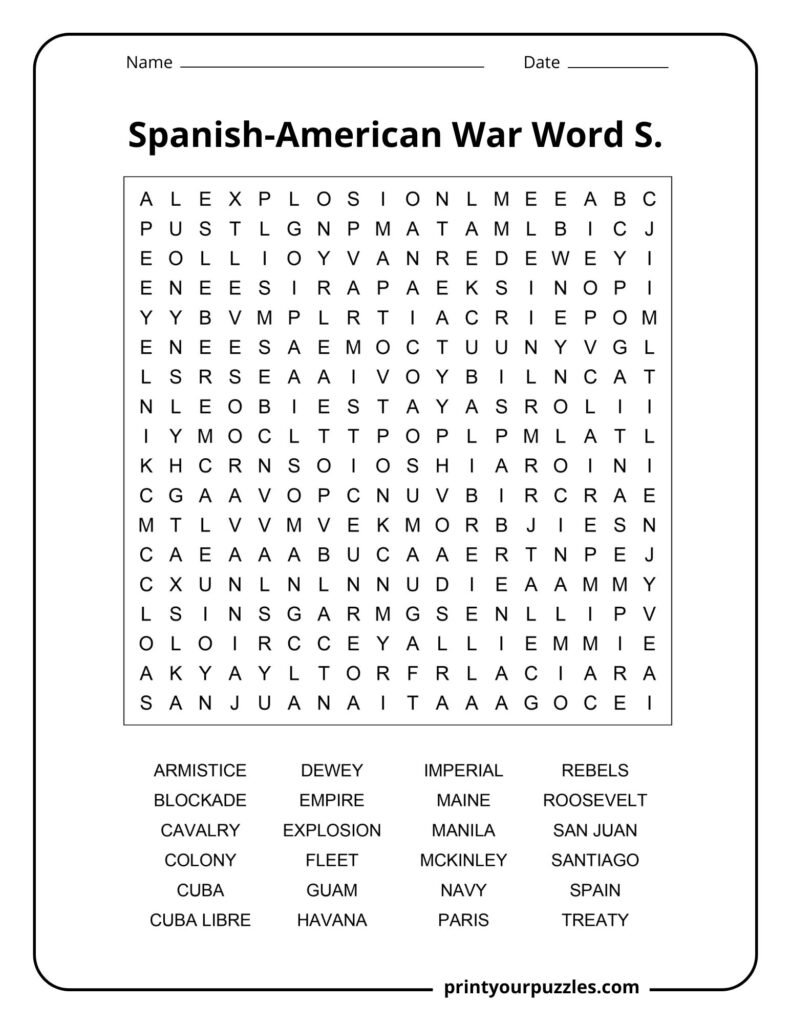
Medium Difficulty Word Search
Words to Find
ARMISTICE, BLOCKADE, CAVALRY, COLONY, CUBA, CUBA LIBRE, DEWEY, EMPIRE, EXPLOSION, FLEET, GUAM, HAVANA, IMPERIAL, MAINE, MANILA, MCKINLEY, NAVY, PARIS, REBELS, ROOSEVELT, SAN JUAN, SANTIAGO, SPAIN, TREATY
All Words Defined
ARMISTICE – Agreement that stopped active fighting between Spain and the United States in August 1898, allowing formal peace negotiations to begin before the final treaty was signed.
BLOCKADE – American naval operation that closed important Cuban ports, restricted Spanish supplies and troop movements, and weakened Spain’s ability to continue fighting effectively throughout the Caribbean.
CAVALRY – Military soldiers traditionally trained to fight on horseback; during the war, volunteer cavalry units such as Theodore Roosevelt’s Rough Riders gained widespread national attention and fame.
COLONY – Territory controlled and governed by another country; before the war, Spain ruled Cuba, Puerto Rico, Guam, and the Philippines as parts of its extensive overseas empire.
CUBA – Caribbean island whose long struggle for independence from Spanish colonial rule became the principal cause of growing tension between Spain and the United States in 1898.
CUBA LIBRE – Spanish phrase meaning Free Cuba, used by supporters of Cuban independence who wanted to end Spanish colonial rule and establish an independent, self-governing Cuban nation.
DEWEY – George Dewey, American naval commander who led the decisive victory over Spain’s Pacific fleet at the Battle of Manila Bay on May 1, 1898.
EMPIRE – Group of territories controlled by a powerful nation; Spain’s overseas empire declined dramatically after it lost several important colonies following its defeat in the war.
EXPLOSION – Sudden blast that destroyed the USS Maine in Havana Harbor, killing more than 260 American sailors and increasing public anger and suspicion toward Spain.
FLEET – Organized group of military warships; American fleets defeated Spanish naval forces at Manila Bay and Santiago, helping secure victory in both major theaters of conflict.
GUAM – Pacific island captured by the United States from Spain in 1898 and formally transferred to American control through the Treaty of Paris following the war.
HAVANA – Capital of Cuba and location of Havana Harbor, where the USS Maine exploded in February 1898, intensifying American demands for military intervention against Spain.
IMPERIAL – Relating to empire and foreign territorial control; the war created debate over whether the United States should govern distant lands and people outside its borders.
MAINE – American battleship that exploded and sank in Havana Harbor on February 15, 1898, becoming a powerful national symbol used to build public support for war.
MANILA – Capital of the Philippines and site of Manila Bay, where Commodore George Dewey’s American fleet defeated Spanish naval forces early in the conflict.
MCKINLEY – William McKinley, United States president during the war, who requested congressional authority to intervene in Cuba after diplomatic efforts failed to resolve the growing crisis.
NAVY – Military branch responsible for warfare at sea; American naval victories prevented Spanish reinforcements, destroyed enemy fleets, and played a central role in winning the war.
PARIS – French capital where representatives of Spain and the United States negotiated and signed the peace treaty that officially ended the war in December 1898.
REBELS – Cuban and Filipino independence fighters who resisted Spanish colonial rule and sometimes cooperated with American military forces during campaigns against Spain in 1898.
ROOSEVELT – Theodore Roosevelt, future United States president who gained national fame by leading the Rough Riders during important fighting near San Juan Heights in Cuba.
SAN JUAN – Cuban battlefield area where American troops, including Theodore Roosevelt’s Rough Riders, attacked defended Spanish positions during important fighting near Santiago in July 1898.
SANTIAGO – Cuban city and port near major land and naval battles that forced Spanish surrender and effectively ended organized Spanish military resistance on the island.
SPAIN – European nation that fought the United States in 1898 and lost control of Cuba, Puerto Rico, Guam, and the Philippines following its military defeat.
TREATY – Formal agreement signed in Paris in December 1898 that ended the Spanish-American War and transferred several former Spanish territories to control of the United States.
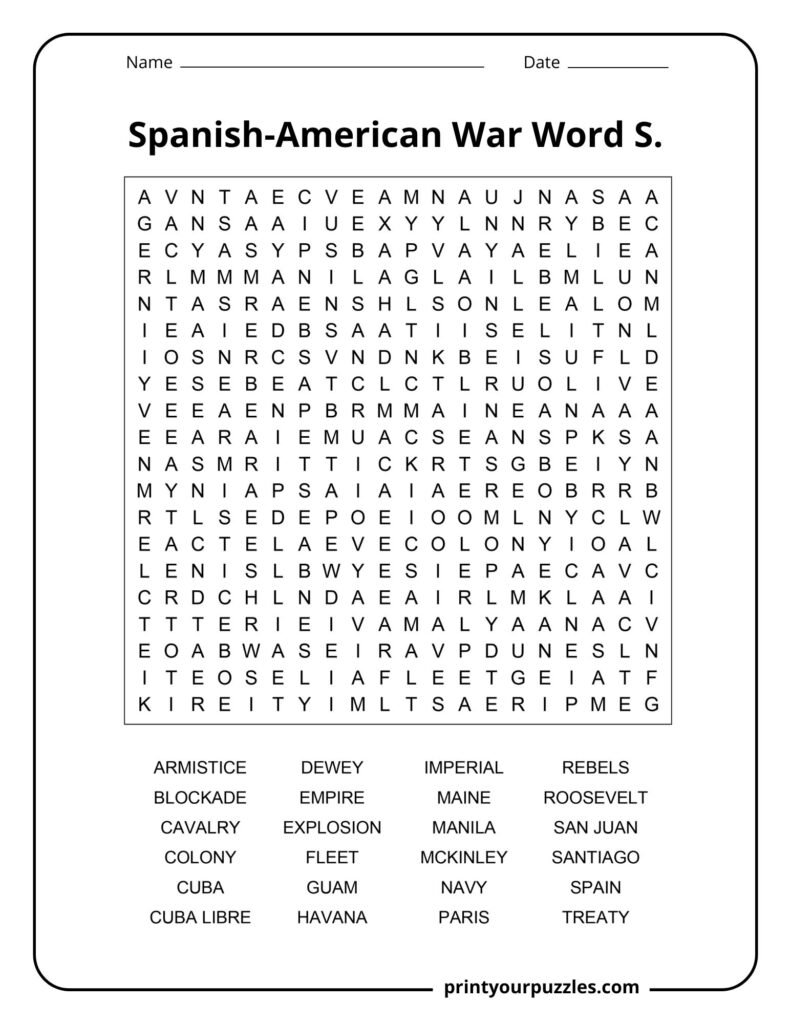
Hard Difficulty Word Search
Words to Find
ARMISTICE, BLOCKADE, CAVALRY, COLONY, CUBA, CUBA LIBRE, DEWEY, EMPIRE, EXPLOSION, FLEET, GUAM, HAVANA, IMPERIAL, MAINE, MANILA, MCKINLEY, NAVY, PARIS, REBELS, ROOSEVELT, SAN JUAN, SANTIAGO, SPAIN, TREATY
5 Key FAQs About the Spanish-American War
5 Curious "Did You Know?" Facts About the Spanish-American War