
The Marshall Plan was a major American program created after World War II to help rebuild Europe. Its official name was the European Recovery Program, and it began in 1948 after being proposed the previous year. The plan became an important part of postwar recovery and early Cold War history.
World War II had left much of Europe badly damaged. Cities had been bombed, factories and railways were destroyed, farms were struggling, and millions of people faced shortages of food, fuel, housing, and jobs. Many European countries needed help not only to repair buildings and roads, but also to restart trade, industry, and everyday economic life.
The plan was named after George C. Marshall, the U.S. Secretary of State. In a 1947 speech at Harvard University, Marshall explained that the United States should help European nations recover from the destruction of war. He argued that economic stability was necessary for peace, cooperation, and political strength.
The United States had several reasons for supporting the plan. American leaders wanted to help Europe recover, but they also wanted to create strong trading partners and prevent another economic crisis. A stable Europe would be better able to buy and sell goods, rebuild democratic institutions, and avoid the social unrest that often follows poverty and hunger.
The Marshall Plan was also closely connected to the Cold War. U.S. leaders feared that economic hardship could make communism more attractive in struggling countries. By helping Western Europe rebuild, the United States hoped to strengthen democratic governments and limit Soviet influence. The Soviet Union rejected the plan and pressured Eastern European countries not to take part, which deepened the division between Western and Eastern Europe.
The program provided billions of dollars in aid, including money, food, fuel, machinery, raw materials, and technical assistance. Participating countries worked together to plan recovery and modernize their economies. The aid helped factories reopen, farms produce more food, transportation systems improve, and communities recover from wartime destruction.
The Marshall Plan did not solve every postwar problem, but it helped Western Europe recover more quickly and strengthened ties between the United States and its allies.
This Marshall Plan word search helps students review vocabulary connected to Europe, recovery, aid, Marshall, World War II, Cold War, communism, rebuilding, economy, trade, and allies. A Marshall Plan word search can make this important topic easier to understand through key terms and historical connections.
Related Word Searches:
Cold War | Berlin Wall | Harry S. Truman | Truman Doctrine | Korean War | Camp David Accords
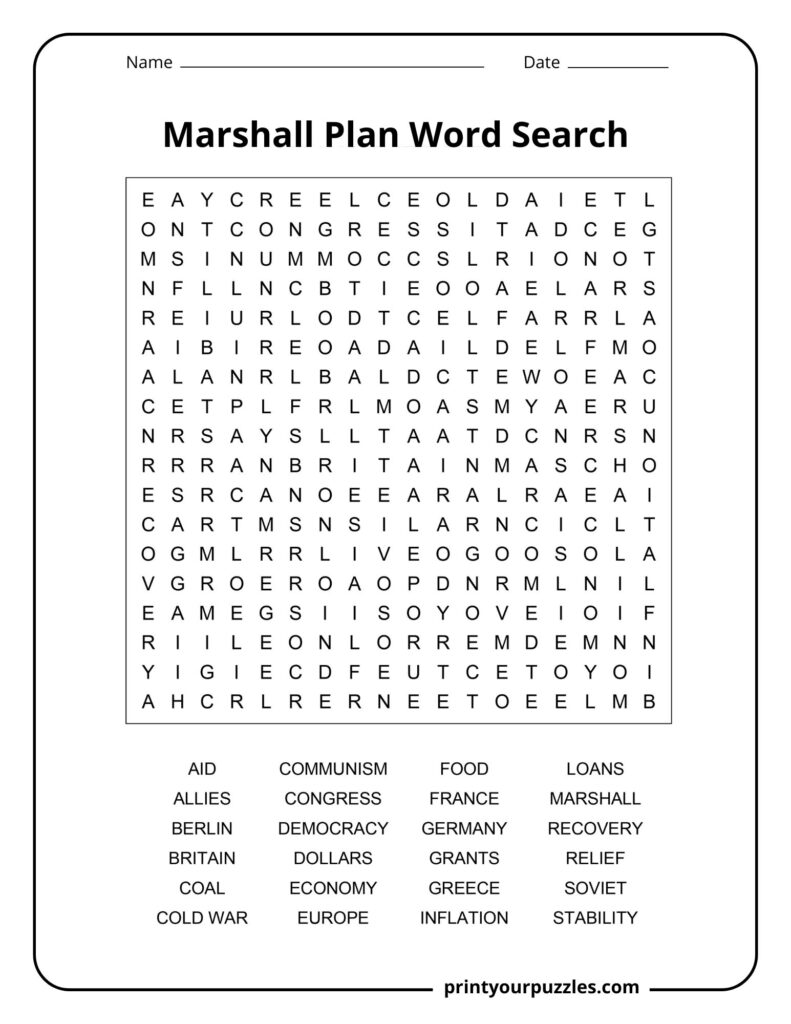
AID, ALLIES, BERLIN, BRITAIN, COAL, COLD WAR, COMMUNISM, CONGRESS, DEMOCRACY, DOLLARS, ECONOMY, EUROPE, FOOD, FRANCE, GERMANY, GRANTS, GREECE, INFLATION, LOANS, MARSHALL, RECOVERY, RELIEF, SOVIET, STABILITY
AID – Financial and material assistance provided by the United States to European nations after World War II to help rebuild their economies and infrastructure.
ALLIES – Western European nations that partnered with the United States during World War II and received Marshall Plan assistance to rebuild and resist Soviet influence.
BERLIN – German city that became a focal point of Cold War tensions, where the Marshall Plan helped support West Berlin’s economic recovery and stability.
BRITAIN – Major European recipient of Marshall Plan funds, receiving significant financial aid to rebuild its war-damaged economy and maintain its role in European recovery.
COAL – Essential natural resource needed for industrial production and heating, whose shortage in postwar Europe the Marshall Plan helped address through strategic distribution.
COLD WAR – Geopolitical tension between the United States and Soviet Union that influenced the Marshall Plan’s creation as a strategy to contain communism in Europe.
COMMUNISM – Political and economic ideology that the Marshall Plan aimed to prevent from spreading in Western Europe by strengthening democratic capitalist economies there.
CONGRESS – United States legislative body that debated and ultimately approved funding for the Marshall Plan, officially called the European Recovery Program in 1948.
DEMOCRACY – Form of government that the Marshall Plan sought to strengthen in Western Europe by providing economic stability and prosperity to democratic nations.
DOLLARS – American currency totaling approximately thirteen billion dollars that was distributed to European countries through the Marshall Plan between 1948 and 1952.
ECONOMY – System of production and trade that the Marshall Plan targeted for reconstruction, helping European nations restore industrial capacity and commercial activity after war.
EUROPE – Continent devastated by World War II that received American economic assistance through the Marshall Plan to rebuild infrastructure, industry, and agriculture comprehensively.
FOOD – Critical resource in short supply after World War II that the Marshall Plan provided to prevent starvation and malnutrition across war-torn European nations.
FRANCE – Key Marshall Plan recipient that used American aid to modernize its economy, rebuild infrastructure, and become a cornerstone of European economic integration.
GERMANY – Divided nation whose western zones received Marshall Plan assistance to rebuild industry and create economic stability, preventing communist expansion from the
east.
GRANTS – Direct financial transfers given to European countries without repayment obligations, comprising a significant portion of the Marshall Plan’s total economic assistance package.
GREECE – Strategic Mediterranean nation that received Marshall Plan aid to rebuild after civil war and resist communist insurgency, maintaining Western alignment during reconstruction.
INFLATION – Economic problem of rapidly rising prices that threatened European stability, which the Marshall Plan helped control by increasing supply of goods and currency.
LOANS – Financial assistance provided to European countries with favorable repayment terms, complementing outright grants as part of the Marshall Plan’s comprehensive economic aid.
MARSHALL – George C. Marshall, United States Secretary of State who proposed the European Recovery Program in 1947, earning the Nobel Peace Prize for it.
RECOVERY – Process of rebuilding European economies, industries, and societies after World War II devastation, which the Marshall Plan successfully accelerated through coordinated international cooperation.
RELIEF – Immediate humanitarian assistance including food, fuel, and medical supplies that the Marshall Plan provided to address urgent needs in postwar European nations.
SOVIET – Referring to the USSR, which rejected Marshall Plan participation and prevented Eastern European satellite states from accepting American economic assistance offers.
STABILITY – Political and economic steadiness that the Marshall Plan aimed to achieve in Europe, preventing chaos that could lead to communist takeovers or renewed conflict.
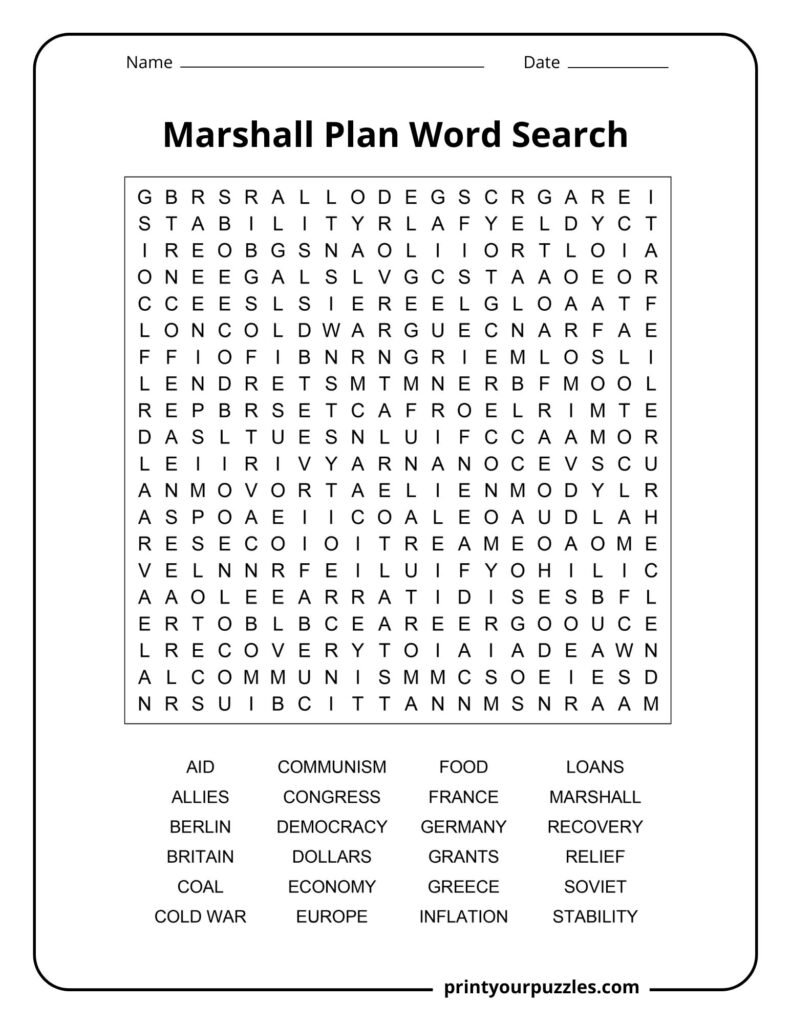
AID, ALLIES, BERLIN, BRITAIN, COAL, COLD WAR, COMMUNISM, CONGRESS, DEMOCRACY, DOLLARS, ECONOMY, EUROPE, FOOD, FRANCE, GERMANY, GRANTS, GREECE, INFLATION, LOANS, MARSHALL, RECOVERY, RELIEF, SOVIET, STABILITY
The Marshall Plan was an American initiative launched in 1948 that provided over $13 billion in economic assistance to help rebuild Western European economies after World War II.
The plan aimed to rebuild war-torn Europe, prevent economic collapse, stop the spread of communism, create stable democracies, and establish markets for American goods.
Sixteen Western European nations participated, including Britain, France, West Germany, Italy, the Netherlands, Belgium, Austria, Greece, Turkey, and the Scandinavian countries. Eastern European nations declined.
The Marshall Plan operated for four years, from April 1948 to December 1951, distributing approximately $13 billion in economic and technical assistance across participating European nations.
Yes, the plan succeeded remarkably. European industrial production increased significantly, living standards improved, economic stability returned, and Western Europe remained aligned with democratic capitalism, resisting communist expansion.
In 1953, George C. Marshall became the only career military officer to receive the Nobel Peace Prize, honored for creating the Marshall Plan that rebuilt Europe peacefully.
The $13 billion spent between 1948-1951 equals approximately $150-175 billion in today’s currency, representing one of history’s largest peaceful international aid programs ever undertaken.
Stalin and Eastern European nations were offered Marshall Plan assistance but rejected it, viewing the program as American economic imperialism designed to undermine Soviet influence.
Former Nazi Germany received substantial Marshall Plan aid, approximately $1.4 billion, helping transform it into Europe’s strongest economy and a democratic ally against communism.
George Marshall first proposed the European Recovery Program during a Harvard University graduation ceremony on June 5, 1947, in a brief, understated ten-minute address.