
The War of 1812 was a conflict between the United States and Great Britain that took place from 1812 to 1815. It happened only a few decades after the Revolutionary War, when the United States was still a young nation trying to defend its rights, trade, and independence in a world dominated by powerful European empires.
Several problems helped cause the war. Britain was fighting France in the Napoleonic Wars and interfered with American trade across the Atlantic. British ships also stopped American vessels and forced some sailors into service in the British navy, a practice known as impressment. Many Americans saw this as an insult to national honor and a threat to the country’s independence.
Tensions also grew on the western frontier. Some Americans believed Britain was supporting Native American resistance against U.S. expansion. At the same time, a group of young members of Congress known as the War Hawks pushed for war. They wanted to defend American rights, reduce British influence, and, in some cases, expand into Canada.
The fighting took place in several regions. American forces tried to invade Canada, but these campaigns were difficult and often unsuccessful. Battles also occurred around the Great Lakes, where control of waterways was important. In 1814, British troops entered Washington, D.C., and burned public buildings, including the White House and the Capitol.
Soon after, British forces attacked Baltimore. During the bombardment of Fort McHenry, Francis Scott Key saw the American flag still flying after the battle. This inspired him to write a poem that later became “The Star-Spangled Banner,” the national anthem of the United States.
The war officially ended with the Treaty of Ghent, signed in 1814. The treaty mostly restored conditions to how they had been before the war, but many Americans saw the conflict as proof that the young nation could stand up to Britain again. The Battle of New Orleans, fought in 1815 after the treaty had been signed, made Andrew Jackson a national hero. For Native American nations, however, the war weakened British support and increased pressure from U.S. expansion.
Students can use this War of 1812 word search to review vocabulary connected to Britain, sailors, impressment, War Hawks, Canada, Baltimore, Fort McHenry, New Orleans, treaty, and independence. These words help connect the causes, battles, leaders, symbols, and consequences of this important early American conflict.
Related Word Searches:
James Madison | Monroe Doctrine | Thomas Jefferson | Revolutionary War | Andrew Jackson | Westward Expansion
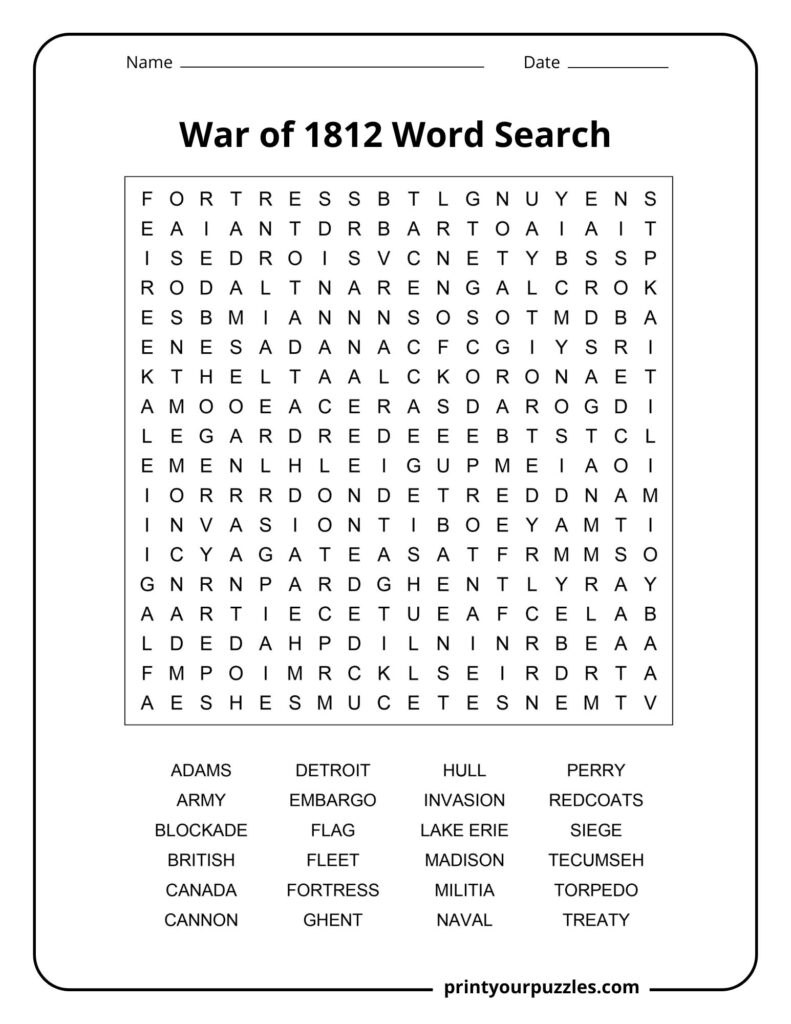
ADAMS, ARMY, BLOCKADE, BRITISH, CANADA, CANNON, DETROIT, EMBARGO, FLAG, FLEET, FORTRESS, GHENT, HULL, INVASION, LAKE ERIE, MADISON, MILITIA, NAVAL, PERRY, REDCOATS, SIEGE, TECUMSEH, TORPEDO, TREATY
ADAMS – John Quincy Adams was a key American diplomat who helped negotiate the Treaty of Ghent in 1814, which officially ended the War of 1812 between the United States and Britain.
ARMY – The United States Army was the primary land fighting force during the War of 1812, though it was poorly trained and undermanned at the conflict’s start, struggling in early campaigns.
BLOCKADE – The British Royal Navy imposed a naval blockade along the American coastline, severely restricting trade and crippling the young nation’s economy throughout much of the war’s duration.
BRITISH – The British Empire was the primary enemy of the United States during the War of 1812, fighting to maintain dominance over North American territories and control of the seas.
CANADA – Canada, then a British colony, was a major target of American invasion attempts during the war. Multiple campaigns to conquer Canadian territory ultimately failed against strong British and Canadian defense.
CANNON – Cannons were essential artillery weapons used extensively in both land battles and naval engagements throughout the War of 1812, causing devastating damage to fortifications, ships, and infantry formations.
DETROIT – Detroit was surrendered to the British by General William Hull in August 1812 without a fight, marking one of the most humiliating American defeats during the early stages of the war.
EMBARGO – Trade embargoes were economic measures used by the United States before and during the war to pressure Britain, though they often hurt American merchants and the domestic economy more than the enemy.
FLAG – The American flag became a powerful symbol during the war, especially after the bombardment of Fort McHenry in 1814, which inspired Francis Scott Key to write “The Star-Spangled Banner.”
FLEET – Naval fleets played a crucial role in the War of 1812, with both American and British warships battling for control of the Great Lakes and the Atlantic Ocean trade routes.
FORTRESS – Fortresses and fortified positions were vital defensive structures throughout the war, including Fort McHenry in Baltimore and Fort Erie in Canada, where major battles took place during the conflict.
GHENT – Ghent is the Belgian city where American and British diplomats signed the peace treaty on December 24, 1814, officially ending the War of 1812 and restoring prewar boundaries between nations.
HULL – General William Hull was the American commander who infamously surrendered Detroit to the British in 1812 without significant resistance, later being court-martialed and sentenced to death for cowardice.
INVASION – Multiple invasion attempts defined the War of 1812, with Americans trying to conquer Canada and the British invading American territory, most notably burning Washington, D.C., in August 1814.
LAKE ERIE – Lake Erie was the site of a decisive American naval victory in September 1813, where Commodore Oliver Hazard Perry defeated the British fleet, securing control of the strategic western Great Lakes.
MADISON – James Madison was the President of the United States who led the nation into the War of 1812, signing the declaration of war against Britain in June 1812 over maritime disputes.
MILITIA – State militias formed a significant portion of American fighting forces during the war, though they were often unreliable, poorly trained, and sometimes refused to fight outside their home states.
NAVAL – Naval warfare was a defining aspect of the War of 1812, with surprising American victories at sea against the powerful British Royal Navy boosting national morale and proving American maritime strength.
PERRY – Oliver Hazard Perry was the American naval commander who won the Battle of Lake Erie in 1813, famously sending the message “We have met the enemy and they are ours.”
REDCOATS – Redcoats was the popular nickname for British soldiers, derived from their distinctive red uniform jackets. They fought across multiple fronts during the War of 1812 against American forces.
SIEGE – Sieges were common military tactics during the War of 1812, with prolonged attacks on fortified positions such as Fort Meigs, Fort Erie, and Fort McHenry shaping the outcome of the conflict.
TECUMSEH – Tecumseh was a powerful Shawnee leader who allied with the British against the Americans, seeking to protect Native lands. He was killed at the Battle of the Thames in October 1813.
TORPEDO – Torpedoes during the War of 1812 referred to early underwater explosive mines used in harbors and rivers to defend against enemy warships, representing an innovative but primitive naval warfare technology of that era.
TREATY – The Treaty of Ghent, signed in December 1814, formally ended the War of 1812 between the United States and Britain, restoring borders to their prewar positions with no territorial changes made.
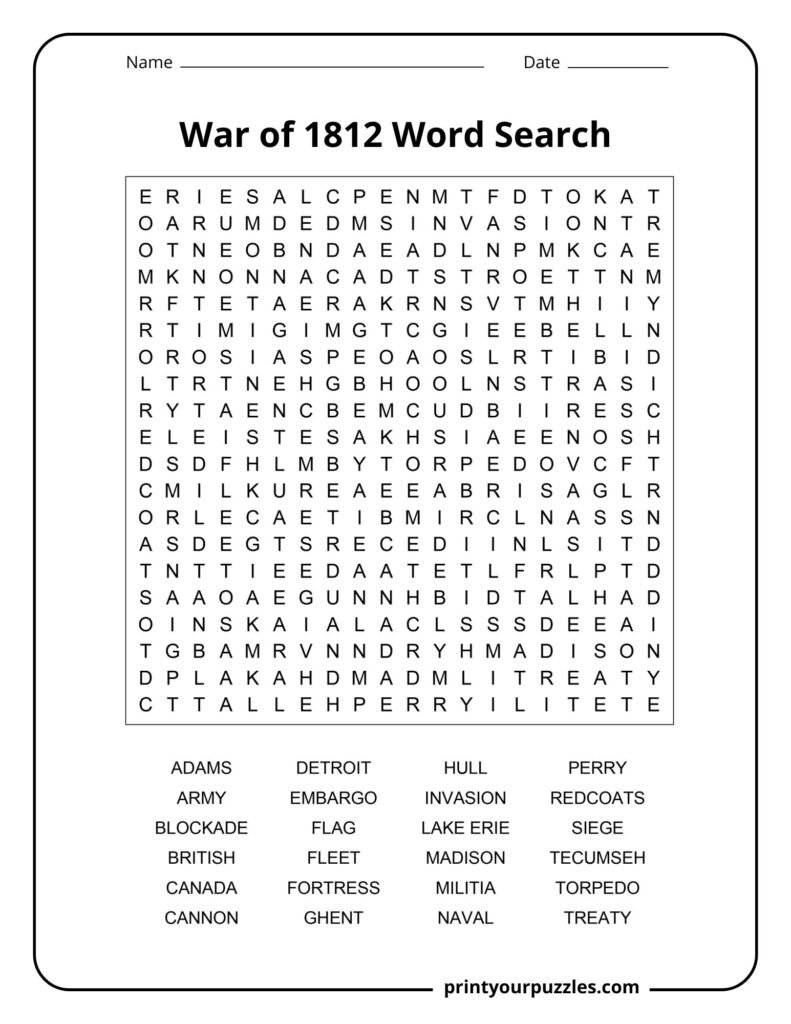
ADAMS, ARMY, BLOCKADE, BRITISH, CANADA, CANNON, DETROIT, EMBARGO, FLAG, FLEET, FORTRESS, GHENT, HULL, INVASION, LAKE ERIE, MADISON, MILITIA, NAVAL, PERRY, REDCOATS, SIEGE, TECUMSEH, TORPEDO, TREATY
The main causes were British impressment of American sailors, trade restrictions during the Napoleonic Wars, and British support for Native American tribes resisting American westward expansion into frontier territories.
There was no clear winner. The Treaty of Ghent restored prewar boundaries with no territorial changes. However, the United States gained national pride, and Native American nations suffered the greatest losses overall.
In August 1814, British forces captured and burned Washington, D.C., including the White House and Capitol, as retaliation for the American burning of York, the capital of Upper Canada.
Native American nations, led by leaders like Tecumseh, allied with the British to resist American expansion. Their defeat during the war devastated tribal power and opened vast western lands to American settlement.
The war strengthened American nationalism, ended dependence on European goods by boosting domestic manufacturing, weakened Native American resistance, and established the United States as a respected independent nation on the world stage.
News traveled slowly in 1814, so Andrew Jackson’s famous victory on January 8, 1815, occurred two weeks after the Treaty of Ghent officially ended the war.
After the British burned the presidential mansion in 1814, it was repainted white to cover the smoke damage. This is widely believed to be the origin of its iconic name.
Francis Scott Key composed the poem after witnessing the British bombardment of Fort McHenry in Baltimore during September 1814. It later became the official national anthem in 1931.
Canadians view the war as a successful defense of their homeland against American invasion, and it remains a proud and defining moment in Canadian national identity and history.
As British troops approached Washington in 1814, First Lady Dolley Madison bravely rescued the iconic Gilbert Stuart portrait of George Washington before fleeing the burning White House.