
The Mexican-American War was a conflict between the United States and Mexico that lasted from 1846 to 1848. It became a major event in the history of U.S. westward expansion and changed the map of North America. The war was connected to questions of territory, borders, national ambition, and the future of slavery in the United States.
One of the main causes was the dispute over Texas. Texas had declared independence from Mexico in 1836, but Mexico did not fully accept this separation. When the United States annexed Texas in 1845, Mexico viewed the action as a threat. The situation became even more tense because the two countries disagreed about the southern border of Texas.
The United States claimed that the border was the Rio Grande, while Mexico argued that it was farther north, at the Nueces River. President James K. Polk, who strongly supported expansion, sent American troops into the disputed area. Fighting soon broke out, and Congress declared war in 1846.
The war was closely connected to Manifest Destiny, the belief that the United States was meant to expand westward toward the Pacific Ocean. Many Americans supported the war because they wanted new land, trade routes, and access to California and the Southwest. Others opposed it, arguing that it was aggressive and unfair to Mexico.
U.S. forces fought in several regions, including northern Mexico, New Mexico, California, and central Mexico. Generals such as Zachary Taylor and Winfield Scott became important military leaders. Scott’s campaign eventually led American troops to Mexico City, placing strong pressure on the Mexican government to make peace.
The war ended in 1848 with the Treaty of Guadalupe Hidalgo. Under this treaty, Mexico ceded a huge amount of territory to the United States, including land that later became California, Nevada, Utah, Arizona, New Mexico, and parts of Colorado and Wyoming. The United States also paid Mexico $15 million as part of the agreement.
The Mexican-American War greatly expanded U.S. territory, but it also had serious consequences for Mexico and for the people living in the transferred lands. It intensified debates over whether slavery would expand into the new territories, increasing tensions that later helped lead to the Civil War.
To review this important chapter of 1800s history, this Mexican-American War word search includes vocabulary related to Texas, Mexico, the Rio Grande, President Polk, Manifest Destiny, soldiers, treaties, California, territory, and expansion. These words help students understand how the war began, what changed after it ended, and why it mattered for the future of the United States.
Related Word Searches:
Manifest Destiny | Westward Expansion | California Gold Rush | Oregon Trail | James K. Polk | Texas Annexation
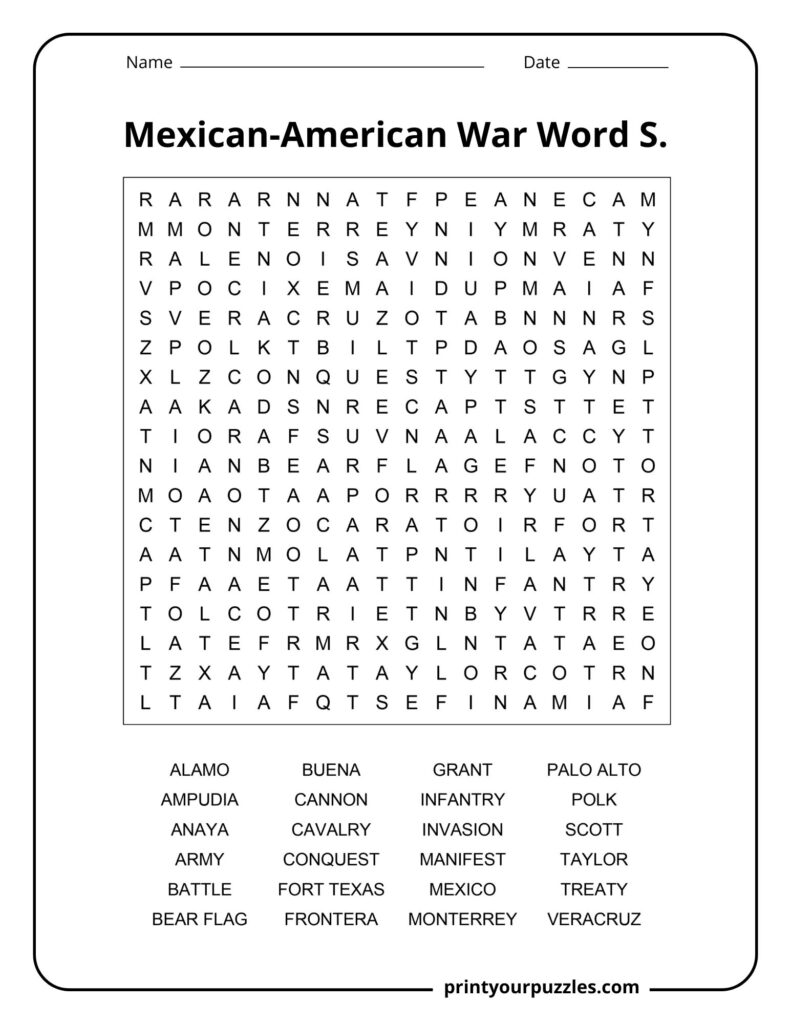
ALAMO, AMPUDIA, ANAYA, ARMY, BATTLE, BEAR FLAG, BUENA, CANNON, CAVALRY, CONQUEST, FORT TEXAS, FRONTERA, GRANT, INFANTRY, INVASION, MANIFEST, MEXICO, MONTERREY, PALO ALTO, POLK, SCOTT, TAYLOR, TREATY, VERACRUZ
ALAMO – Historic mission in San Antonio, Texas, where a famous 1836 battle occurred. Its memory fueled American resolve and played a role in the conflict with Mexico.
AMPUDIA – Pedro de Ampudia was a Mexican general who commanded forces at Monterrey. He negotiated an armistice with American General Zachary Taylor after the city’s siege.
ANAYA – Pedro María Anaya served as interim president of Mexico during the war. He is remembered for his defiant resistance during the Battle of Churubusco in 1847.
ARMY – The United States Army was the principal military force engaged in the war. It carried out major campaigns across northern Mexico, central Mexico, and the western territories.
BATTLE – Numerous battles defined the Mexican-American War, including Palo Alto, Buena Vista, and Chapultepec. These engagements ultimately led to the American victory and territorial expansion.
BEAR FLAG – The Bear Flag Revolt of 1846 was an uprising by American settlers in California against Mexican rule. It led to the short-lived California Republic before U.S. annexation.
BUENA – Buena Vista was a decisive battle in February 1847 where General Zachary Taylor defeated a much larger Mexican force led by Santa Anna in northern Mexico.
CANNON – Cannons were essential artillery weapons used by both armies throughout the war. American superiority in artillery technology proved to be a significant advantage in many key battles.
CAVALRY – Mounted cavalry units played a vital role in reconnaissance, skirmishes, and battlefield charges. Both Mexican and American forces relied heavily on horseback soldiers during the campaign.
CONQUEST – The war resulted in the American conquest of vast Mexican territories, including present-day California, Nevada, Utah, Arizona, and New Mexico, reshaping the North American continent permanently.
FORT TEXAS – Fort Texas was an American fortification built along the Rio Grande opposite Matamoros. Its bombardment by Mexican forces in May 1846 was among the war’s opening hostilities.
FRONTERA – The Spanish word for border or frontier, referring to the disputed boundary between Mexico and Texas along the Rio Grande, which was a central cause of the war.
GRANT – Ulysses S. Grant served as a young lieutenant during the Mexican-American War. His combat experience proved invaluable when he later commanded Union forces during the American Civil War.
INFANTRY – Infantry soldiers formed the backbone of both armies, fighting on foot in harsh terrain. They endured long marches, disease, and intense combat throughout the entire military campaign.
INVASION – The United States launched a large-scale invasion of Mexican territory in 1846. Forces advanced through northern Mexico and eventually captured Mexico City, forcing Mexico to negotiate peace.
MANIFEST – Manifest Destiny was the widespread belief that American expansion across the continent was both justified and inevitable. This ideology was a driving force behind the war with Mexico.
MEXICO – Mexico was the opposing nation in the conflict, defending its territory against American expansion. The war devastated Mexico, which lost nearly half of its national territory in defeat.
MONTERREY – The Battle of Monterrey in September 1846 was a hard-fought American victory in northeastern Mexico. General Taylor’s forces captured the fortified city after several days of urban combat.
PALO ALTO – Palo Alto was the first major battle of the war, fought on May 8, 1846, in southern Texas. American artillery dominance secured a clear victory over Mexican forces that day.
POLK – James K. Polk was the eleventh President of the United States and a strong advocate for territorial expansion. He orchestrated the political circumstances that led to war with Mexico.
SCOTT – Winfield Scott was the American general who led the bold amphibious invasion of Veracruz and the subsequent march to Mexico City, effectively winning the war for the United States.
TAYLOR – Zachary Taylor was an American general whose victories in northern Mexico made him a national hero. His wartime fame propelled him to the presidency of the United States in 1849.
TREATY – The Treaty of Guadalupe Hidalgo, signed in February 1848, officially ended the war. Mexico ceded enormous territories to the United States in exchange for fifteen million dollars in compensation.
VERACRUZ – Veracruz was a major Mexican port city besieged by General Winfield Scott in March 1847. Its capture provided the launching point for the American advance inland toward Mexico City.
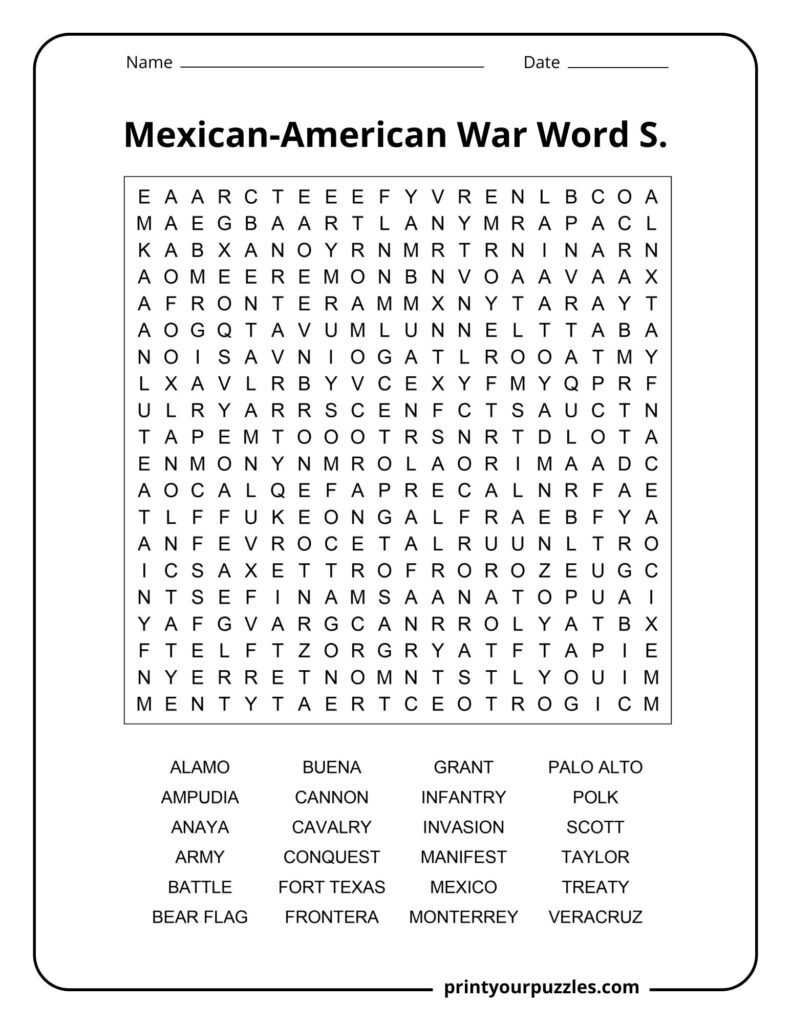
ALAMO, AMPUDIA, ANAYA, ARMY, BATTLE, BEAR FLAG, BUENA, CANNON, CAVALRY, CONQUEST, FORT TEXAS, FRONTERA, GRANT, INFANTRY, INVASION, MANIFEST, MEXICO, MONTERREY, PALO ALTO, POLK, SCOTT, TAYLOR, TREATY, VERACRUZ
The war was primarily caused by the United States annexation of Texas in 1845, a disputed border along the Rio Grande, and American ambitions driven by Manifest Destiny.
The war began in April 1846 when Mexican and American forces clashed along the Rio Grande, and it officially ended with the Treaty of Guadalupe Hidalgo in February 1848.
Through the Treaty of Guadalupe Hidalgo, Mexico ceded California, Nevada, Utah, Arizona, New Mexico, and parts of Colorado and Wyoming to the United States for fifteen million dollars.
The main American generals were Zachary Taylor and Winfield Scott. On the Mexican side, General Antonio López de Santa Anna led the defense against the American invasion forces.
The war dramatically reshaped North America, expanding United States territory by one-third. It also intensified the national debate over slavery, contributing to tensions that led to the Civil War.
Ulysses S. Grant, who fought in the conflict as a young officer, later called it one of the most unjust wars ever waged by a stronger nation against a weaker one.
Daguerreotype cameras were used to capture images of soldiers and battlefields, making it the earliest U.S. war to be documented through the emerging art of photography.
The opening line of the United States Marines’ Hymn refers to the storming of Chapultepec Castle in Mexico City, one of the final and most dramatic battles of the conflict.
Robert E. Lee, Stonewall Jackson, George McClellan, and Ulysses S. Grant all gained crucial battlefield experience during the Mexican-American War that shaped their future military careers significantly.
The Treaty of Guadalupe Hidalgo forced Mexico to cede over 500,000 square miles, including the lands that became California just before the famous Gold Rush of 1849.