
Some presidents promise a great deal and struggle to deliver. James K. Polk (1845–1849) did the opposite: he entered office with a clear set of goals and achieved nearly all of them in just one term. His presidency was energetic, ambitious, and deeply connected to the idea of westward expansion. The James K. Polk word search gives students a way to explore a leader whose four years in office changed the map of the United States.
Polk came to national attention as a determined Democrat from Tennessee and a strong supporter of Andrew Jackson’s political ideas. Before becoming president, he had been speaker of the House and governor of Tennessee. In 1844, he was not the most obvious candidate, but he emerged as a compromise choice and then defeated Henry Clay in a campaign shaped by expansion, Texas, Oregon, and the future of the West.
James K. Polk served as president from 1845 to 1849. During those years, the United States annexed Texas, settled the Oregon boundary dispute with Britain, and fought the Mexican-American War. The Oregon agreement established the northern boundary of the United States in the Pacific Northwest, while the annexation of Texas increased tensions with Mexico and reopened arguments over slavery and territorial growth.
The Mexican-American War became the defining event of Polk’s presidency. The war ended with the Treaty of Guadalupe Hidalgo in 1848, which added a vast amount of land to the United States. This territory included what would later become California, Nevada, Utah, Arizona, New Mexico, and parts of other states. For supporters of Manifest Destiny, Polk had helped fulfill the vision of a nation stretching from the Atlantic to the Pacific.
Yet expansion came with serious consequences. Critics argued that the war was aggressive and that the new lands would intensify the conflict over slavery. The question of whether slavery would be allowed in western territories divided the country more sharply and helped move the United States closer to the Civil War.
Polk also lowered tariffs, restored the independent treasury system, and worked with unusual focus for a one-term president. He chose not to run for reelection and left office exhausted, dying only a few months later.
This James K. Polk word search highlights expansion, war, diplomacy, campaign promises, Manifest Destiny, and the consequences of territorial growth. Polk’s presidency shows how quickly the United States changed during the 1840s—and how decisions that looked successful at the time could create difficult questions for the future.
Travel across the Jacksonian Era and Westward Expansion with our John Tyler word search, Zachary Taylor word search, Andrew Jackson word search, and the full US Presidents Word Searches collection.
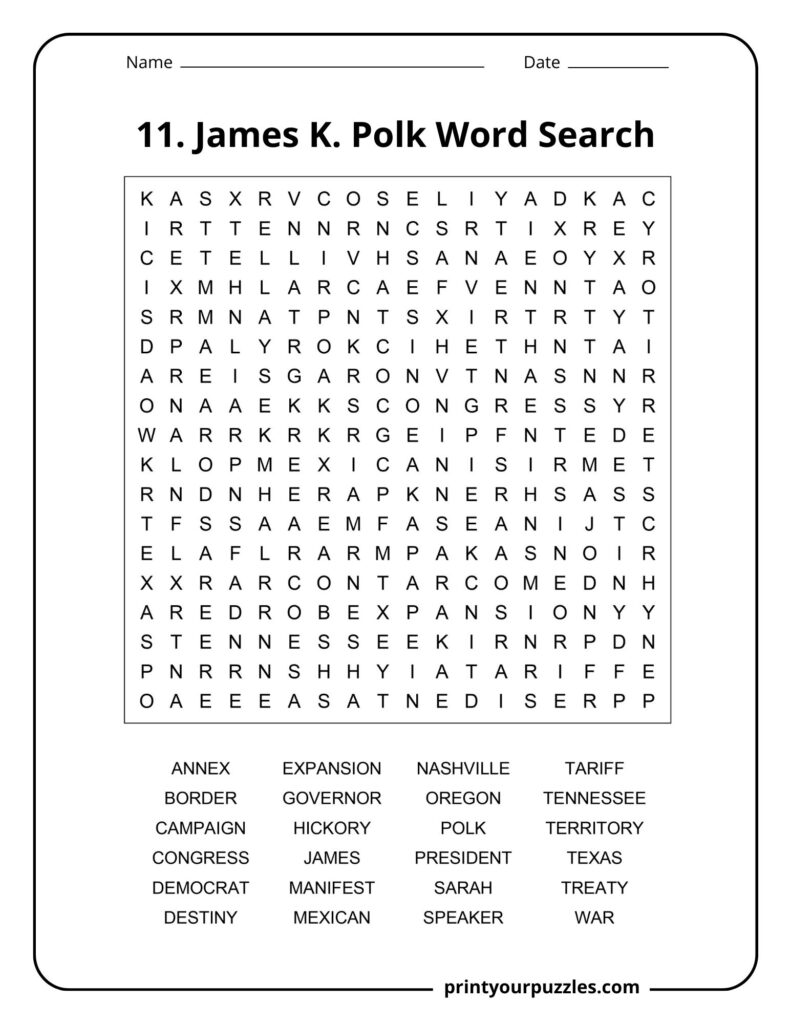
ANNEX, BORDER, CAMPAIGN, CONGRESS, DEMOCRAT, DESTINY, EXPANSION, GOVERNOR, HICKORY, JAMES, MANIFEST, MEXICAN, NASHVILLE, OREGON, POLK, PRESIDENT, SARAH, SPEAKER, TARIFF, TENNESSEE, TERRITORY, TEXAS, TREATY, WAR
ANNEX – Polk supported the annexation of Texas in 1845, making it the 28th state, which was a major campaign promise and a key achievement of his presidency.
BORDER – Polk expanded US borders dramatically, acquiring over 500,000 square miles of territory, extending the nation from the Atlantic to the Pacific Ocean during his single term.
CAMPAIGN – His 1844 presidential campaign focused on territorial expansion, promoting the annexation of Texas and claiming the entire Oregon Territory with the slogan “Fifty-Four Forty or Fight.”
CONGRESS – Polk served fourteen years in the US House of Representatives from Tennessee, rising to become Speaker of the House from 1835 to 1839 before his presidency.
DEMOCRAT – A loyal Jacksonian Democrat, Polk championed states’ rights, limited federal government, and westward expansion, embodying the party’s principles during the 1840s era of territorial growth.
DESTINY – Polk embraced Manifest Destiny, the belief that America was destined to expand across the continent, using this ideology to justify territorial acquisitions and westward expansion.
EXPANSION – Territorial expansion defined Polk’s presidency; he added more land to the United States than any president except Thomas Jefferson, fulfilling his campaign promises of continental growth.
GOVERNOR – Polk served as Governor of Tennessee from 1839 to 1841, though he lost two subsequent reelection bids before emerging as the Democratic dark horse presidential candidate.
HICKORY – Nicknamed “Young Hickory” as a political protégé of Andrew Jackson, who was called “Old Hickory,” Polk shared Jackson’s political philosophy and strong executive leadership style.
JAMES – James Knox Polk was his full name, the eleventh President of the United States, serving from 1845 to 1849 as one of the most consequential one-term presidents.
MANIFEST – Manifest Destiny was the prevailing ideology Polk championed, asserting America’s divine right to expand westward across North America, shaping his aggressive territorial policies and foreign relations.
MEXICAN – The Mexican-American War from 1846 to 1848 resulted from border disputes after Texas annexation, ending with Mexico ceding vast territories including California to the United States.
NASHVILLE – Nashville, Tennessee’s capital, was Polk’s home base throughout his political career, where he practiced law, entered politics, and maintained his residence during his governorship.
OREGON – The Oregon Territory dispute with Britain was peacefully resolved in 1846 through the Oregon Treaty, establishing the 49th parallel as the border, securing the Pacific Northwest.
POLK – James K. Polk served as the eleventh US President from 1845 to 1849, achieving all his major campaign goals in one term but dying shortly after leaving office.
PRESIDENT – As President from 1845 to 1849, Polk was highly effective, accomplishing every major campaign promise including territorial expansion, though he declined to seek reelection as promised.
SARAH – Sarah Childress Polk was his wife and trusted political advisor, serving as First Lady with intelligence and grace, maintaining influence throughout his political career and long widowhood.
SPEAKER – Polk served as Speaker of the House from 1835 to 1839, the only president to hold this position, demonstrating his legislative skill and political leadership abilities.
TARIFF – The Walker Tariff of 1846 significantly reduced import duties, reflecting Polk’s Democratic principles of free trade and opposition to protective tariffs favored by Northern manufacturing interests.
TENNESSEE – Tennessee was Polk’s home state, where he built his political career, serving as congressman, Speaker of the House, and governor before becoming president in 1845.
TERRITORY – Polk acquired approximately 1.2 million square miles of territory, including the Oregon Territory and Mexican Cession, nearly completing America’s continental expansion to the Pacific Ocean.
TEXAS – Texas annexation in 1845 was Polk’s first major achievement, fulfilling a campaign promise but triggering tensions with Mexico that led to war and further territorial acquisitions.
TREATY – The Treaty of Guadalupe Hidalgo in 1848 ended the Mexican-American War, with Mexico ceding California, New Mexico, and other territories for $15 million and debt assumption.
WAR – The Mexican-American War from 1846 to 1848 was initiated by Polk over border disputes, resulting in decisive American victory and massive territorial gains for the nation.
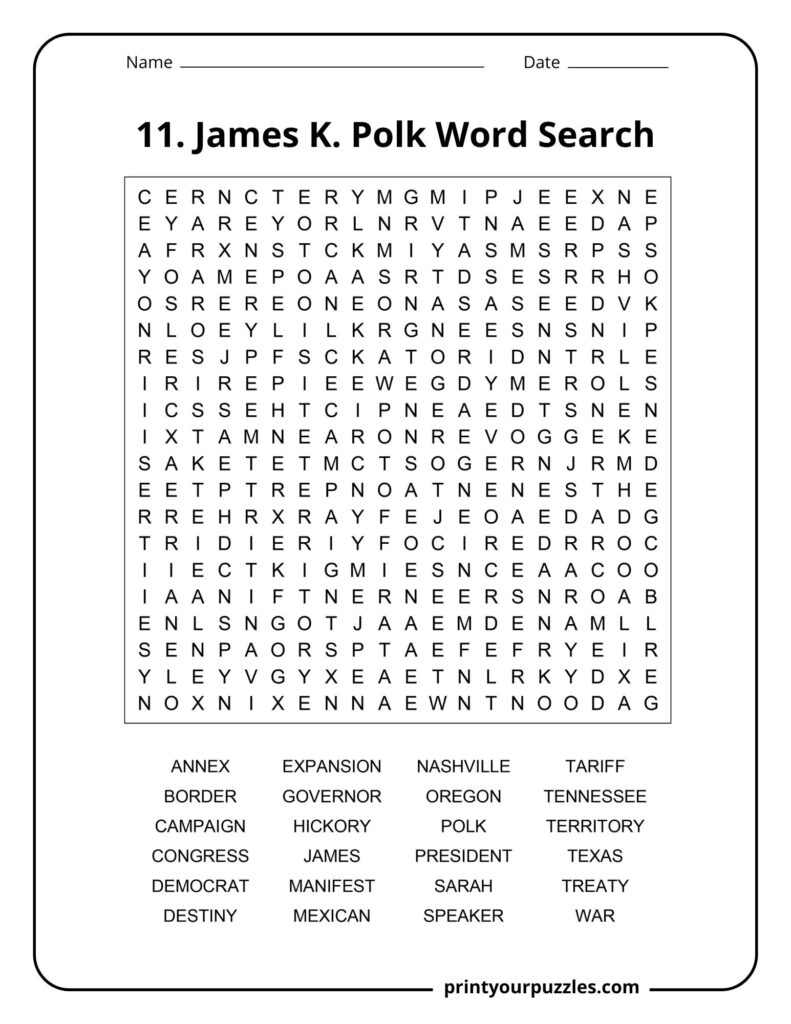
ANNEX, BORDER, CAMPAIGN, CONGRESS, DEMOCRAT, DESTINY, EXPANSION, GOVERNOR, HICKORY, JAMES, MANIFEST, MEXICAN, NASHVILLE, OREGON, POLK, PRESIDENT, SARAH, SPEAKER, TARIFF, TENNESSEE, TERRITORY, TEXAS, TREATY, WAR
Polk achieved all four campaign goals: reducing tariffs, establishing an independent treasury, settling the Oregon boundary dispute, and acquiring California. He expanded US territory by over 1.2 million square miles.
Polk is considered highly effective because he accomplished every major campaign promise in one term, dramatically expanding American territory and fulfilling the vision of Manifest Destiny from coast to coast.
The war resulted from disputes over the Texas-Mexico border after annexation and Polk’s desire to acquire California and New Mexico. American troops’ presence in disputed territory provoked the conflict in 1846.
No, Polk pledged to serve only one term and kept his promise, declining to run for reelection in 1848. He died just three months after leaving office, exhausted from his demanding presidency.
Polk was Jackson’s political protégé and earned the nickname “Young Hickory” after Jackson’s “Old Hickory.” He faithfully supported Jackson’s policies and shared his philosophy of strong presidential leadership and Democratic principles.
For official administration records and historical biography, visit the James K. Polk page in the White House Archives. If you are planning a trip, check out the official James K. Polk Home & Museum.
A Country of Vast Designs: James K. Polk, the Mexican War, and the Conquest of the American Continent by Robert W. Merry. Shows how a one-term president dramatically expanded U.S. territory, fulfilling Manifest Destiny through political cunning and relentless ambition.
At the 1844 Democratic Convention, Polk emerged as a compromise candidate after nine ballots. He was relatively unknown nationally, making him America’s first surprising underdog presidential nominee to win.
Exhausted from his grueling work schedule as president, Polk died on June 15, 1849, at age 53. He holds the record for the shortest retirement of any US president in history.
Polk was obsessively dedicated to his duties, working long hours daily without rest. His relentless work ethic contributed to his declining health and early death shortly after leaving office.
On March 4, 1845, Polk’s inauguration marked a technological milestone when news was transmitted via Samuel Morse’s telegraph from Washington to Baltimore, revolutionizing how Americans received political news.
The Polks were one of several presidential couples without children. Sarah devoted herself entirely to supporting her husband’s political career, serving as his trusted advisor and influential First Lady.