
A president can shape history not only through speeches or wars, but through the political systems he helps build. Martin Van Buren (1837–1841) is remembered as a master organizer, a skilled party leader, and one of the key figures behind the rise of modern American politics. Yet when he reached the presidency, he faced a severe economic crisis that tested his ability to lead. The Martin Van Buren word search introduces students to a president whose story combines political strategy, democratic change, and national hardship.
Van Buren came from New York and built his career through law, party politics, and careful organization. He served as senator, governor, secretary of state, and vice president under Andrew Jackson before winning the presidency in 1836. Unlike many earlier presidents, he was not part of the Revolutionary generation. His world was one of mass elections, party loyalty, newspapers, campaign networks, and growing voter participation.
One of Van Buren’s greatest historical contributions was his role in strengthening the Democratic Party. He believed that organized political parties could give voters a clearer voice and help connect local, state, and national politics. This made him an important figure in the development of the party system that still shapes American elections today.
His presidency, however, was dominated by the Panic of 1837. Banks failed, businesses closed, unemployment rose, and many Americans suffered through years of economic trouble. Because the crisis began so early in his administration, it shaped almost everything about his time in office. Critics blamed him for not doing enough, while Van Buren argued that the federal government should not directly control the economy.
One of his major responses was the Independent Treasury system, designed to keep federal money separate from private banks. This idea reflected his belief in limited government and financial caution, but it did not quickly solve the depression. For many voters, hardship mattered more than his careful political reasoning.
Van Buren’s presidency also took place during continuing debates over slavery, expansion, and Native American removal policies inherited from the Jackson years. Although he was less dramatic than Jackson, he worked within many of the same political currents and helped define the Democratic Party’s direction.
This Martin Van Buren word search looks at political parties, elections, banking, economic panic, limited government, and the challenges of leadership during hard times. His presidency reminds students that organization and strategy can shape history, even when a leader is remembered mainly for a crisis.
Keep learning about the Jacksonian Era and Westward Expansion with our Andrew Jackson word search, William Henry Harrison word search, John Tyler word search, and the full US Presidents Word Searches collection.
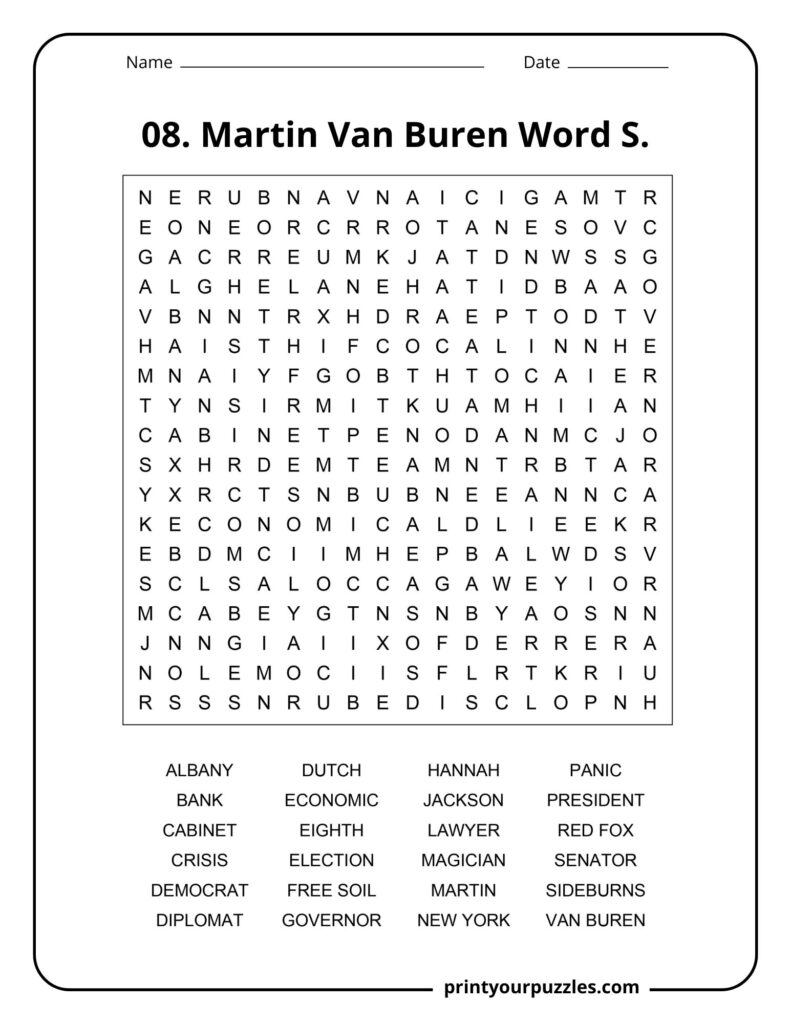
ALBANY, BANK, CABINET, CRISIS, DEMOCRAT, DIPLOMAT, DUTCH, ECONOMIC, EIGHTH, ELECTION, FREE SOIL, GOVERNOR, HANNAH, JACKSON, LAWYER, MAGICIAN, MARTIN, NEW YORK, PANIC, PRESIDENT, RED FOX, SENATOR, SIDEBURNS, VAN BUREN
ALBANY – Capital city of New York where Van Buren built his political career and led the Albany Regency, a powerful Democratic political machine controlling state politics.
BANK – Van Buren opposed the Second Bank of the United States, continuing Andrew Jackson’s war against centralized banking and supporting the Independent Treasury System instead.
CABINET – Van Buren served as Secretary of State under Andrew Jackson, becoming a trusted advisor before resigning during the Eaton Affair and later becoming president.
CRISIS – The Panic of 1837 created a severe economic crisis during Van Buren’s presidency, causing widespread unemployment, bank failures, and a devastating depression lasting years.
DEMOCRAT – Van Buren was a founding architect of the modern Democratic Party, organizing political machinery and establishing party structures that defined American politics for generations.
DIPLOMAT – Served as U.S. Minister to Great Britain and later as Secretary of State, handling delicate foreign relations and establishing diplomatic protocols during crucial expansion years.
DUTCH – Van Buren was the first president of Dutch ancestry, born in Kinderhook, New York, to Dutch-speaking parents in a predominantly Dutch-American community.
ECONOMIC – His presidency faced severe economic challenges including the Panic of 1837, bank failures, and depression, testing his fiscal policies and Independent Treasury proposals.
EIGHTH – Martin Van Buren served as the eighth President of the United States from 1837 to 1841, succeeding his mentor Andrew Jackson in office.
ELECTION – Lost his 1840 re-election bid to William Henry Harrison in the “Log Cabin and Hard Cider” campaign, then ran unsuccessfully as Free Soil candidate in 1848.
FREE SOIL – Van Buren became the 1848 Free Soil Party presidential candidate, opposing slavery’s expansion into western territories, marking his shift from mainstream
Democratic politics.
GOVERNOR – Served as Governor of New York in 1829, though briefly, before resigning to join Andrew Jackson’s cabinet as Secretary of State that same year.
HANNAH – Hannah Hoes Van Buren was his wife and childhood sweetheart from Kinderhook. She died in 1819, eighteen years before he became president.
JACKSON – Andrew Jackson was Van Buren’s political mentor and predecessor as president. Van Buren served as his Secretary of State and Vice President, continuing Jacksonian policies.
LAWYER – Van Buren practiced law in New York after studying in a law office, building a successful legal practice that launched his political career.
MAGICIAN – Nicknamed “The Little Magician” for his skillful political maneuvering, strategic thinking, and ability to build coalitions and manipulate political situations to his advantage.
MARTIN – His first name was Martin, born Martin Van Buren on December 5, 1782, in Kinderhook, New York, to Abraham and Maria Van Buren.
NEW YORK – Van Buren’s home state where he built his political base, serving as state senator, attorney general, governor, and U.S. senator before national office.
PANIC – The Panic of 1837 began shortly after Van Buren’s inauguration, causing bank collapses, business failures, unemployment, and a depression that dominated his entire presidency.
PRESIDENT – Served as eighth President of the United States from March 1837 to March 1841, facing economic depression and political challenges throughout his single term.
RED FOX – Nicknamed “The Red Fox of Kinderhook” for his
reddish hair, shrewd political cunning, and origins in Kinderhook, New York, reflecting his clever tactics.
SENATOR – Represented New York in the United States Senate from 1821 to 1828, building national political connections before joining Jackson’s administration as Secretary of State.
SIDEBURNS – Fashionable facial hair style of the era, popular during Van Buren’s time in politics, though the term actually derives from Civil War General Ambrose Burnside.
VAN BUREN – His surname, of Dutch origin, meaning “from Buren,” a town in the Netherlands. He was the first president born after American independence.
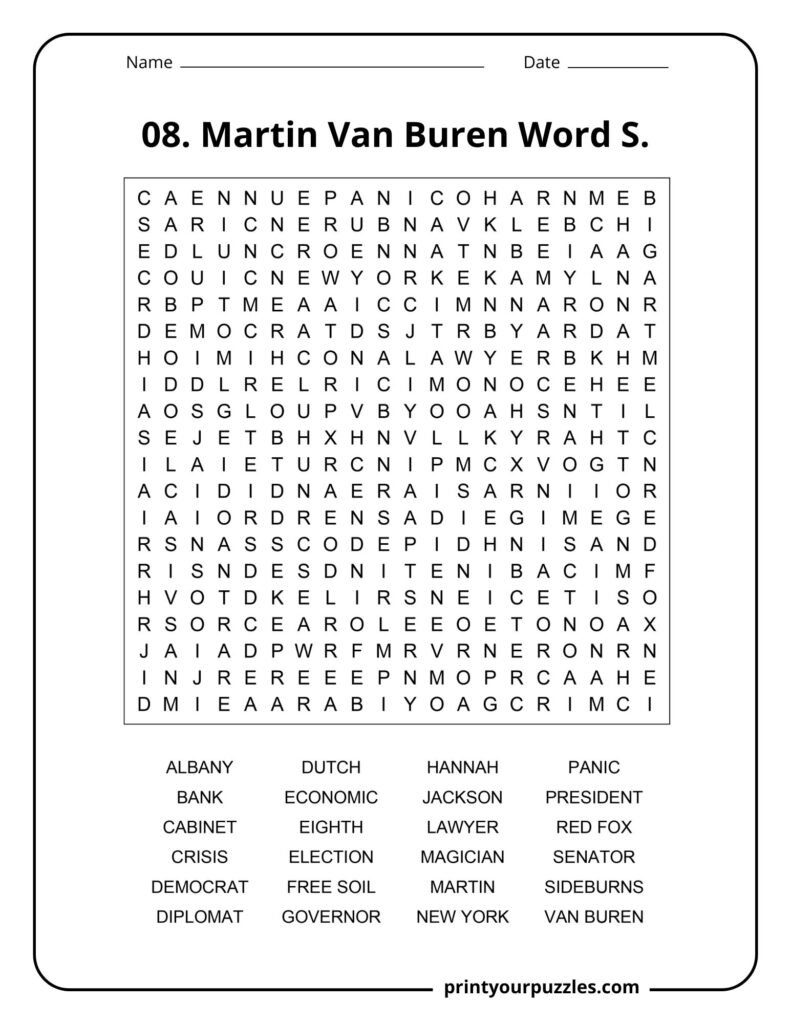
ALBANY, BANK, CABINET, CRISIS, DEMOCRAT, DIPLOMAT, DUTCH, ECONOMIC, EIGHTH, ELECTION, FREE SOIL, GOVERNOR, HANNAH, JACKSON, LAWYER, MAGICIAN, MARTIN, NEW YORK, PANIC, PRESIDENT, RED FOX, SENATOR, SIDEBURNS, VAN BUREN
Martin Van Buren was the eighth President of the United States, serving from 1837 to 1841. He was the first president of Dutch ancestry and born as an American citizen.
Van Buren earned this nickname for his masterful political skills, strategic maneuvering, and ability to build coalitions. He skillfully navigated complex political situations with cunning and diplomatic finesse.
The Panic of 1837 was a severe economic crisis that began shortly after Van Buren’s inauguration, causing widespread bank failures, unemployment, and a devastating depression lasting several years.
Van Buren’s presidency is considered largely unsuccessful due to the economic depression he inherited. He lost his 1840 re-election bid and served only one term in office.
After losing re-election in 1840, Van Buren ran again in 1848 as the Free Soil Party candidate, opposing slavery’s expansion into western territories, but lost decisively.
For official administration records and historical biography, visit the Martin Van Buren page in the White House Archives. If you are planning a trip, check out the official Lindenwald National Historic Site.
Martin Van Buren and the American Political System by Donald B. Cole. The best available study of the political mastermind who built America’s first party machine but struggled as president during economic crisis.
The phrase “OK” possibly originated from Van Buren’s 1840 campaign slogan “Old Kinderhook,” referring to his New York birthplace. His supporters formed “OK Clubs” to promote his re-election.
Van Buren grew up speaking Dutch at home in Kinderhook’s Dutch-American community. He remains the only U.S. president whose first language was not English, learning it later.
Despite marrying his childhood sweetheart Hannah Hoes, Van Buren’s 800-page autobiography contains no mention of her. She died eighteen years before he became president, remaining mysteriously absent.
Since Van Buren was a widower, his daughter-in-law Angelica Singleton Van Buren served as White House hostess, fulfilling the First Lady’s social duties throughout his presidency.
Unlike many presidents, Van Buren retired comfortably wealthy to his estate Lindenwald in Kinderhook. He invested wisely and lived luxuriously, entertaining guests until his 1862 death.