
John Tyler (1841–1845) became president because of a question the Constitution had not fully answered. When William Henry Harrison died after only 31 days in office, Americans had to decide whether the vice president should become the full president or merely act as a temporary leader. Tyler gave his own answer immediately: he claimed the complete powers of the presidency. That bold decision made his story much larger than many people expect. The John Tyler word search gives students a way to explore a president whose term helped define presidential succession.
Tyler had a long political career before entering the White House. He worked as a lawyer, served as governor of Virginia, represented his state in Congress, became a senator, and later joined Harrison’s ticket as vice president. Although he was elected with the Whig Party in 1840, many of his beliefs did not fit comfortably with Whig leaders. He strongly supported states’ rights and often disagreed with politicians who wanted a more active federal role in banking and economic policy.
Conflict came quickly after Tyler became president in 1841. He vetoed major Whig banking bills, angering members of his own party. Most of his cabinet resigned, and Whig leaders expelled him from the party. This left Tyler in a rare position: he was a president without a clear political home. Opponents even called him “His Accidency,” suggesting that he had reached power only by chance.
Despite this isolation, Tyler’s administration included important achievements. The Webster-Ashburton Treaty helped settle a boundary dispute between the United States and British Canada, reducing tensions with Great Britain. Near the end of his presidency, Tyler also strongly supported the annexation of Texas, a decision that increased debate over slavery, expansion, and the future balance of power between North and South.
Tyler’s legacy is complicated. He strengthened the precedent that a vice president becomes full president when a president dies, but his political choices made him deeply controversial. His support for Texas annexation helped shape the nation’s future while also bringing sectional conflict closer.
This John Tyler word search focuses on succession, party conflict, states’ rights, diplomacy, Texas, expansion, and presidential authority. Tyler may not be remembered as a great president, but his time in office changed how Americans understood the power and continuity of the presidency.
Explore more leaders from the Jacksonian and expansion period with our William Henry Harrison word search, James K. Polk word search, Zachary Taylor word search, and the full US Presidents Word Searches collection.
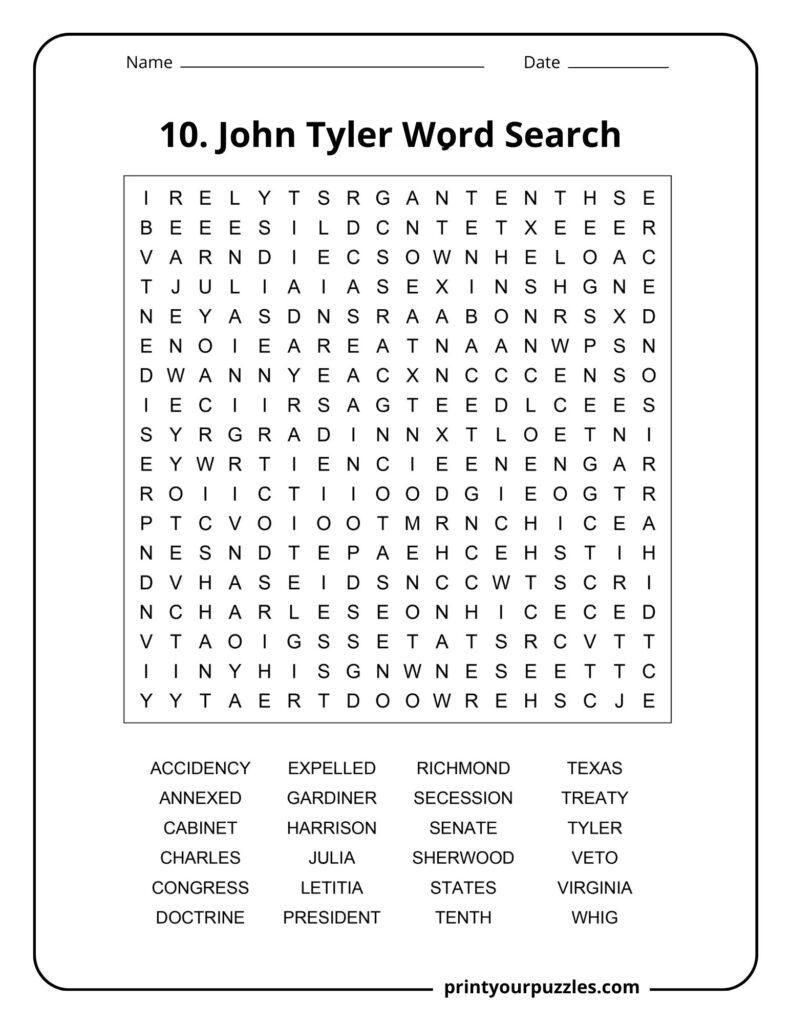
ACCIDENCY, ANNEXED, CABINET, CHARLES, CONGRESS, DOCTRINE, EXPELLED, GARDINER, HARRISON, JULIA, LETITIA, PRESIDENT, RICHMOND, SECESSION, SENATE, SHERWOOD, STATES, TENTH, TEXAS, TREATY, TYLER, VETO, VIRGINIA., WHIG
ACCIDENCY – Tyler’s nickname “His Accidency” given mockingly by opponents, as he was the first vice president to assume the presidency after a president’s death in office.
ANNEXED – Tyler successfully annexed the Republic of Texas into the United States in 1845, just days before leaving office, fulfilling his major foreign policy goal despite opposition.
CABINET – Tyler’s entire cabinet, except Secretary of State Daniel Webster, resigned in protest after he vetoed Whig banking legislation, creating unprecedented governmental crisis and political isolation.
CHARLES – Charles City County, Virginia, Tyler’s birthplace in 1790, located along the James River in the historic Tidewater region of the Commonwealth of Virginia.
CONGRESS – Tyler frequently clashed with Congress over banking, tariffs, and internal improvements, vetoing Whig legislation and becoming the first president to have veto overridden by Congress.
DOCTRINE – The Tyler Doctrine warned European powers against interfering in Hawaii, extending Monroe Doctrine principles to the Pacific and establishing American interest in Hawaiian independence.
EXPELLED – Tyler was expelled from the Whig Party in 1841 after repeatedly vetoing their legislative priorities, making him a president without a party for his term.
GARDINER – Julia Gardiner, Tyler’s second wife whom he married in 1844, was thirty years younger and became First Lady at age twenty-four, mother to seven children.
HARRISON – William Henry Harrison, ninth president, died after only thirty-one days in office, making Tyler president and establishing the constitutional precedent for presidential succession procedures.
JULIA – Julia Gardiner Tyler was Tyler’s second wife, a vivacious New York socialite who embraced her role as First Lady and strongly supported Texas annexation efforts.
LETITIA – Letitia Christian Tyler, John Tyler’s first wife and mother of eight children, suffered a stroke and died in 1842 while serving as First Lady.
PRESIDENT – Tyler became the tenth president in 1841, serving one term without party support and establishing the precedent that vice presidents become full presidents, not acting presidents.
RICHMOND – Richmond, Virginia’s capital city, where Tyler later served in the Confederate House of Representatives and died in 1862 before taking his Confederate Congress seat.
SECESSION – Tyler supported Virginia’s secession from the Union in 1861, presided over the Peace Conference attempting to prevent war, then served the Confederate government until death.
SENATE – Tyler served as United States Senator from Virginia before becoming vice president, and was elected to the Confederate Senate but died before serving.
SHERWOOD – Sherwood Forest Plantation, Tyler’s Virginia estate on the James River, named after Robin Hood’s hideout, where he lived in retirement until the Civil War.
STATES – Tyler strongly advocated for states’ rights and limited federal government power, opposing centralized banking and federal internal improvements throughout his political career and presidency.
TENTH – Tyler was the tenth president of the United States, serving from 1841 to 1845 after Harrison’s death, completing the term without being elected president.
TEXAS – Texas annexation was Tyler’s crowning achievement; he signed the joint resolution admitting the Republic of Texas as the twenty-eighth state on March 1, 1845.
TREATY – The Treaty of Wanghia in 1844 established diplomatic and commercial relations with China, giving Americans the same trading rights as other foreign nations in Chinese ports.
TYLER – John Tyler, born 1790, tenth president, first to assume office through succession, strong states’ rights advocate, later Confederate politician who died in 1862.
VETO – Tyler issued ten vetoes during his presidency, blocking Whig Party legislation on banking and internal improvements, becoming the first president to have a veto overridden.
VIRGINIA – Virginia was Tyler’s home state, where he was born, served as governor, owned plantations, and ultimately supported secession during the Civil War era.
WHIG – The Whig Party elected Tyler as vice president in 1840, but expelled him after he vetoed their legislative agenda, leaving him politically isolated and without party.
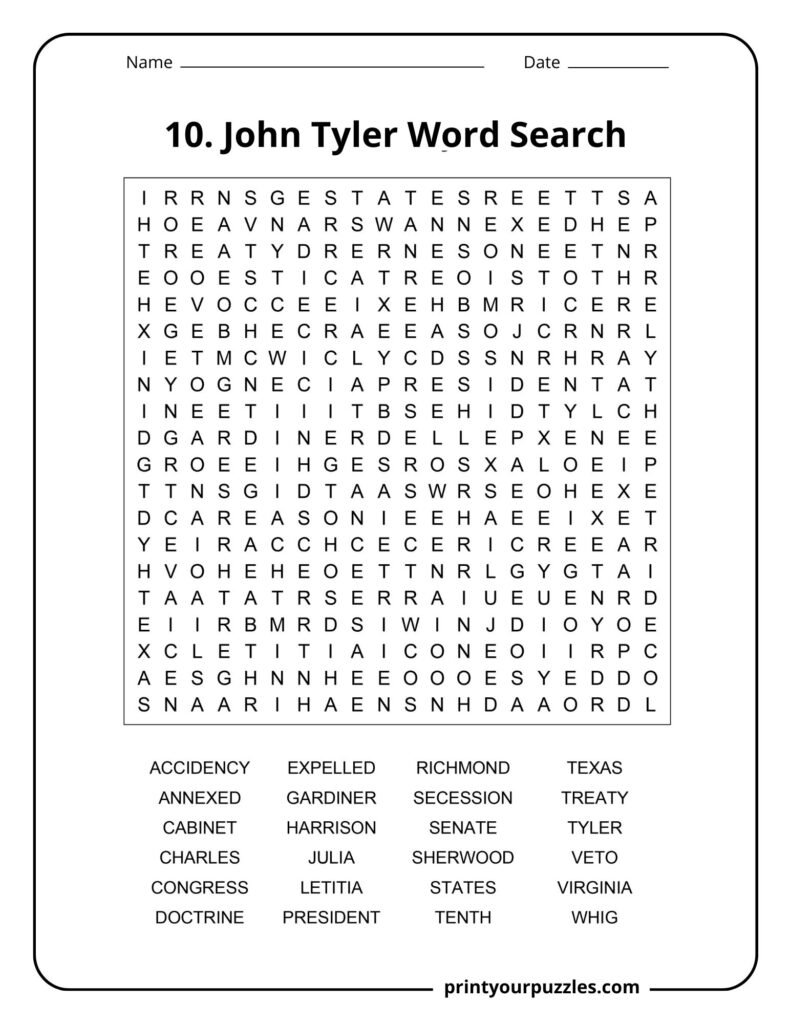
ACCIDENCY, ANNEXED, CABINET, CHARLES, CONGRESS, DOCTRINE, EXPELLED, GARDINER, HARRISON, JULIA, LETITIA, PRESIDENT, RICHMOND, SECESSION, SENATE, SHERWOOD, STATES, TENTH, TEXAS, TREATY, TYLER, VETO, VIRGINIA., WHIG
Tyler received this mocking nickname because he was the first vice president to assume the presidency after a sitting president’s death, with critics questioning his constitutional authority and legitimacy.
Tyler’s greatest achievement was the annexation of Texas in 1845. He signed the joint resolution admitting Texas as the twenty-eighth state just days before leaving office, despite significant opposition.
Tyler was expelled from the Whig Party in 1841 after repeatedly vetoing their banking legislation and internal improvement bills, defying party leadership and making him a president without party support.
John Tyler fathered fifteen children with his two wives, Letitia and Julia, more than any other president. His last child was born when he was seventy years old.
Yes, Tyler supported Virginia’s secession in 1861 and was elected to the Confederate House of Representatives. He died in Richmond in 1862 before taking his seat, making him the only president buried under a foreign flag.
For official administration records and historical biography, visit the John Tyler page in the Trump White House Archives. If you are planning a trip, check out his official estate, Sherwood Forest Plantation.
John Tyler, the Accidental President by Edward P. Crapol. A concise, revisionist look at the first vice president to assume office by death, whose bold precedent defined presidential succession.
Tyler’s grandson Harrison Ruffin Tyler lived until 2023, and Lyon Gardiner Tyler Jr. died in 2020. Tyler’s late-in-life children created this remarkable three-generation span across American history.
Tyler’s coffin was draped with the Confederate flag at his 1862 funeral in Richmond. The U.S. government did not officially recognize his death or hold any memorial services.
Tyler became vice president through the Electoral College in 1840 and assumed the presidency after Harrison’s death, making him the only president never chosen directly by voters.
They met when a naval gun exploded on the USS Princeton, killing Julia’s father. Tyler comforted her, and they married secretly in 1844, despite their thirty-year age difference.
A South Carolina elector cast a protest vote for Tyler, making him one of the few people to receive electoral votes without actively seeking the presidency that year.