Introduction to the Texas Annexation Word Search
Texas annexation was one of the most important and controversial events in the expansion of the United States during the 19th century. It took place in 1845, when the Republic of Texas officially became the 28th state of the United States. However, the story began years earlier and involved independence, diplomacy, slavery, political debate, and growing tensions with Mexico.
Texas had originally been part of Mexico. During the 1820s and 1830s, many settlers from the United States moved into the region, encouraged by the Mexican government. Disagreements soon developed over Mexican laws, immigration, slavery, and political control. In 1836, Texans rebelled against Mexico and declared independence. After famous battles such as the Alamo and San Jacinto, Texas became an independent republic.
For nearly ten years, the Republic of Texas existed as a separate nation. Many Texans wanted to join the United States, but annexation was politically difficult. Mexico still considered Texas part of its territory and warned that American annexation could lead to conflict. Within the United States, the issue was also connected to slavery. Texas permitted slavery, and some Northern politicians feared that admitting such a large slaveholding state would increase Southern political power.
Support for annexation increased during the presidency of John Tyler. In 1845, shortly before leaving office, Tyler signed a congressional resolution offering Texas admission to the Union. Texas accepted the offer, and on December 29, 1845, President James K. Polk signed legislation making Texas the 28th state.
The annexation increased tensions between the United States and Mexico, especially because the two countries disagreed about Texas’s southern border. The United States claimed the Rio Grande as the boundary, while Mexico argued that the border was farther north at the Nueces River. This dispute contributed directly to the Mexican-American War, which began in 1846.
A Texas Annexation word search offers an engaging way to explore key people, places, events, and ideas connected with this major turning point. By studying annexation, readers can better understand westward expansion, Manifest Destiny, slavery debates, relations with Mexico, and the rapid territorial growth of the United States during the 1840s.
Related Word Searches:
Texas Revolution | Mexican-American War | Manifest Destiny | James K. Polk | Westward Expansion | California Gold Rush
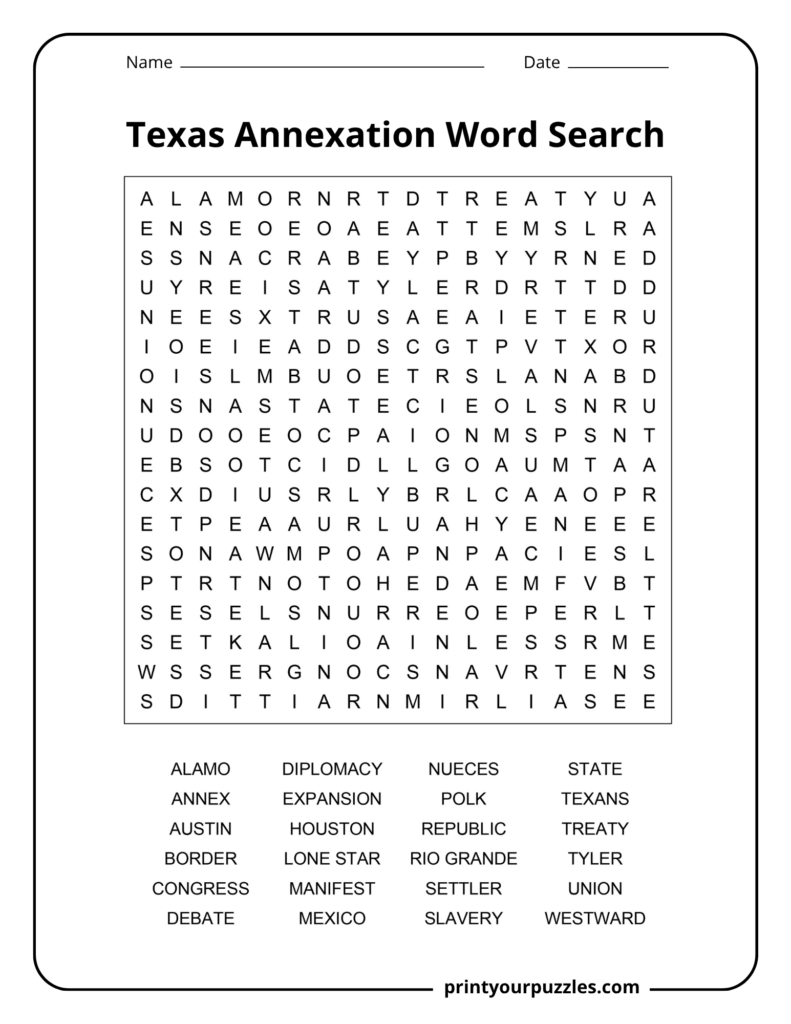
Medium Difficulty Word Search
Words to Find:
ALAMO, ANNEX, AUSTIN, BORDER, CONGRESS, DEBATE, DIPLOMACY, EXPANSION, HOUSTON, LONE STAR, MANIFEST, MEXICO, NUECES, POLK, REPUBLIC, RIO GRANDE, SETTLER, SLAVERY, STATE, TEXANS, TREATY, TYLER, UNION, WESTWARD
All Words Defined
ALAMO – Former Spanish mission in San Antonio where Texan defenders fought Mexican forces in 1836, becoming a powerful symbol of sacrifice during the Texas Revolution.
ANNEX – To formally add territory to a country. The United States annexed Texas in 1845, turning the former independent republic into the nation’s 28th state.
AUSTIN – Stephen F. Austin helped bring American settlers to Mexican Texas and later supported Texas independence, earning recognition as one of the republic’s most important founders.
BORDER – The disputed boundary between Texas and Mexico became a major source of tension after annexation, especially disagreement over the Nueces River and Rio Grande.
CONGRESS – The United States Congress approved a joint resolution in 1845 offering annexation to Texas, providing the legal path for its admission into the Union.
DEBATE – Texas annexation created intense political debate in the United States over slavery, territorial expansion, relations with Mexico, and the balance of power between regions.
DIPLOMACY – Negotiations between Texas, the United States, Mexico, and European powers influenced annexation, as leaders considered recognition, security, trade, and the risks of international conflict.
EXPANSION – Texas annexation became an important part of American territorial expansion, helping the United States grow westward and strengthening support for acquiring additional western lands.
HOUSTON – Sam Houston was a leading Texas revolutionary, military commander, president of the Republic of Texas, and strong supporter of eventual annexation by the United States.
LONE STAR – Popular nickname and symbol for Texas, originating from its period as an independent republic and remaining closely associated with the state’s identity and history.
MANIFEST – Short reference to Manifest Destiny, the 19th-century belief that the United States was destined to expand across North America from the Atlantic to Pacific.
MEXICO – Country that controlled Texas before its independence in 1836 and strongly opposed American annexation, which increased tensions and helped lead to war in 1846.
NUECES – Texas river that Mexico considered the proper southern boundary of Texas, while the United States claimed territory farther south to the Rio Grande.
POLK – James K. Polk became president in 1845 and strongly supported territorial expansion, overseeing Texas statehood and later leading the nation during the Mexican-American War.
REPUBLIC – Texas existed as an independent republic from 1836 until annexation in 1845, maintaining its own government, diplomacy, military forces, and relations with foreign countries.
RIO GRANDE – River claimed by Texas and the United States as Texas’s southern boundary, creating a serious territorial dispute with Mexico after annexation and before war.
SETTLER – Many American settlers moved into Mexican Texas during the early 1800s, forming communities that later played important roles in the Texas Revolution and independence movement.
SLAVERY – Slavery was a major political issue surrounding Texas annexation because Texas allowed enslaved labor, raising concerns about expanding Southern influence in the United States.
STATE – Texas became the 28th state of the United States on December 29, 1845, formally ending its period as an independent republic after nearly ten years.
TEXANS – Residents and citizens of Texas who experienced Mexican rule, revolution, independence, and eventual annexation, with many supporting closer political ties to the United States.
TREATY – An attempted 1844 treaty to annex Texas failed in the Senate, leading President John Tyler to pursue annexation through a congressional joint resolution instead.
TYLER – President John Tyler strongly supported annexing Texas and signed the 1845 congressional resolution offering statehood shortly before leaving office, advancing the annexation process.
UNION – The United States was commonly called the Union, and Texas formally joined it in 1845 after accepting Congress’s offer of annexation and statehood.
WESTWARD – Westward expansion encouraged Americans to seek new lands and settlements beyond existing borders, making Texas annexation part of a broader movement across the continent.
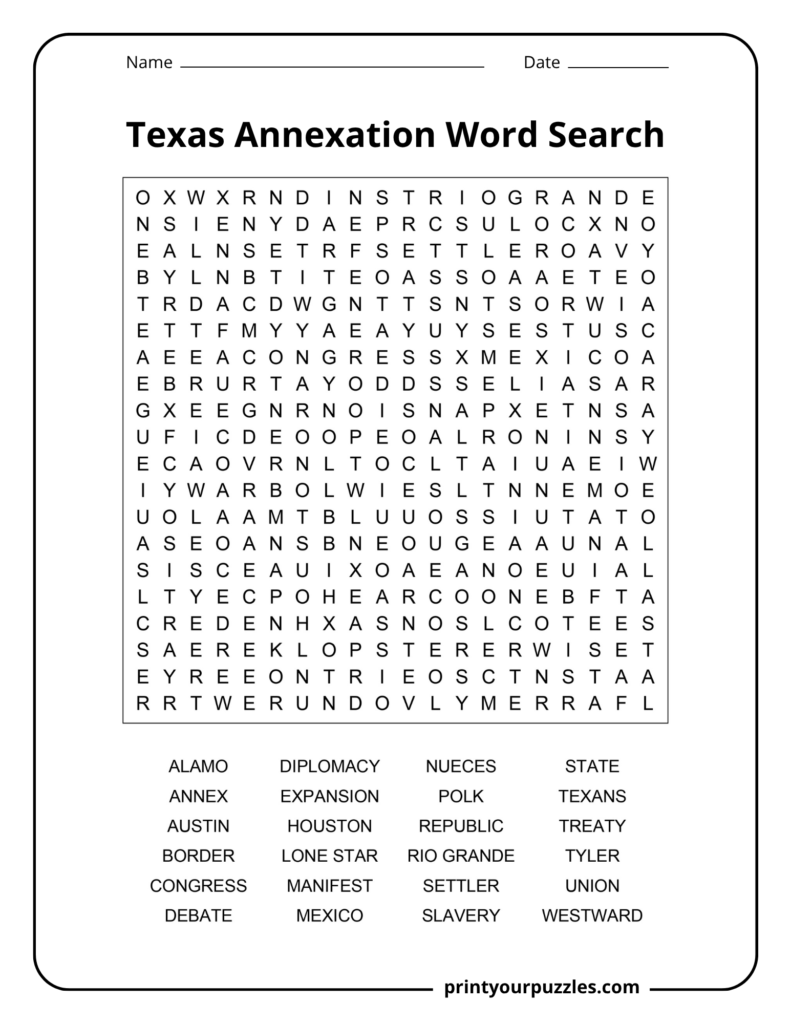
Hard Difficulty Word Search
Words to Find:
ALAMO, ANNEX, AUSTIN, BORDER, CONGRESS, DEBATE, DIPLOMACY, EXPANSION, HOUSTON, LONE STAR, MANIFEST, MEXICO, NUECES, POLK, REPUBLIC, RIO GRANDE, SETTLER, SLAVERY, STATE, TEXANS, TREATY, TYLER, UNION, WESTWARD
5 Key FAQs About the Texas Annexation
5 Curious "Did You Know?" Facts About the Texas Annexation