Dr. Martin Luther King Jr. was one of the most important leaders of the Civil Rights Movement. He worked to end racial segregation and discrimination in the United States, encouraging people to demand change through peaceful protest. His speeches, marches, and campaigns helped bring national attention to the unfair treatment experienced by African Americans.
King was born on January 15, 1929, in Atlanta, Georgia. His father and grandfather were Baptist ministers, and religion played an important role in his life. King became a minister himself after studying at Morehouse College, Crozer Theological Seminary, and Boston University. During his studies, he learned about nonviolent resistance and was strongly influenced by the peaceful methods used by Mahatma Gandhi in India.
King became a national figure during the Montgomery Bus Boycott, which began in 1955 after Rosa Parks was arrested for refusing to give up her seat to a white passenger. African American residents avoided using the city’s buses for more than a year. King helped lead the boycott, which ended when the Supreme Court ruled that segregation on public buses was unconstitutional.
In 1957, King helped establish the Southern Christian Leadership Conference. Through this organization, he supported peaceful demonstrations against segregation and racial injustice. Protesters organized marches, boycotts, sit-ins, and voter registration campaigns, even though they often faced arrests, threats, and violence.
One of King’s most famous moments came during the March on Washington on August 28, 1963. Speaking before a huge crowd at the Lincoln Memorial, he delivered his celebrated “I Have a Dream” speech. He described his hope for a country where people would be judged by their character rather than the color of their skin.
King’s activism contributed to major legal changes, including the Civil Rights Act of 1964 and the Voting Rights Act of 1965. In 1964, he received the Nobel Peace Prize for his leadership and commitment to nonviolence.
Dr. Martin Luther King Jr. was assassinated in Memphis, Tennessee, on April 4, 1968. He was only 39 years old. His life and achievements are remembered every year on Martin Luther King Jr. Day, commonly called MLK Day. This federal holiday is observed on the third Monday of January and encourages people to honor his legacy through service, education, and reflection.
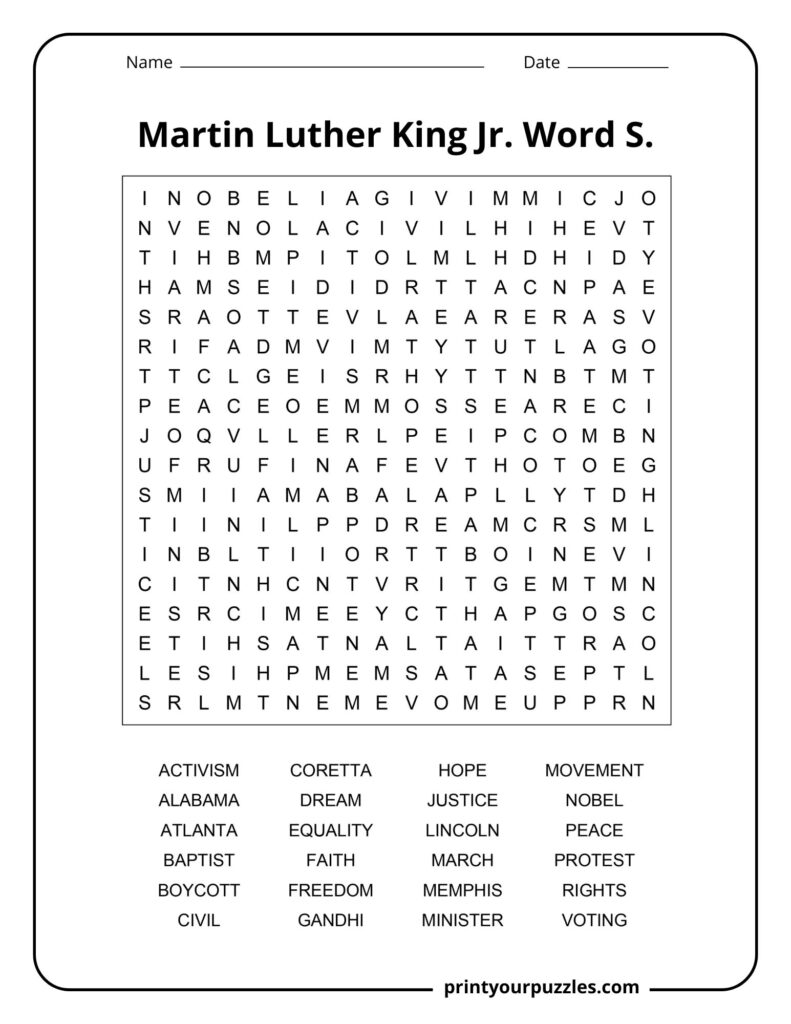
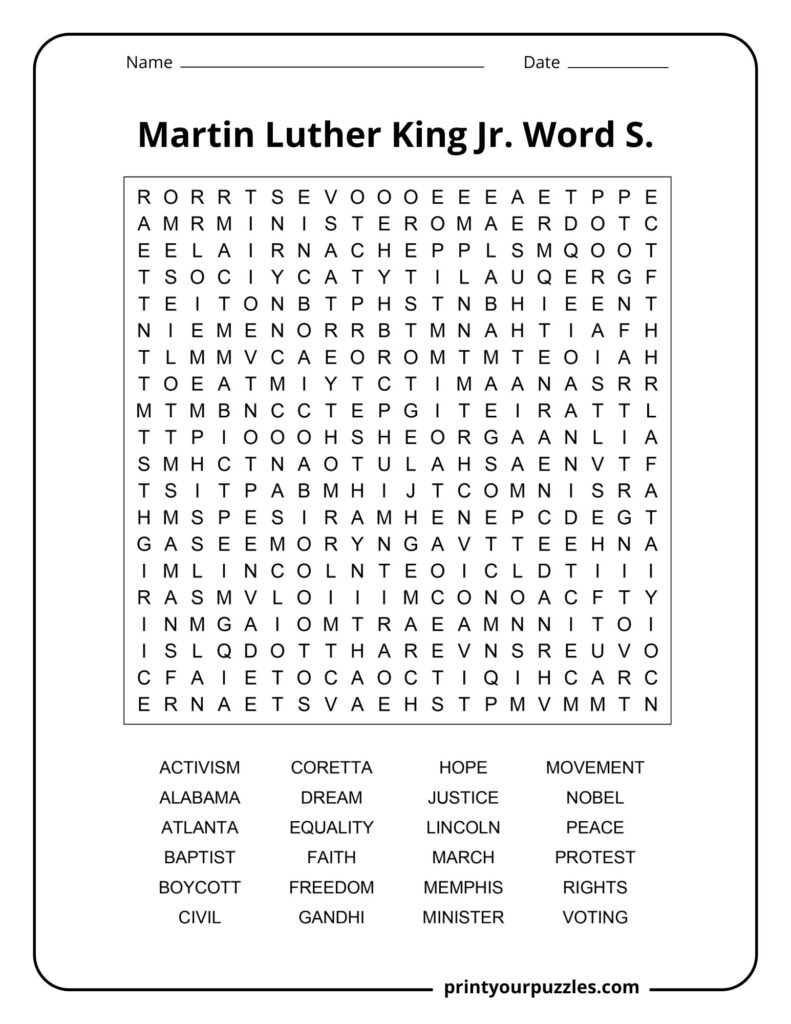
Through this Martin Luther King Jr word search and the accompanying information, students can explore vocabulary connected to civil rights, equality, peaceful protest, justice, leadership, and one of the most influential figures in modern American history.
Related Word Searches:
Civil Rights Movement | Civil Rights Act | Rosa Parks | Lyndon B. Johnson | John F. Kennedy | Reconstruction Era
ACTIVISM – Organized action intended to create social or political change, such as King’s peaceful campaigns against racial segregation, discrimination, unequal voting rights, and economic injustice.
ALABAMA – Southern state where King led important civil rights campaigns, including the Montgomery Bus Boycott and demonstrations against segregation in Birmingham and Selma during the 1950s and 1960s.
ATLANTA – Georgia city where Martin Luther King Jr. was born in 1929 and later served as a minister at Ebenezer Baptist Church alongside his father.
BAPTIST – Christian denomination closely connected to King’s life, family, and ministry, providing churches that became important meeting places and organizing centers for civil rights activists.
BOYCOTT – Organized refusal to use a service or buy something, such as the Montgomery protest against segregated buses that King helped lead for more than a year.
CIVIL – Relating to citizens and their rights within society, especially the legal protections, freedoms, and equal treatment demanded by the civil rights movement.
CORETTA – Coretta Scott King was Martin Luther King Jr.’s wife, a civil rights activist, author, and important defender of his legacy after his death.
DREAM – King’s vision of a fair society where people would be judged by their character rather than by the color of their skin or family background.
EQUALITY – Principle that every person deserves the same rights, opportunities, dignity, and protection under the law, regardless of race, religion, income, or background.
FAITH – Strong religious belief that guided King’s commitment to justice, forgiveness, peaceful protest, and hope during difficult moments in the long civil rights struggle.
FREEDOM – Ability to live without unfair restrictions or discrimination, a central goal of King’s campaigns for racial justice, voting rights, and equal citizenship.
GANDHI – Indian independence leader whose methods of nonviolent resistance strongly influenced King’s peaceful approach to challenging segregation, discrimination, poverty, and other forms of injustice.
HOPE – Belief that positive change is possible, even during hardship, violence, or discrimination, and a powerful theme throughout King’s speeches, sermons, and campaigns.
JUSTICE – Fair treatment under laws and institutions, which King demanded for African Americans facing segregation, discrimination, poverty, police violence, and barriers to voting.
LINCOLN – United States president who ended slavery through the Emancipation Proclamation and whose memorial was the setting for King’s famous 1963 “I Have a Dream” speech.
MARCH – Organized public walk supporting a cause, used by King and other activists to demand civil rights, voting access, equality, economic opportunity, and justice.
MEMPHIS – Tennessee city where King traveled to support striking sanitation workers and where he was assassinated on April 4, 1968, at the Lorraine Motel.
MINISTER – Religious leader who teaches and guides a congregation; King served as a Baptist minister and connected Christian beliefs with civil rights, equality, and social justice.
MOVEMENT – Organized effort involving many people working toward change, such as the civil rights movement that challenged segregation, racial discrimination, and unequal laws across America.
NOBEL – International prize awarded to King in 1964 for his leadership, dedication to nonviolence, and work against racial injustice, segregation, and discrimination in the United States.
PEACE – Absence of violence and conflict, promoted by King as both a method of protest and an essential goal for a fair, united, and just society.
PROTEST – Public action expressing disagreement or demanding change, including the peaceful marches, boycotts, demonstrations, sit-ins, and public speeches organized or supported by King.
RIGHTS – Legal and moral freedoms belonging to every person, including equal education, fair treatment, voting access, economic opportunity, and protection from racial discrimination.
VOTING – Act of choosing political representatives, a right King defended because many African Americans were unfairly prevented from participating freely and equally in elections.