Rosa Parks became one of the most important figures in the Civil Rights Movement after refusing to give up her bus seat to a white passenger. Her quiet act of resistance on December 1, 1955, helped challenge racial segregation and inspired thousands of people to demand equal rights. Although her decision may appear simple, it took place during a time when unfair laws controlled many parts of daily life for African Americans.
Rosa Louise McCauley was born on February 4, 1913, in Tuskegee, Alabama. She grew up in the segregated South, where Black and white people attended different schools, used separate public facilities, and were often treated very differently under the law. From a young age, Parks understood the injustice and danger caused by racism. As an adult, she worked as a seamstress and became involved with the National Association for the Advancement of Colored People, commonly known as the NAACP.
In Montgomery, Alabama, city buses were segregated. African American passengers usually had to sit at the back, and they could be ordered to give up their seats when the white section became full. When a bus driver told Parks to surrender her seat, she refused. She was arrested and fined, but her action became the starting point for the Montgomery Bus Boycott.
For more than a year, many African Americans in Montgomery refused to use public buses. They walked, shared cars, and organized transportation to work and school. The boycott was supported by local leaders, including a young minister named Martin Luther King Jr. In 1956, the United States Supreme Court allowed a ruling that declared segregation on Montgomery buses unconstitutional.
Rosa Parks continued working for civil rights throughout her life. She moved to Detroit, Michigan, and supported campaigns for equality, voting rights, education, and fair housing. She received several major honors, including the Presidential Medal of Freedom and the Congressional Gold Medal.
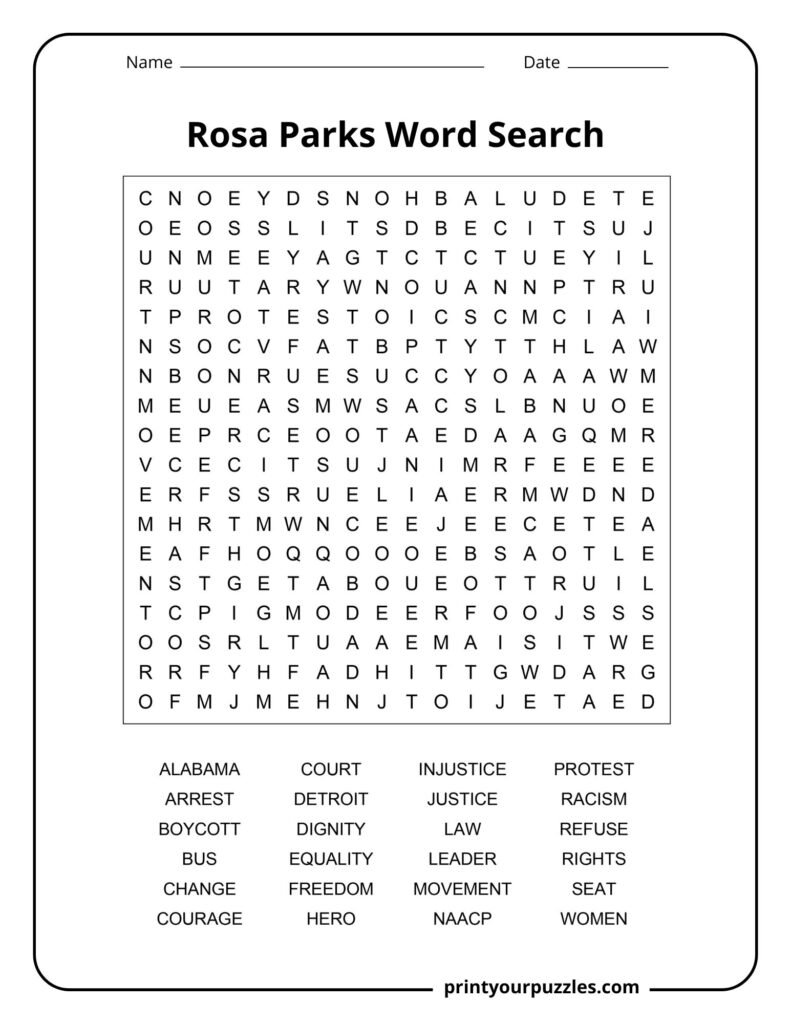
A Rosa Parks word search can help students recognize important vocabulary connected with her life, including boycott, equality, courage, justice, Montgomery, segregation, and civil rights. Her story shows that one person’s determined action can help begin a much larger movement for change. Rosa Parks is remembered not only for remaining seated on a bus, but also for standing firmly against injustice.
Related Word Searches:
Civil Rights Movement | Civil Rights Act | Martin Luther King Jr. | Lyndon B. Johnson | John F. Kennedy | Reconstruction Era
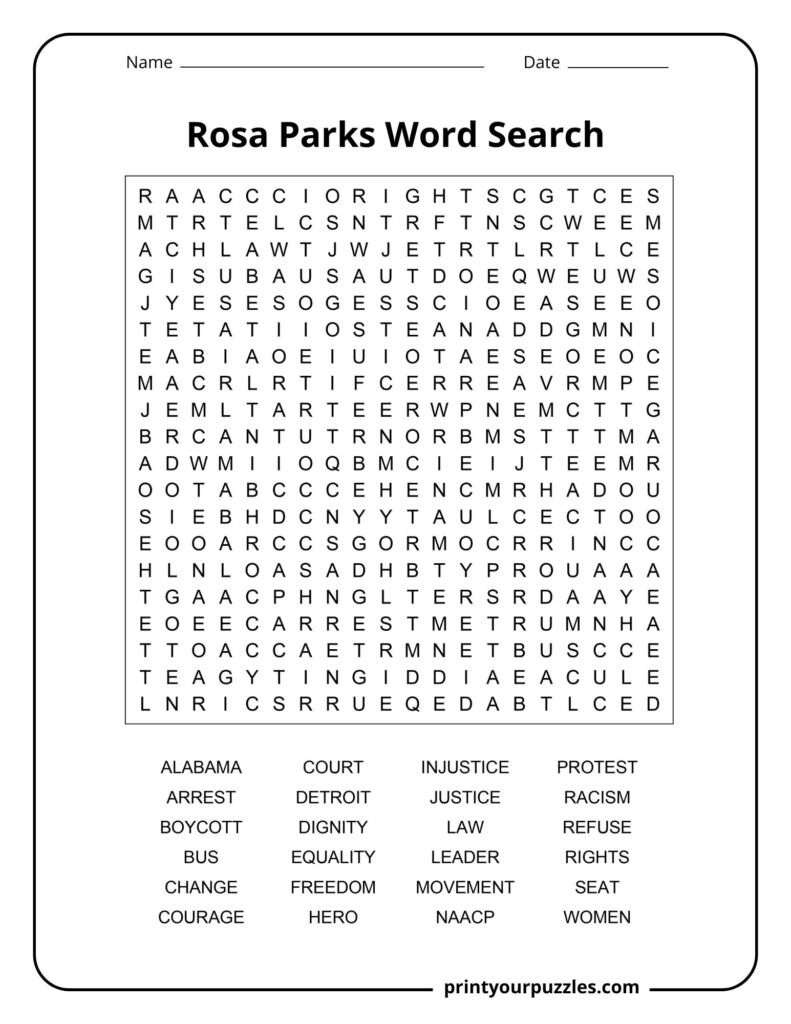
ALABAMA, ARREST, BOYCOTT, BUS, CHANGE, COURAGE, COURT, DETROIT, DIGNITY, EQUALITY, FREEDOM, HERO, INJUSTICE, JUSTICE, LAW, LEADER, MOVEMENT, NAACP, PROTEST, RACISM, REFUSE, RIGHTS, SEAT, WOMEN
ALABAMA – Southern state where Rosa Parks was born and later challenged bus segregation in Montgomery, helping inspire a major national civil rights campaign.
ARREST – Rosa Parks was taken into police custody after refusing to surrender her bus seat to a white passenger in Montgomery, Alabama, in 1955.
BOYCOTT – Organized refusal to use Montgomery buses for more than a year, protesting segregation and demanding fair treatment for Black passengers throughout the city.
BUS – Public vehicle where Rosa Parks made her historic stand by remaining seated when ordered to move because of unfair racial segregation rules.
CHANGE – The social and legal progress encouraged by Rosa Parks’s courage, activism, and willingness to challenge an unfair system through peaceful personal resistance.
COURAGE – The strength Rosa Parks showed by resisting injustice despite knowing she could face arrest, punishment, threats, criticism, and widespread public attention.
COURT – Legal institution that helped end segregated seating on Montgomery buses after civil rights activists challenged the city’s discriminatory public transportation laws.
DETROIT – Michigan city where Rosa Parks lived for many years and continued supporting civil rights, education, fair housing, youth programs, and equality campaigns.
DIGNITY – The sense of self-respect Rosa Parks protected when she refused to accept humiliating treatment under Montgomery’s unfair and discriminatory segregation system.
EQUALITY – The principle that all people deserve the same rights, opportunities, respect, and legal protection regardless of their race, color, gender, or background.
FREEDOM – The right to live without unfair restrictions, discrimination, oppression, or segregation, which became a central goal of Rosa Parks’s lifelong civil rights activism.
HERO – A person admired for bravery and important actions; Rosa Parks became a national hero for standing firmly and peacefully against racial injustice.
INJUSTICE – Unfair treatment, behavior, or laws, such as racial segregation, that Rosa Parks and other determined civil rights activists worked courageously to challenge.
JUSTICE – Fair treatment under the law and within society, which Rosa Parks pursued through peaceful protest, community activism, and resistance to racial discrimination.
LAW – Official rules governing society; some segregation laws were deeply unjust, while later court decisions helped protect equal rights and access to public services.
LEADER – Someone who guides or inspires others; Rosa Parks became an influential civil rights figure through her personal example, community service, courage, and activism.
MOVEMENT – An organized effort for social change, especially the Civil Rights Movement that fought racial segregation, discrimination, and inequality across the United States.
NAACP – Civil rights organization where Rosa Parks served as secretary and helped investigate racial discrimination, violence, legal injustice, and unfair treatment of African Americans.
PROTEST – An action expressing opposition to injustice; Rosa Parks’s refusal and the Montgomery Bus Boycott became powerful examples of organized and peaceful protest.
RACISM – Beliefs, actions, attitudes, and systems that unfairly discriminate based on race, which Rosa Parks challenged throughout her life, activism, and public work.
REFUSE – Rosa Parks chose not to obey the order to surrender her bus seat, turning her refusal into a powerful stand against segregation and injustice.
RIGHTS – Legal and human protections belonging to every person, including equal access, fair treatment, voting, education, employment, housing, and safe public transportation.
SEAT – The place Rosa Parks refused to leave on a Montgomery bus, turning an ordinary object into a powerful symbol of dignity and resistance.
WOMEN – Rosa Parks and many other women played essential roles in organizing, leading, funding, and sustaining the American Civil Rights Movement and bus boycott.
ALABAMA, ARREST, BOYCOTT, BUS, CHANGE, COURAGE, COURT, DETROIT, DIGNITY, EQUALITY, FREEDOM, HERO, INJUSTICE, JUSTICE, LAW, LEADER, MOVEMENT, NAACP, PROTEST, RACISM, REFUSE, RIGHTS, SEAT, WOMEN