IKEA is one of the world’s most recognizable home-furnishing brands, known for affordable furniture, practical design, and a shopping experience that has become part of its identity. Founded in Sweden in 1943 by Ingvar Kamprad, the company began as a small mail-order business before developing into an international retailer with stores in countries around the world. Today, IKEA is closely associated with Scandinavian design, simple shapes, functional products, and furniture that customers often assemble themselves at home.
One of the most distinctive features of IKEA is its approach to design. Many products are created to be attractive, useful, and reasonably priced at the same time. The company sells furniture for almost every part of the home, including bedrooms, kitchens, living rooms, offices, bathrooms, and outdoor spaces. Its stores also offer lighting, textiles, storage solutions, decorations, kitchenware, toys, and many other everyday household products.
IKEA stores are famous for their large showroom layouts. Visitors usually follow a suggested route through fully furnished rooms that demonstrate how different products can be combined. After exploring the showroom, shoppers can collect flat-packed furniture from the warehouse area or purchase smaller items directly. This system has helped IKEA create a shopping experience that feels very different from a traditional furniture store.
The brand is also well known for giving many of its products Swedish or Scandinavian-inspired names. Tables, chairs, shelves, beds, lamps, and other items often have distinctive names that customers may recognize long after visiting a store. Food has become another part of the IKEA experience, especially Swedish meatballs, which are served in many IKEA restaurants alongside other Scandinavian-inspired dishes.
Over the years, IKEA has also increased its focus on sustainability, recycling, energy efficiency, and products designed to reduce environmental impact. The company continues to experiment with new materials, services, and ways of helping people make better use of limited living space.
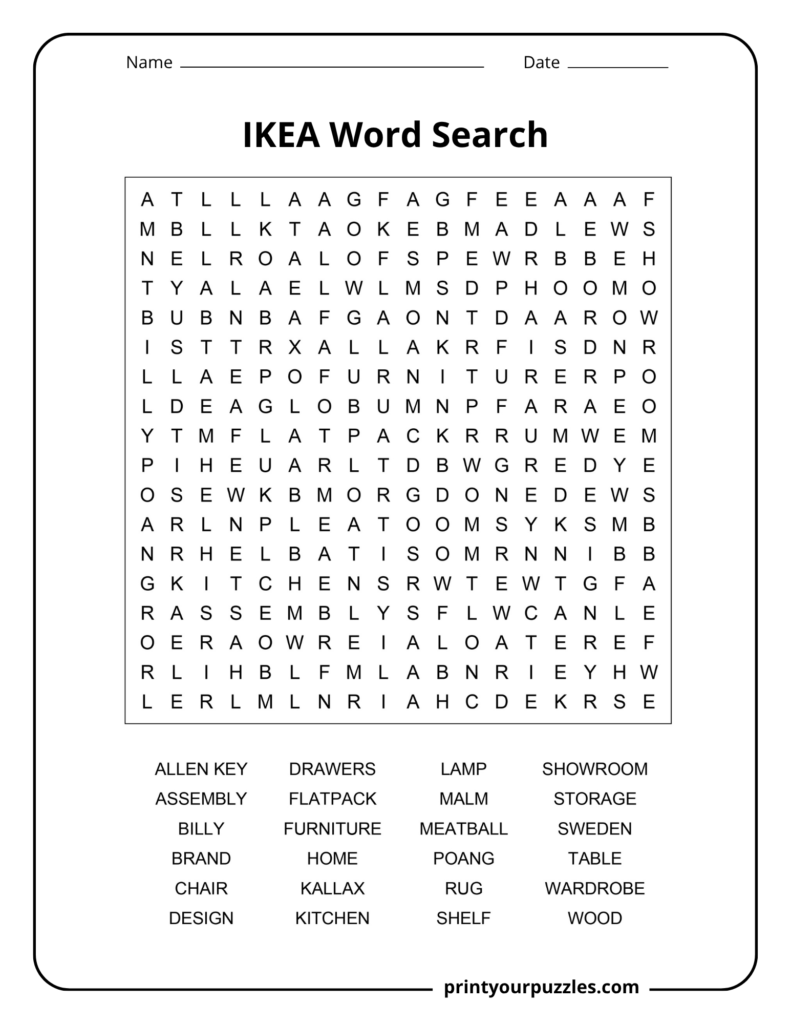
This IKEA word search introduces vocabulary connected with the company’s history, furniture, design, stores, products, Swedish heritage, and shopping experience. As you complete the puzzle, you can explore the words and ideas that have helped make IKEA one of the most familiar names in modern home furnishing.
Related Word Searches:
Amazon | Walmart | Lego | H&M
ALLEN KEY – A small L-shaped tool commonly included with IKEA furniture, used to tighten hexagonal screws and bolts during the assembly of tables, beds, shelves, and cabinets.
ASSEMBLY – The process of putting IKEA furniture together at home by following illustrated instructions and connecting panels, screws, fittings, and other parts supplied inside the package.
BILLY – One of IKEA’s best-known bookcase ranges, introduced in 1979 and valued for its simple design, adjustable shelves, affordability, and suitability for many different rooms.
BRAND – A company identity recognized through its name, products, design, colors, reputation, and customer experience; IKEA has become a globally familiar home-furnishing brand.
CHAIR – A piece of furniture designed for sitting, available at IKEA in many styles for dining rooms, offices, bedrooms, living spaces, gardens, and children’s rooms.
DESIGN – The planning of a product’s appearance, function, materials, and construction; IKEA emphasizes practical Scandinavian design combining simplicity, affordability, comfort, and efficient use of space.
DRAWERS – Sliding storage compartments found in many IKEA dressers, desks, cabinets, and bedroom units, helping people organize clothing, documents, accessories, and other household belongings efficiently.
FLATPACK – A packaging method in which furniture is sold disassembled inside compact boxes, making products easier to transport, store, ship, and carry home for later assembly.
FURNITURE – Movable household items such as tables, chairs, beds, sofas, cabinets, and desks; furniture represents the central product category associated with IKEA stores worldwide.
HOME – The living space where people relax, sleep, cook, work, and spend time together; IKEA designs products intended to make homes practical, comfortable, and attractive.
KALLAX – A popular IKEA shelving unit featuring square compartments that can hold books, boxes, decorations, toys, records, and other items while providing flexible storage for different rooms.
KITCHEN – An area used for preparing and cooking food; IKEA sells cabinets, worktops, sinks, appliances, utensils, lighting, tables, and storage systems designed for kitchen spaces.
LAMP – A lighting product used to brighten or decorate a room; IKEA offers table lamps, floor lamps, desk lamps, ceiling lights, and other affordable lighting options.
MALM – A well-known IKEA furniture series recognized especially for beds and chests of drawers, featuring clean lines, simple forms, and a modern Scandinavian-inspired appearance.
MEATBALL – A famous food associated with IKEA restaurants, particularly Swedish-style meatballs traditionally served with gravy, mashed potatoes, vegetables, and lingonberry jam in many store locations.
POANG – An iconic IKEA armchair introduced in the 1970s, known for its curved wooden frame, comfortable cushioned seat, lightweight construction, and recognizable Scandinavian design.
RUG – A textile floor covering used for comfort, warmth, decoration, or defining spaces; IKEA sells rugs in different sizes, patterns, materials, textures, and styles.
SHELF – A flat horizontal surface used for storing or displaying books, decorations, kitchenware, and other objects; shelves are common elements in many IKEA storage products.
SHOWROOM – A carefully arranged area inside an IKEA store where furniture and accessories are displayed in realistic room settings, helping customers imagine products inside their homes.
STORAGE – The organization and keeping of household belongings in cabinets, shelves, boxes, wardrobes, and drawers; IKEA offers many storage solutions for small and large living spaces.
SWEDEN – The Scandinavian country where IKEA was founded in 1943; Swedish culture, design traditions, language, foods, and place names have strongly influenced the company’s identity.
TABLE – A piece of furniture with a flat top supported by legs or another base, used for dining, working, studying, displaying objects, or preparing food.
WARDROBE – A tall piece of furniture used for storing clothes, shoes, and accessories; IKEA wardrobes often include customizable shelves, drawers, doors, rails, and interior organizers.
WOOD – A natural material widely used in furniture production; IKEA products may use solid wood, veneers, fiberboard, particleboard, or engineered materials with wood-based components.