Introduction to the Walmart Word Search
Walmart is one of the largest and most recognizable retail companies in the world, known for supermarkets, discount stores, groceries, clothing, electronics, household goods, and many other everyday products. Its story began with Sam Walton, an American businessman who gained experience managing retail stores before developing his own approach to discount shopping. Walton believed that customers in smaller towns deserved the same low prices and broad selection available in larger cities.
After operating other stores, Walton opened the first Walmart in Rogers, Arkansas, in 1962. His strategy was simple but powerful: keep prices low, sell large volumes of merchandise, control costs carefully, and build stores in communities that many larger retailers overlooked. The idea worked, and Walmart began opening more locations across Arkansas and neighboring states.
Growth accelerated as the company developed an increasingly efficient distribution system. Instead of depending entirely on outside wholesalers, Walmart built large distribution centers that could supply many stores across a region. Trucks moved products quickly between warehouses and stores, while computerized inventory systems later helped the company track sales and restock merchandise more efficiently. This focus on logistics became one of Walmart’s greatest competitive advantages.
The company also introduced Walmart Supercenters, combining general merchandise with full grocery departments. These very large stores allowed customers to buy food, clothing, electronics, toys, pharmacy products, and household essentials during a single visit.
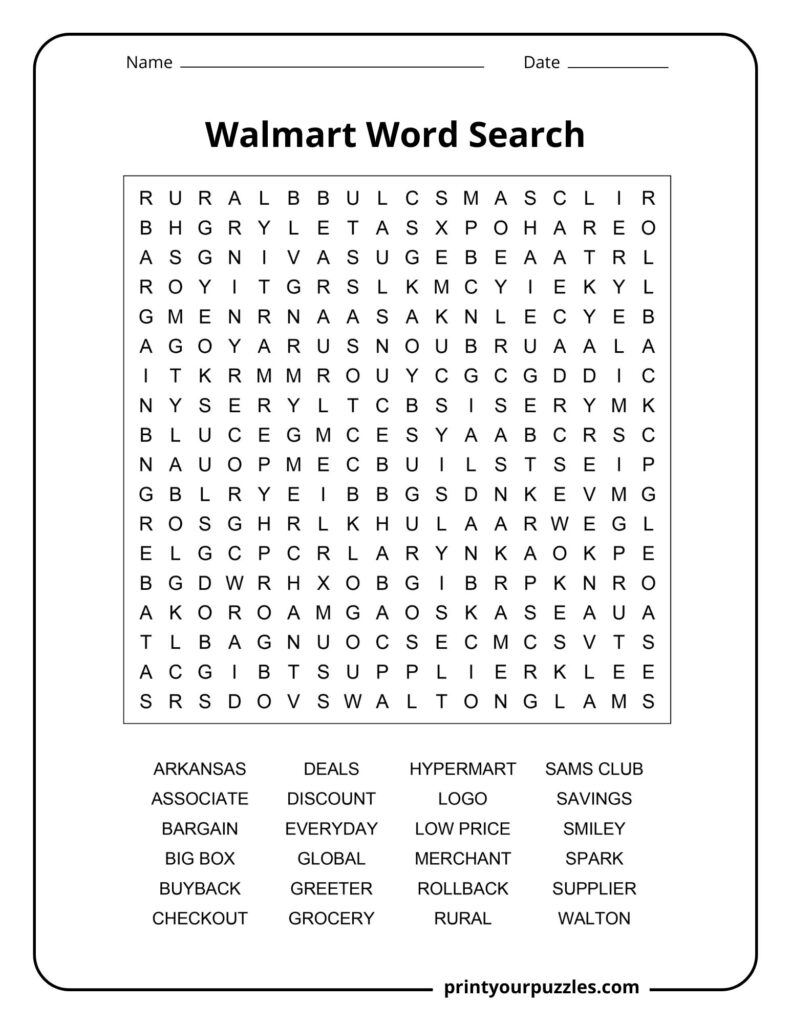
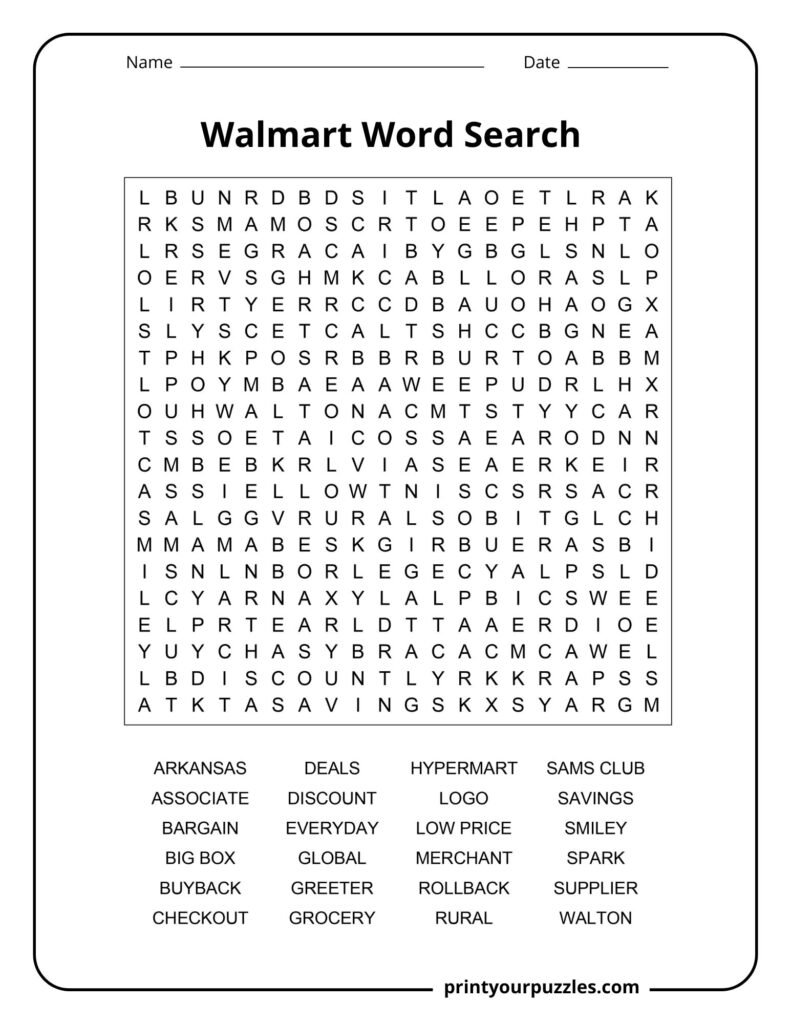
A printable Walmart word search can connect this growth story through terms such as Arkansas, Walton, Supercenter, groceries, carts, checkout, savings, distribution, retail, and low prices.
As Walmart expanded across the United States and internationally, its blue branding and spark-shaped logo became familiar to millions of shoppers. The company also moved strongly into e-commerce, store pickup, home delivery, and digital shopping as consumer habits changed.
From one Arkansas discount store to a vast retail network, Walmart grew through a disciplined focus on price, scale, logistics, and convenience. Its history shows how a retailer can become enormously successful by combining everyday products with efficient distribution and a clear promise to help customers spend less.
Related Word Searches:
Amazon | McDonald’s | Heinz | Coca-Cola
Medium Difficulty Word Search
Words to Find
ARKANSAS, ASSOCIATE, BARGAIN, BIG BOX, BUYBACK, CHECKOUT, DEALS, DISCOUNT, EVERYDAY, GLOBAL, GREETER, GROCERY, HYPERMART, LOGO, LOW PRICE, MERCHANT, ROLLBACK, RURAL, SAMS CLUB, SAVINGS, SMILEY, SPARK, SUPPLIER, WALTON
All Words Defined
ARKANSAS – The southern U.S. state where Sam Walton opened the first Walmart store in Rogers in 1962, making it the birthplace and lasting headquarters of the entire Walmart empire.
ASSOCIATE – The official term Walmart uses for its employees, reflecting Sam Walton’s belief that every worker deserves respect and recognition as a valued partner in the company’s success.
BARGAIN – A core promise of the Walmart brand since its founding, offering customers significantly reduced prices on everyday products, making quality goods accessible to working-class and budget-conscious shoppers everywhere.
BIG BOX – A retail format popularized by Walmart featuring massive warehouse-style stores with enormous square footage, housing thousands of products across multiple departments under one single roof.
BUYBACK – A financial strategy used by Walmart to repurchase its own shares from the market, returning value to shareholders and demonstrating long-term confidence in the company’s continued growth and profitability.
CHECKOUT – The final step of the Walmart shopping experience, evolving over decades from traditional cashier lanes to self-service kiosks and mobile payment options, reflecting the brand’s ongoing commitment to convenience.
DEALS – Walmart has built its entire reputation around offering customers exceptional deals, providing consistently reduced prices on thousands of products daily, fulfilling Sam Walton’s original promise of unbeatable everyday value.
DISCOUNT – The foundational retail philosophy that built Walmart into a global giant, consistently undercutting competitors’ prices to attract high-volume shoppers and dominate the mass-market retail landscape.
EVERYDAY – Central to Walmart’s famous “Everyday Low Prices” slogan, this concept promises customers consistently low prices year-round rather than relying on temporary sales or promotional discount events.
GLOBAL – Describing Walmart’s international expansion beyond the United States, operating thousands of stores across dozens of countries under various brand names, making it one of the world’s largest employers.
GREETER – A uniquely Walmart tradition introduced in 1980, placing a friendly employee at store entrances to welcome shoppers, reduce theft, and create a warm, community-oriented shopping atmosphere.
GROCERY – A major expansion of Walmart’s original merchandise offering, growing into one of America’s largest food retailers through Supercenter formats that combined general merchandise with full-service grocery departments.
HYPERMART – A large-scale retail concept experimented with by Walmart in the late 1980s, combining grocery and general merchandise in massive spaces, later evolving into the successful Supercenter store format.
LOGO – Walmart’s visual identity has evolved significantly over decades, from early serif lettering to the modern 2008 redesign featuring the iconic six-pointed yellow spark symbol representing energy and optimism.
LOW PRICE – The absolute cornerstone of Walmart’s brand identity and competitive strategy, driving every business decision from supplier negotiations to store operations in pursuit of delivering maximum customer savings.
MERCHANT – A term deeply respected within Walmart’s culture, honoring Sam Walton’s identity as a true retailer who understood customers intimately and built his entire business philosophy around serving their needs.
ROLLBACK – Walmart’s signature promotional program that temporarily reduces prices on selected items, using a smiley face icon in marketing to signal cheerful savings and reinforce the brand’s value promise.
RURAL – The strategic insight behind Walmart’s early growth, targeting small towns and underserved rural communities that larger retailers ignored, building fierce customer loyalty before expanding into competitive urban markets.
SAMS CLUB – Walmart’s membership-based warehouse retail chain founded in 1983, offering bulk products at discounted prices to individual members and small businesses, named directly in honor of Sam Walton.
SAVINGS – The ultimate value proposition Walmart delivers to its hundreds of millions of customers globally, summarized perfectly in the brand’s longstanding tagline “Save Money, Live Better,” introduced in 2007.
SMILEY – The cheerful yellow smiley face that became strongly associated with Walmart’s Rollback promotions throughout the 1990s and 2000s, symbolizing friendly prices and becoming one of retail’s most recognized icons.
SPARK – The six-pointed yellow starburst symbol introduced in Walmart’s 2008 logo redesign, representing energy, optimism, and the spark of a great idea, replacing the hyphen that previously divided the brand name.
SUPPLIER – A critical partner in Walmart’s business model, with the company famously demanding low costs from manufacturers worldwide, fundamentally reshaping global supply chains and influencing production practices across multiple industries.
WALTON – The founding family surname synonymous with Walmart’s entire history, led by visionary patriarch Sam Walton, whose descendants remain among the wealthiest people on Earth through continued ownership stakes.
Hard Difficulty Word Search
Words to Find
ARKANSAS, ASSOCIATE, BARGAIN, BIG BOX, BUYBACK, CHECKOUT, DEALS, DISCOUNT, EVERYDAY, GLOBAL, GREETER, GROCERY, HYPERMART, LOGO, LOW PRICE, MERCHANT, ROLLBACK, RURAL, SAMS CLUB, SAVINGS, SMILEY, SPARK, SUPPLIER, WALTON
6 Key FAQs About the Walmart Brand
5 Curious "Did You Know?" Facts About Walmart