Introduction to the Kodak Word Search
Kodak is one of the most famous names in the history of photography, but its story begins with the difficult early life of George Eastman. Born in New York State in 1854, Eastman was the youngest child of George Washington Eastman and Maria Kilbourn Eastman. His father operated a business school, but died when George was still a child, leaving his mother responsible for the family. Maria took in boarders to earn money, and George eventually left school and went to work while still young to help support the household.
Eastman did not originally plan a career in photography. As a young adult, however, he became interested in taking pictures and discovered just how complicated the process could be. Photographers had to carry bulky equipment and prepare photographic materials with considerable care. Eastman became fascinated by the challenge of making the process simpler. In 1880, he began commercially manufacturing dry photographic plates, and the following year he formed the Eastman Dry Plate Company with businessman Henry Strong.
His ambitions went much further. Eastman wanted photography to become something ordinary people could enjoy, not an activity limited to professionals and dedicated enthusiasts. In 1888, the Kodak camera appeared with a remarkably simple idea: customers could take their pictures and send the camera back for processing. The memorable advertising message “You press the button, we do the rest” captured this new approach.
Roll film and inexpensive cameras helped the business grow rapidly. In 1892, the organization became the Eastman Kodak Company, and manufacturing expanded in Rochester, New York. The introduction of the Brownie camera in 1900 made photography affordable to an even broader public, helping snapshots become part of birthdays, holidays, travel, and everyday family life.
This transformation gives a printable Kodak word search puzzle a particularly rich history to explore. Cameras, film, Brownie, negatives, Rochester, snapshots, processing, and color all represent chapters in the company’s development.
Kodak later became famous for products such as Kodachrome film and for its important role in both still photography and motion pictures. The familiar yellow packaging and expression “Kodak moment” strengthened its connection with preserving memories. Although digital photography eventually transformed the industry and challenged Kodak’s traditional film business, the company’s historical influence remains enormous.
From a young man helping support his family to an entrepreneur determined to make photography simple, George Eastman built a company that changed who could take pictures. Kodak’s growth helped turn photography from a complicated technical process into an everyday way for millions of families to record their lives.
Related Word Searches:
Sony | Apple | IBM | Disney
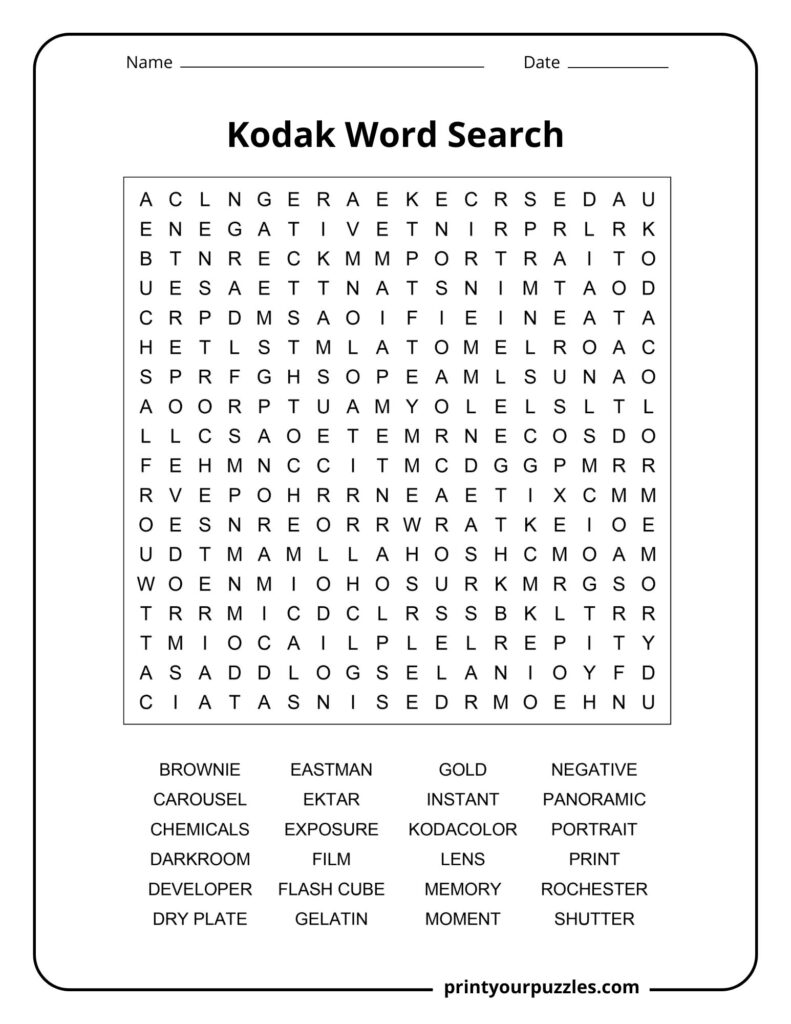
Medium Difficulty Word Search
Words to Find
BROWNIE, CAROUSEL, CHEMICALS, DARKROOM, DEVELOPER, DRY PLATE, EASTMAN, EKTAR, EXPOSURE, FILM, FLASH CUBE, GELATIN, GOLD, INSTANT, KODACOLOR, LENS, MEMORY, MOMENT, NEGATIVE, PANORAMIC, PORTRAIT, PRINT, ROCHESTER, SHUTTER
All Words Defined
BROWNIE – Iconic low-cost camera introduced by Kodak in 1900, designed to make photography accessible to everyone. Named after Palmer Cox’s cartoon characters, it revolutionized amateur photography worldwide.
CAROUSEL – Kodak’s legendary circular slide projector launched in 1961, allowing smooth and reliable presentation of photographic slides. It became a cultural symbol of family memories and professional presentations.
CHEMICALS – Essential substances used in photographic film processing, including developers, fixers, and stop baths. Kodak pioneered the formulation of reliable chemical kits that standardized darkroom work globally.
DARKROOM – A light-sealed space where photographic film is developed and prints are made. Kodak supplied equipment and chemicals that transformed darkrooms into accessible creative spaces for amateur photographers.
DEVELOPER – A chemical solution that makes latent images on exposed film visible. Kodak developed proprietary formulas that became industry standards, ensuring consistent and high-quality photographic results worldwide.
DRY PLATE – A gelatin-coated glass plate used as a photographic medium before roll film. Kodak’s adoption of this technology helped transition photography away from cumbersome wet collodion processes.
EASTMAN – George Eastman, founder of Kodak, born in 1854. A visionary entrepreneur who democratized photography by developing affordable cameras and roll film, transforming it from an elite art into a mass medium.
EKTAR – A premium Kodak film and lens product line celebrated for exceptional sharpness and vivid color accuracy. Ektar film remains highly regarded among professional and enthusiast film photographers today.
EXPOSURE – The process of allowing light to reach photographic film or a sensor to create an image. Kodak’s cameras and films were engineered to optimize exposure across a wide range of lighting conditions.
FILM – Kodak’s defining product: a light-sensitive strip used to capture photographic images. For over a century, Kodak film set the global standard for color accuracy, grain quality, and reliability.
FLASH CUBE – A compact rotating flash accessory introduced by Kodak in 1965 for Instamatic cameras. Each cube contained four individual flash bulbs, enabling four consecutive flash photos without manual bulb replacement.
GELATIN – A biological material used to create light-sensitive emulsions on photographic film and paper. Kodak refined gelatin-based emulsion technology, making mass production of consistent, high-quality photographic film possible.
GOLD – Kodak Gold is a widely used consumer color negative film, introduced in the 1980s. Known for warm tones and versatility in various lighting conditions, it remains one of Kodak’s most recognizable products.
INSTANT – Refers to Kodak’s instant photography products developed to compete with Polaroid. Kodak entered the instant camera market in 1976, offering prints that developed quickly without a traditional darkroom process.
KODACOLOR – The world’s first color negative film for prints, launched by Kodak in 1942. Kodacolor revolutionized consumer photography by making affordable, reproducible color prints widely available to the general public.
LENS – The optical component of a camera that focuses light onto film. Kodak designed and manufactured precision lenses for its cameras, contributing significantly to image sharpness and photographic quality standards.
MEMORY – Central to Kodak’s brand identity through the famous “Kodak Moment” concept. The brand positioned photography as a means of preserving precious personal memories, deeply embedding itself in emotional consumer culture.
MOMENT – The “Kodak Moment” became one of advertising’s most powerful slogans, capturing the idea of preserving fleeting, meaningful life experiences through photography. It shaped how generations understood and valued personal photography.
NEGATIVE – A film image where tones and colors are reversed, used to produce positive photographic prints. Kodak’s advances in negative film technology dramatically improved image quality, color rendition, and ease of reproduction.
PANORAMIC – Kodak produced panoramic cameras capable of capturing wide-angle scenes in a single expansive frame. These cameras were popular for landscapes, group photographs, and architectural subjects requiring an unusually broad field of view.
PORTRAIT – Photography of people was central to Kodak’s marketing strategy. Kodak developed specific films and cameras optimized for portrait photography, with flattering skin tones and fine grain becoming hallmarks of their products.
PRINT – A photographic image produced on light-sensitive paper from a negative. Kodak dominated the photographic printing industry for decades, supplying both amateur consumers and professional labs with paper, chemicals, and printing equipment.
ROCHESTER – The upstate New York city where George Eastman founded Kodak in 1892. Rochester became synonymous with photographic innovation, hosting Kodak’s global headquarters and thousands of employees throughout the twentieth century.
SHUTTER – The mechanical camera component that controls how long light reaches the film during exposure. Kodak engineers refined shutter mechanisms across their camera range to ensure precise timing and consistent photographic results.
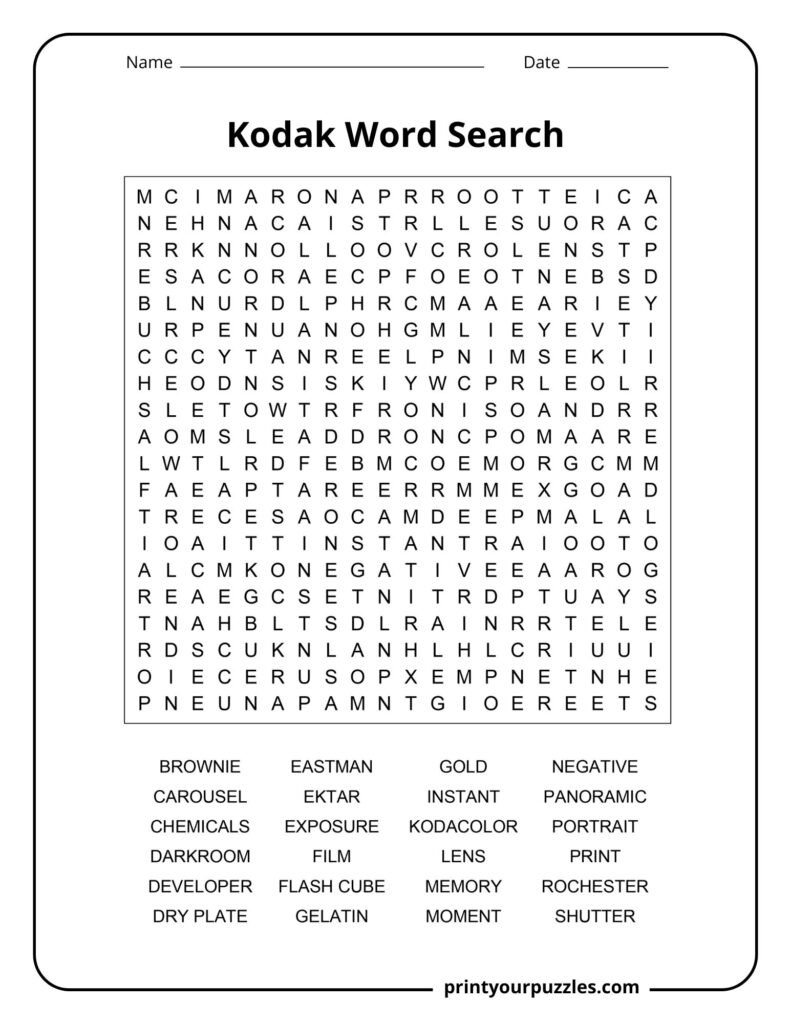
Hard Difficulty Word Search
Words to Find
BROWNIE, CAROUSEL, CHEMICALS, DARKROOM, DEVELOPER, DRY PLATE, EASTMAN, EKTAR, EXPOSURE, FILM, FLASH CUBE, GELATIN, GOLD, INSTANT, KODACOLOR, LENS, MEMORY, MOMENT, NEGATIVE, PANORAMIC, PORTRAIT, PRINT, ROCHESTER, SHUTTER
6 Key FAQs About the Kodak Brand
5 Curious "Did You Know?" Facts About Kodak