Apple has played a major role in shaping the way people use personal technology. The company was founded in 1976 by Steve Jobs, Steve Wozniak, and Ronald Wayne, during a period when computers were still mainly associated with businesses, universities, and hobbyists. Jobs and Wozniak believed computers could eventually become useful and appealing to ordinary people, not just technical specialists.
The company’s earliest work was modest. Wozniak designed the Apple I, while Jobs saw the commercial potential of selling it as a complete computer board rather than simply as a hobbyist project. The two worked from Jobs’s family home in California, and early orders helped them move from experimentation into a real business. Their next machine, the Apple II, became much more successful. Introduced in 1977, it offered color graphics, expansion options, and a more approachable design, helping Apple become one of the important companies in the emerging personal computer industry.
Apple continued growing rapidly, but its history was not always smooth. The Macintosh, introduced in 1984, became one of the company’s defining products because of its graphical interface and mouse-based controls. It presented computing in a more visual and intuitive way. After internal disagreements, Steve Jobs left Apple in 1985, but he returned more than a decade later when the company was struggling. His return marked the beginning of another major period of growth.
Products such as the iMac helped refresh Apple’s image, while the iPod and iTunes transformed digital music. The iPhone, introduced in 2007, became one of the most influential products in the history of mobile technology, combining calling, internet access, photography, apps, and touchscreen controls in one device. The iPad, Apple Watch, AirPods, and MacBook later expanded the company’s ecosystem even further.
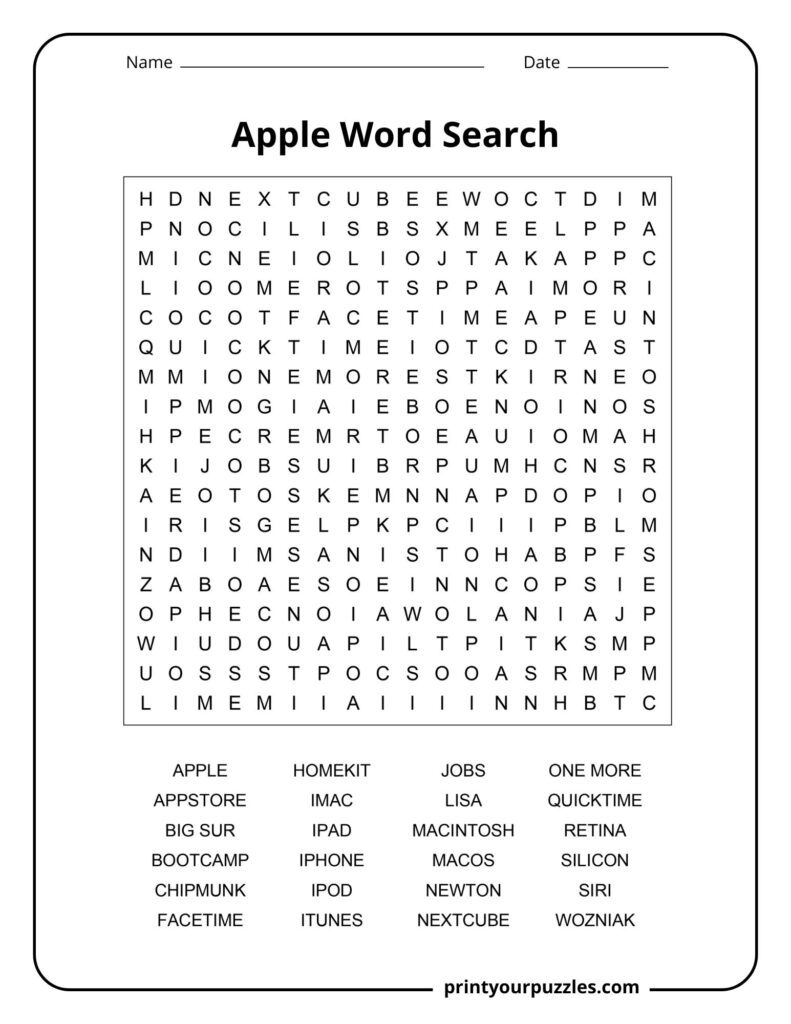
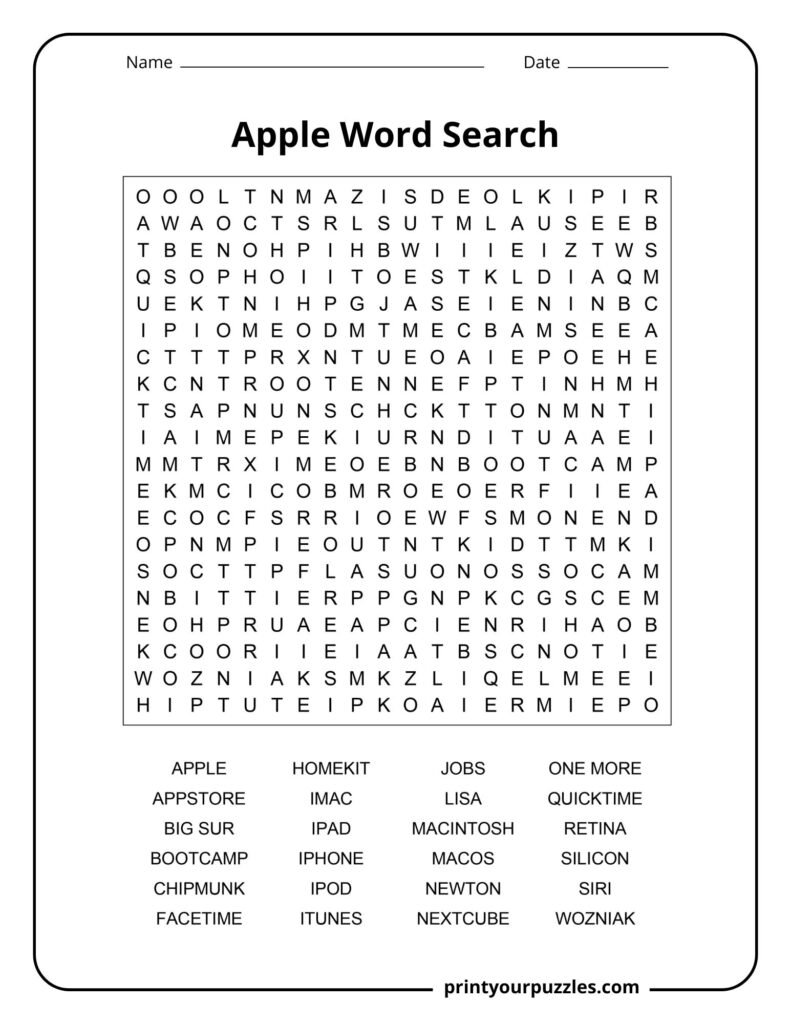
A printable Apple word search puzzle can connect many stages of this story through terms such as Macintosh, iPhone, iPod, App Store, Siri, Mac, design, and innovation.
From a small California startup to a global technology company, Apple’s growth has been driven by a mix of engineering, design, marketing, and a repeated effort to make complex technology feel simple and personal.
Related Word Searches:
Microsoft | Google | IBM | Nvidia
APPLE, APP STORE, BIG SUR, BOOTCAMP, CHIPMUNK, FACETIME, HOMEKIT, IMAC, IPAD, IPHONE, IPOD, ITUNES, JOBS, LISA, MACINTOSH, MACOS, NEWTON, NEXT CUBE, ONE MORE, QUICKTIME, RETINA, SILICON, SIRI, WOZNIAK
APPLE – Technology company founded in 1976 by Steve Jobs, Steve Wozniak, and Ronald Wayne, revolutionizing personal computing, mobile devices, and digital media through iconic products and innovative design philosophy.
APP STORE – Digital marketplace launched in 2008 allowing iPhone users to download applications, transforming software distribution and creating a multibillion-dollar ecosystem of developers, games, and productivity tools worldwide.
BIG SUR – macOS version 11 released in 2020, introducing a dramatic visual redesign inspired by iOS, with rounded corners, translucency effects, and a refreshed Control Center for Mac computers.
BOOTCAMP – Apple utility introduced in 2006 enabling Mac users to install and run Microsoft Windows alongside macOS on Intel-based computers, bridging the gap between the two operating systems.
CHIPMUNK – Internal code name reflecting Apple’s tradition of giving animal or nature-themed nicknames to early projects, representing the creative and secretive development culture within Apple’s engineering teams.
FACETIME – Video and audio calling application launched in 2010 with the iPhone 4, allowing seamless communication between Apple devices over Wi-Fi and cellular networks with high-quality video.
HOMEKIT – Apple’s smart home platform introduced in 2014, enabling users to control compatible lights, locks, thermostats, and cameras securely through Siri or the dedicated Home app.
IMAC – All-in-one desktop computer relaunched in 1998 with a distinctive translucent colorful design that saved Apple from near bankruptcy and signaled the beginning of its modern design era.
IPAD – Touchscreen tablet computer unveiled by Steve Jobs in 2010, creating an entirely new product category between smartphones and laptops, widely adopted in education, business, and creative industries.
IPHONE – Revolutionary smartphone introduced by Steve Jobs in 2007, combining phone, music player, and internet device into one touchscreen product that permanently transformed the entire mobile industry.
IPOD – Portable digital music player launched in 2001 with the tagline “1,000 songs in your pocket,” revitalizing Apple’s finances and paving the way for iTunes and the iPhone.
ITUNES – Digital media application launched in 2001 for managing music libraries, later evolving into a full entertainment store selling songs, movies, and apps before being split into separate apps in 2019.
JOBS – Steve Jobs, Apple’s visionary co-founder and longtime CEO, whose relentless pursuit of simplicity, beauty, and user experience shaped every major Apple product across four transformative decades.
LISA – Apple’s 1983 personal computer, one of the first commercially available machines with a graphical user interface and mouse, ahead of its time but commercially unsuccessful due to its high price.
MACINTOSH – Iconic personal computer launched in January 1984 with a legendary Super Bowl advertisement, introducing mainstream audiences to the graphical user interface and forever changing personal computing history.
MACOS – Apple’s Unix-based desktop operating system powering all Mac computers, known for its stability, security, elegant design, and seamless integration with iPhone, iPad, and other Apple devices.
NEWTON – Apple’s pioneering personal digital assistant produced from 1993 to 1998, featuring handwriting recognition technology and touchscreen input, considered a visionary forerunner of modern tablets and smartphones.
NEXT CUBE – Workstation computer created by Steve Jobs’ company NeXT after leaving Apple in 1985, notable for its elegant black cube design and the operating system that eventually became the foundation of macOS.
ONE MORE – “One more thing…” Steve Jobs’ famous phrase used during Apple keynote presentations to dramatically reveal a surprise product or feature, creating anticipation and theatrical storytelling that became a beloved part of Apple’s culture.
QUICKTIME – Apple’s multimedia framework and player introduced in 1991, enabling Macs to play video for the first time and becoming foundational technology for digital video playback and streaming standards.
RETINA – Apple’s marketing term introduced with the iPhone 4 in 2010 describing high-resolution displays with pixel density so high the human eye cannot distinguish individual pixels at normal viewing distance.
SILICON – Refers to Apple Silicon, the company’s transition beginning in 2020 from Intel processors to custom ARM-based chips like the M1, delivering dramatically improved performance and energy efficiency across all Macs.
SIRI – Apple’s voice-activated intelligent assistant launched with the iPhone 4S in 2011, allowing users to send messages, set reminders, search the web, and control devices using natural spoken language.
WOZNIAK – Steve Wozniak, Apple’s brilliant co-founder and engineering genius who designed the original Apple I and Apple II computers, whose technical innovations laid the entire hardware foundation for Apple’s success.
APPLE, APP STORE, BIG SUR, BOOTCAMP, CHIPMUNK, FACETIME, HOMEKIT, IMAC, IPAD, IPHONE, IPOD, ITUNES, JOBS, LISA, MACINTOSH, MACOS, NEWTON, NEXT CUBE, ONE MORE, QUICKTIME, RETINA, SILICON, SIRI, WOZNIAK