McDonald’s is one of the most recognizable restaurant brands in the world, known for hamburgers, fries, breakfast items, and the famous golden arches. Its story began with brothers Richard and Maurice McDonald, who opened a restaurant in California and gradually developed a new way of serving food. Rather than offering a large traditional menu, they focused on a smaller number of popular items that could be prepared quickly and consistently.
In 1948, the brothers introduced what they called the Speedee Service System. Their kitchen was reorganized almost like an assembly line, with different workers responsible for specific tasks. Hamburgers, fries, and drinks could be prepared much faster than at a conventional restaurant, while standardized methods helped keep the food consistent. This simple but highly efficient idea attracted attention because it suited the growing demand for convenient meals.
Ray Kroc entered the story in the 1950s after becoming interested in the unusually large number of milkshake machines used by the McDonald brothers’ restaurant. He visited the business, recognized that the system could work in many locations, and became involved in expanding McDonald’s through franchising. Kroc opened a franchised restaurant in Illinois in 1955 and eventually built a much larger company around the concept.
As McDonald’s expanded across the United States, recognizable branding became increasingly important. The golden arches, standardized restaurant designs, and familiar menu helped customers know what to expect wherever they visited. Products such as the Big Mac, Filet-O-Fish, Egg McMuffin, Chicken McNuggets, and Happy Meal later became closely associated with the brand.
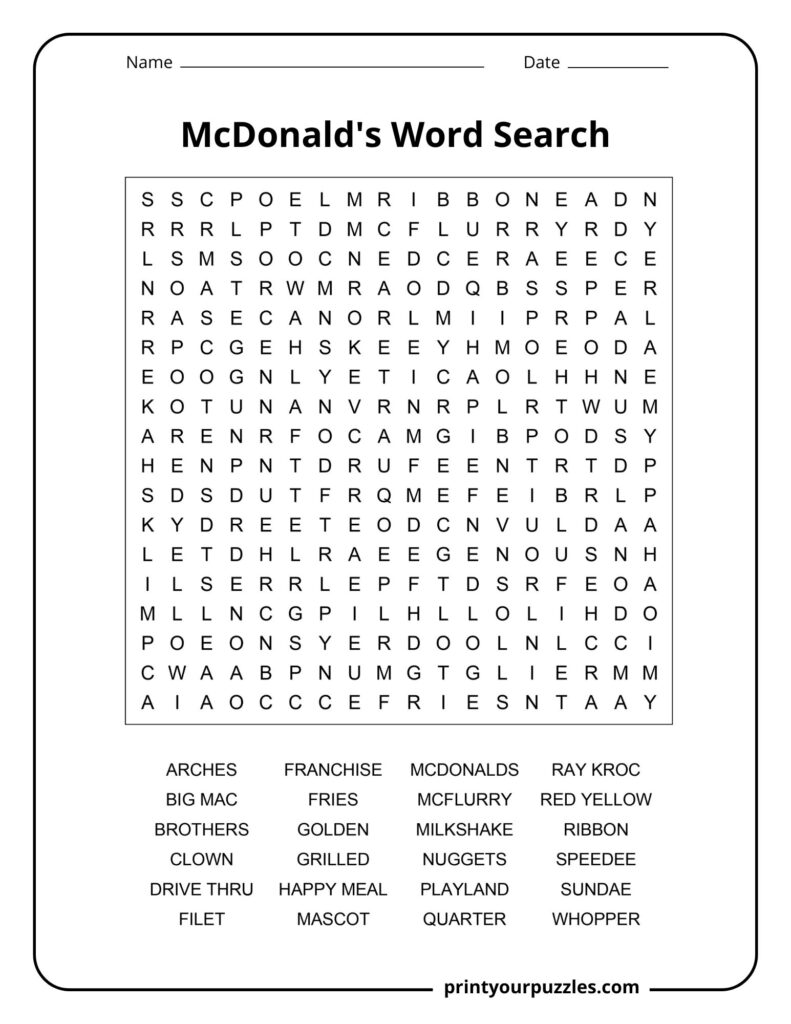
A McDonald’s word search can explore this growth through terms connected with burgers, fries, franchises, golden arches, drive-throughs, Happy Meals, restaurants, and fast service.
McDonald’s eventually expanded into countries around the world, often adapting some menu items to local tastes while keeping its core identity. From an efficient California restaurant to an international fast-food network, the company grew through speed, standardization, franchising, marketing, and a remarkably consistent customer experience.
Related Word Searches:
Coca-Cola | Heinz | Starbucks | Walmart
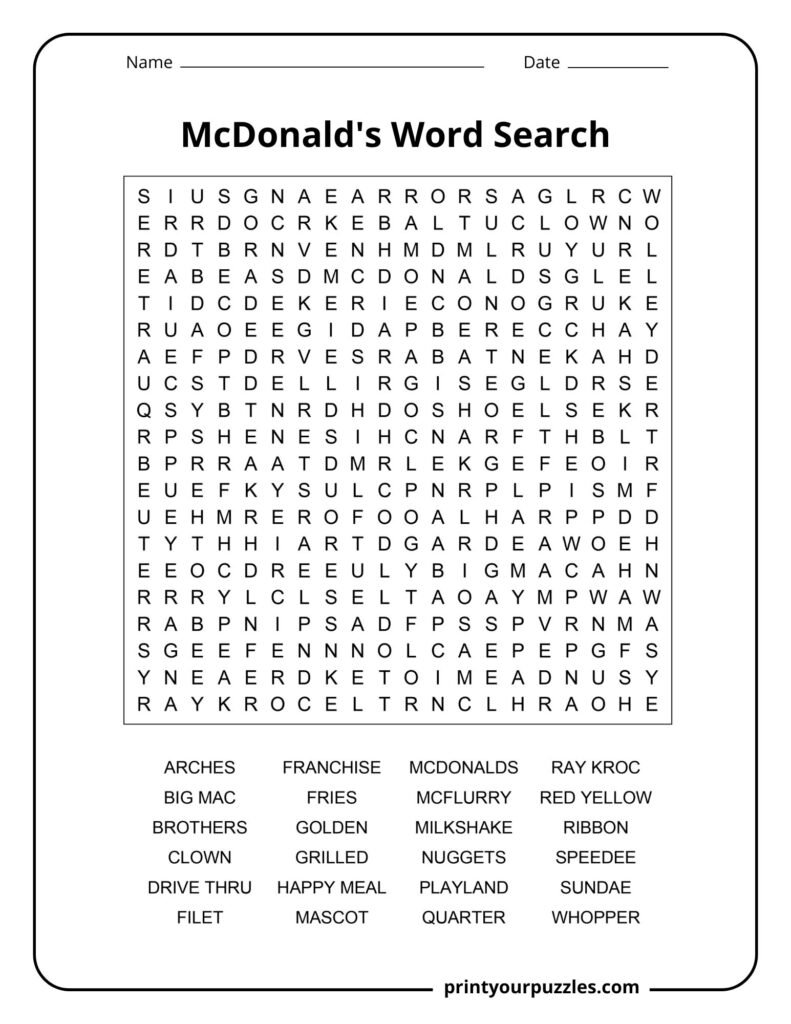
ARCHES, BIG MAC, BROTHERS, CLOWN, DRIVE THRU, FILET, FRANCHISE, FRIES, GOLDEN, GRILLED, HAPPY MEAL, MASCOT, MCDONALDS, MCFLURRY, MILKSHAKE, NUGGETS, PLAYLAND, QUARTER, RAY KROC, RED YELLOW, RIBBON, SPEEDEE, SUNDAE, WHOPPER
ARCHES – The iconic golden arches form the letter M, serving as McDonald’s most recognizable symbol worldwide since the 1960s, representing the brand’s identity.
BIG MAC – Introduced in 1968, the Big Mac is McDonald’s signature double-patty burger, featuring special sauce, lettuce, cheese, pickles, and onions on a sesame bun.
BROTHERS – Richard and Maurice McDonald founded the original McDonald’s restaurant in 1940 in San Bernardino, California, pioneering the fast-food concept with their Speedee Service System.
CLOWN – Ronald McDonald, the beloved clown mascot, debuted in 1963 and became one of the most recognized fictional characters globally, representing fun and family-friendly dining.
DRIVE THRU – McDonald’s introduced its drive-thru service in 1975 in Sierra Vista, Arizona, revolutionizing fast food by allowing customers to order and receive meals without leaving their vehicles.
FILET – The Filet-O-Fish sandwich, launched in 1965, was created to attract Catholic customers during Lent, becoming one of McDonald’s longest-running and most beloved menu items worldwide.
FRANCHISE – Ray Kroc built McDonald’s into a global empire through franchising, allowing independent operators to run restaurants under the brand’s strict standards, quality controls, and unified identity.
FRIES – McDonald’s french fries, made from Russet Burbank potatoes, became a cultural icon after Ray Kroc standardized their preparation, making them the world’s most famous fast-food side dish.
GOLDEN – The golden color of McDonald’s arches was inspired by the roof design of early restaurant buildings, later evolving into the bright yellow symbol recognized across more than 100 countries.
GRILLED – McDonald’s introduced grilled chicken options in the 1980s as a healthier alternative to fried menu items, responding to growing consumer demand for lighter, lower-calorie fast-food choices.
HAPPY MEAL – Launched in 1979, the Happy Meal combined a child-sized portion of food with a toy, transforming McDonald’s into a family dining destination and creating a beloved childhood tradition globally.
MASCOT – McDonald’s has featured several mascots throughout its history, including Speedee, Ronald McDonald, Grimace, and the Hamburglar, each helping to build the brand’s playful and family-oriented image.
MCDONALDS – The McDonald’s name, originally belonging to brothers Richard and Maurice, was licensed and later purchased by Ray Kroc, becoming the most visited fast-food brand name in the world.
MCFLURRY – Introduced in 1997, the McFlurry is a soft-serve ice cream dessert blended with mix-ins like Oreo cookies or M&Ms, quickly becoming one of McDonald’s most popular dessert offerings worldwide.
MILKSHAKE – Milkshakes have been a McDonald’s staple since its earliest days, and it was a milkshake machine that originally brought Ray Kroc to the brothers’ restaurant, changing fast-food history forever.
NUGGETS – Chicken McNuggets debuted in 1983 and became an instant sensation, transforming how the world consumed chicken and cementing McDonald’s reputation for creating entirely new fast-food categories and cravings.
PLAYLAND – McDonald’s PlayPlace indoor and outdoor playgrounds, introduced in the 1970s and 1980s, made restaurants a destination for families, encouraging longer visits and associating the brand with childhood fun.
QUARTER – The Quarter Pounder, introduced in 1971, was McDonald’s answer to growing demand for a heartier burger, measured by its pre-cooked weight and becoming a permanent menu staple across all markets.
RAY KROC – Ray Kroc joined McDonald’s in 1954, bought out the founding brothers in 1961, and built the chain into a global phenomenon with thousands of locations, earning his place in business history.
RED YELLOW – McDonald’s signature red and yellow color scheme was chosen for their psychological impact, with red stimulating appetite and yellow evoking happiness and warmth, making the brand instantly recognizable worldwide.
RIBBON – The red ribbon motif used in early McDonald’s branding and architecture helped define the visual identity of the restaurants before the golden arches became the dominant and universally recognized symbol.
SPEEDEE – Speedee was McDonald’s original mascot in the 1940s and 1950s, a winking chef character representing the brothers’ fast and efficient Speedee Service System, the precursor to modern fast-food operations.
SUNDAE – The McDonald’s hot fudge sundae became a dessert staple in the 1970s, offering customers a simple, affordable sweet treat and helping establish McDonald’s as a full-meal dining experience for families.
WHOPPER – Though a Burger King product, the Whopper’s 1957 launch intensified the fast-food rivalry, pushing McDonald’s to continuously innovate its own burger lineup and sharpen its brand identity against growing competition.
ARCHES, BIG MAC, BROTHERS, CLOWN, DRIVE THRU, FILET, FRANCHISE, FRIES, GOLDEN, GRILLED, HAPPY MEAL, MASCOT, MCDONALDS, MCFLURRY, MILKSHAKE, NUGGETS, PLAYLAND, QUARTER, RAY KROC, RED YELLOW, RIBBON, SPEEDEE, SUNDAE, WHOPPER