Adidas is one of the world’s most recognizable sportswear companies, known for athletic shoes, clothing, equipment, and its famous three-stripe design. Its story began in Herzogenaurach, Germany, where Adolf “Adi” Dassler started making sports shoes in the 1920s. He worked with his brother Rudolf in a family footwear business, producing shoes designed specifically for athletes and experimenting with ways to improve grip, comfort, and performance.
The brothers’ company gained international attention when athletes wore their footwear at major sporting events, including the 1936 Olympic Games in Berlin. After World War II, however, Adi and Rudolf separated and created rival businesses in the same German town. Rudolf founded Puma, while Adi established Adidas in 1949. The Adidas name combined parts of his first and last names, and the company soon adopted the three stripes that would become its most recognizable visual feature.
Sport remained central to Adidas as the company grew. Its soccer boots were particularly important, and the brand built strong relationships with athletes, clubs, and national teams. Success on the playing field helped Adidas expand beyond Germany and become familiar to sports fans around the world. As demand increased, the company moved from specialized footwear into shirts, tracksuits, jackets, accessories, and equipment for many different sports.
Several Adidas designs later became famous outside traditional athletics. Shoes such as the Superstar, Stan Smith, Gazelle, and Samba developed strong identities of their own, appearing in music, fashion, streetwear, and youth culture. The Superstar, originally created as a basketball shoe, became closely associated with hip-hop culture, while models such as the Samba and Gazelle have repeatedly returned to fashion decades after their first introduction.
The three stripes remain among the most distinctive elements of the company’s identity. They appear on footwear, clothing, uniforms, and advertising, making many Adidas products recognizable even without prominently displaying the company name. Partnerships with athletes, teams, designers, musicians, and cultural figures have also helped the brand reach audiences far beyond competitive sport.
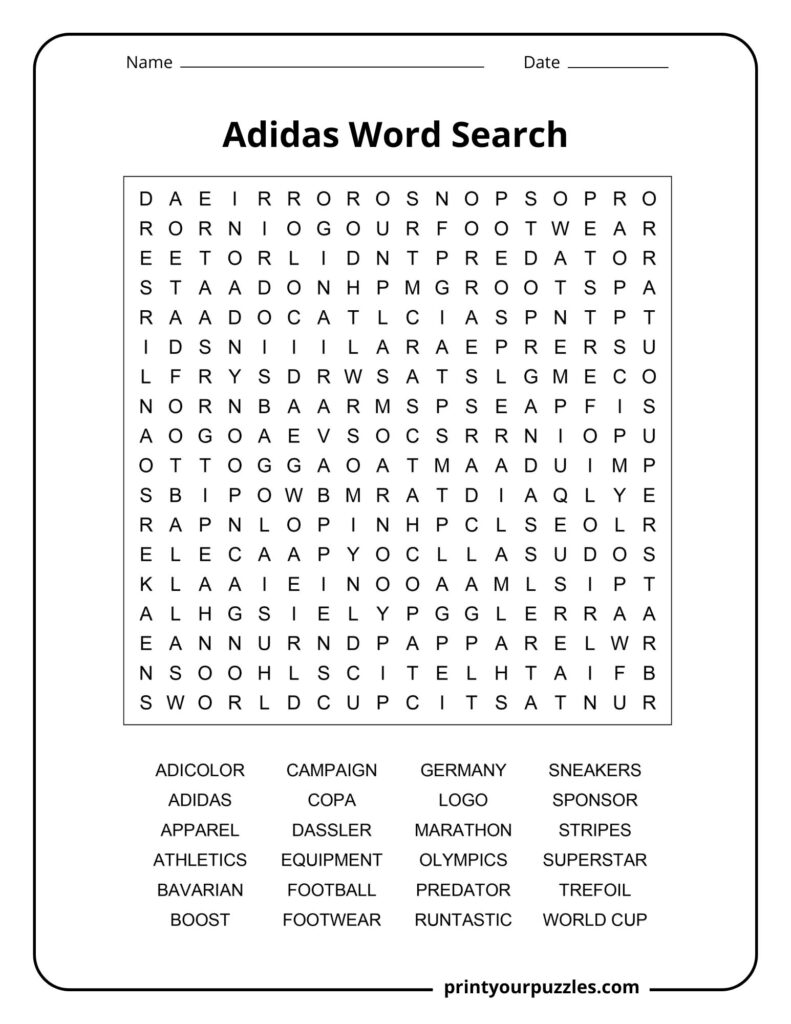
From a small German shoemaking operation to an international sportswear company, Adidas has built a history filled with competition, innovation, iconic products, and cultural influence. A printable Adidas word search offers another way to explore that story, bringing together vocabulary connected with its founders, famous footwear, sports, design, and enduring three-stripe identity.
Related Word Searches:
Nike | Gymshark | Levi’s | Red Bull
ADICOLOR – Launched in 1983, this iconic collection sold plain white sneakers alongside paint markers, inviting customers to personalize their own shoes, becoming a landmark moment in self-expression and streetwear culture.
ADIDAS – The brand name derives from founder Adolf “Adi” Dassler’s nickname and surname, registered in 1949 in Herzogenaurach, Germany, growing into one of the world’s most recognized sportswear companies.
APPAREL – Beyond footwear, Adidas expanded into full clothing lines including tracksuits, jerseys, and performance wear, transforming from a shoe company into a complete global sportswear and lifestyle fashion brand.
ATHLETICS – Adidas was born from track and field, with Adolf Dassler handcrafting spiked running shoes worn by Jesse Owens at the 1936 Berlin Olympics, cementing the brand’s deep athletic heritage.
BAVARIAN – Adidas is rooted in Bavaria, the southern German region where the Dassler family operated their small shoe workshop in Herzogenaurach, a town that would later become home to two rival global brands.
BOOST – Adidas’s revolutionary cushioning technology launched in 2013, which transformed running shoe comfort and became one of the brand’s most successful and copied innovations in footwear history.
CAMPAIGN – Adidas has produced legendary advertising campaigns, most notably “Impossible Is Nothing” launched in 2004, which featured Muhammad Ali and redefined how sports brands communicated inspiration, ambition, and human potential worldwide.
COPA – One of Adidas’s most celebrated football boot lines, the Copa Mundial was launched in 1979 and remains in production today, beloved by players worldwide for its classic kangaroo leather construction and timeless comfort.
DASSLER – The founding surname behind Adidas, Adolf Dassler built his first shoes in his mother’s laundry room in the 1920s, eventually creating a legacy that shaped the entire global athletic footwear industry.
EQUIPMENT – The EQT Equipment line, relaunched in 1991, stripped away excess and focused on pure performance essentials, becoming a defining design philosophy and later a beloved retro lifestyle collection among sneaker enthusiasts globally.
FOOTBALL – Adidas has been the official ball supplier to the FIFA World Cup since 1970, designing iconic match balls like the Telstar and Jabulani, deeply embedding the brand into the world’s most popular sport.
FOOTWEAR – Footwear remains the foundation of Adidas, from early handcrafted leather athletic shoes to modern performance trainers, with iconic silhouettes like the Stan Smith and Superstar shaping sneaker culture across decades.
GERMANY – Founded in Herzogenaurach, Bavaria, Adidas remains headquartered in Germany, a country whose engineering precision and design discipline have deeply influenced the brand’s reputation for quality, innovation, and athletic performance products.
LOGO – The Adidas logo has evolved from the original three stripes to the trefoil in 1971 and the mountain-shaped badge in 1991, each mark reflecting a distinct era of the brand’s identity and ambition.
MARATHON – Adidas has been a major partner of prestigious marathon events worldwide, including the Boston and Berlin Marathons, supplying official race merchandise and footwear to thousands of elite and amateur runners annually.
OLYMPICS – Since Jesse Owens wore Dassler shoes at the 1936 Berlin Games, Adidas has maintained a powerful Olympic presence, outfitting national teams and athletes across dozens of Summer and Winter Olympic Games.
PREDATOR – Introduced in 1994 by footballer Craig Johnston, the Predator boot featured rubber elements on the upper to enhance ball control and power, becoming one of the most innovative and iconic football boots ever made.
RUNTASTIC – Acquired by Adidas in 2015 for approximately 220 million euros, Runtastic is a fitness app platform that expanded the brand into digital health, tracking running, cycling, and workout data for millions of users.
SNEAKERS – Adidas helped define modern sneaker culture with silhouettes like the Superstar and Stan Smith, bridging sport and street style and inspiring generations of collectors, musicians, and fashion designers around the world.
SPONSOR – Adidas is one of sport’s most powerful sponsors, backing major clubs like Real Madrid and Bayern Munich, global federations, and individual athletes, using sponsorship strategically to build brand visibility and loyalty worldwide.
STRIPES – The iconic three stripes were purchased from Finnish brand Karhu in 1952 for two bottles of whisky and 1,600 euros, becoming the most recognizable visual identity in sportswear history and a global cultural symbol.
SUPERSTAR – Launched in 1969 as a basketball shoe, the Superstar gained cultural immortality when hip-hop group Run-DMC wore it without laces in the 1980s, turning a sports silhouette into a timeless streetwear icon.
TREFOIL – The three-leaf clover logo was introduced in 1971 to represent the Olympic spirit and global reach of the brand, today serving as the symbol of Adidas Originals, the heritage and lifestyle division of the company.
WORLD CUP – Adidas has supplied the official match ball to every FIFA World Cup since 1970, with each edition featuring a uniquely designed ball, from the classic Telstar to the aerodynamically controversial Jabulani of 2010.