
Louis Vuitton is one of the most recognizable names in luxury fashion, but its story began with travel rather than clothing. Louis Vuitton was born in rural France in 1821 and left home as a teenager, eventually making his way to Paris. There, he became an apprentice to a respected box and trunk maker, learning how to build protective luggage for wealthy clients at a time when long journeys by carriage, train, and ship were becoming more common.
After years of developing his skills, Vuitton opened his own workshop in Paris in 1854. His early success came from understanding the practical problems travelers faced. Traditional trunks often had rounded tops, which made stacking difficult. Vuitton introduced flat-topped trunks that were easier to transport and store, while still being carefully made and elegant in appearance. This combination of function and craftsmanship helped his business stand out.
The company continued to grow as travel expanded across Europe. Louis Vuitton’s son, Georges Vuitton, later played an important role in taking the business beyond France and protecting it from imitation. Distinctive patterns were introduced to make genuine products easier to recognize. The famous LV monogram appeared in the late nineteenth century and eventually became one of the most recognizable symbols in luxury design.
A printable Louis Vuitton word search puzzle can connect many parts of this history, including Paris, trunks, travel, monograms, leather, craftsmanship, luggage, and fashion. These terms reflect the brand’s original purpose as well as the wider world it later developed.
Over time, Louis Vuitton moved far beyond trunks and suitcases. Handbags, wallets, shoes, clothing, jewelry, watches, and other accessories became major parts of the business. Fashion collections and collaborations with artists and designers also helped the house remain relevant while preserving its travel heritage.
From a young craftsman learning to make trunks in Paris to an international luxury brand, Louis Vuitton grew by solving practical problems with elegant design. Its history shows how craftsmanship, family continuity, recognizable symbols, and changing ideas about travel can transform a specialist workshop into a global fashion house.
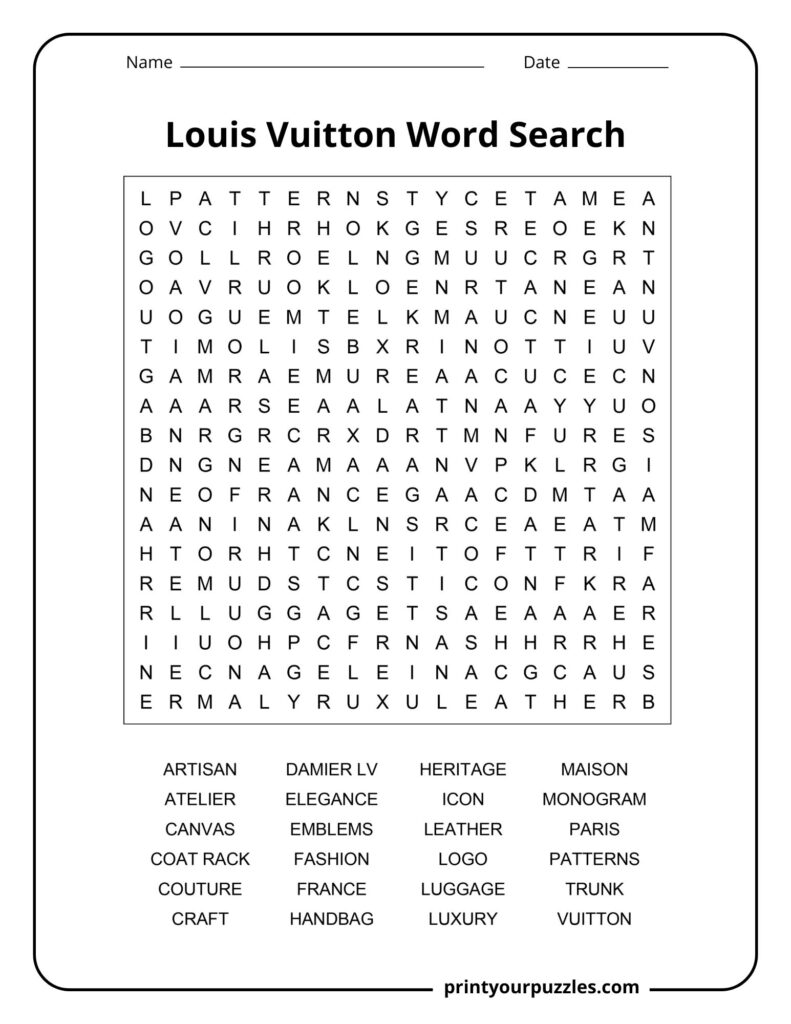
ARTISAN, ATELIER, CANVAS, COAT RACK, COUTURE, CRAFT, DAMIER LV, ELEGANCE, EMBLEMS, FASHION, FRANCE, HANDBAG, HERITAGE, ICON, LEATHER, LOGO, LUGGAGE, LUXURY, MAISON, MONOGRAM, PARIS, PATTERNS, TRUNK, VUITTON
ARTISAN – A highly skilled craftsperson who creates luxury goods by hand, mastering traditional techniques passed down through generations within the Louis Vuitton ateliers.
ATELIER – The prestigious French workshop where Louis Vuitton craftsmen design and handcraft iconic pieces, maintaining the house’s commitment to exceptional quality and savoir-faire.
CANVAS – The signature coated material used to craft Louis Vuitton bags and luggage, recognized worldwide for its durability, water resistance, and distinctive monogrammed surface.
COAT RACK – An early practical furnishing piece reflecting Louis Vuitton’s roots in fine French craftsmanship, representing the brand’s broader dedication to elegant and functional luxury objects.
COUTURE – The refined world of high fashion that Louis Vuitton entered under visionary designers, elevating the house from a trunk maker into a global symbol of Parisian luxury.
CRAFT – The foundation of Louis Vuitton’s identity, where every stitch, cut, and finish is executed with precision, honoring the house’s long tradition of meticulous handmade excellence.
DAMIER LV – One of Louis Vuitton’s most historic patterns, featuring a brown and beige checkerboard design registered in 1888, predating even the iconic Monogram canvas itself.
ELEGANCE – The timeless aesthetic principle guiding every Louis Vuitton creation, blending refined Parisian style with functional design to produce pieces of enduring beauty and sophistication.
EMBLEMS – The distinctive symbols and motifs that define Louis Vuitton’s visual identity, including the interlocking LV initials that have become universally recognized marks of prestige.
FASHION – The evolving creative universe Louis Vuitton entered through ready-to-wear collections, transforming from a luggage specialist into one of the world’s most influential luxury fashion houses.
FRANCE – The birthplace and spiritual home of Louis Vuitton, whose Parisian origins and French craftsmanship tradition remain central to the brand’s heritage, identity, and global prestige.
HANDBAG – One of Louis Vuitton’s most celebrated product categories, encompassing iconic styles like the Speedy and Neverfull, each blending artistic design with exceptional handcrafted quality.
HERITAGE – The rich 170-year history of Louis Vuitton, rooted in Parisian trunk-making tradition, that continues to inspire and inform every contemporary creation the house produces today.
ICON – A term perfectly describing Louis Vuitton itself, whose trunks, bags, and monogram have transcended fashion to become enduring cultural symbols recognized across every corner of the world.
LEATHER – A noble material central to Louis Vuitton’s craft, used in handles, trimmings, and accessories, selected for its exceptional quality and treated to achieve the house’s signature refinement.
LOGO – The interlocking LV monogram, designed in 1896 by Georges Vuitton to honor his father, which became one of the most copied and recognizable luxury symbols in history.
LUGGAGE – The original and defining product of Louis Vuitton, whose flat-topped trunks revolutionized travel in the 19th century by replacing rounded lids and enabling stackable, practical storage.
LUXURY – The very essence of Louis Vuitton’s universe, where exceptional materials, masterful craftsmanship, and timeless design converge to create objects of desire coveted by discerning clients worldwide.
MAISON – The French word for house, used to describe Louis Vuitton as a storied institution, reflecting its status as a prestigious French fashion and leather goods establishment since 1854.
MONOGRAM – The iconic pattern created in 1896, featuring interlocking LV initials with floral motifs on a brown background, originally designed to prevent counterfeiting and now a symbol of global luxury.
PARIS – The city where Louis Vuitton opened his first workshop in 1854, and which remains the beating heart of the brand’s creative vision, elegance, and international fashion influence.
PATTERNS – The distinctive repeating designs, including the Monogram and Damier, that define Louis Vuitton’s visual language and have become among the most recognized textile motifs in fashion history.
TRUNK – The revolutionary creation that launched Louis Vuitton’s legacy, featuring a lightweight flat top and airtight closure, designed to withstand the demands of 19th-century steam travel.
VUITTON – Louis Vuitton, born in 1821 in France, who established his legendary trunk-making house in Paris in 1854, forever changing the world of luxury travel goods.
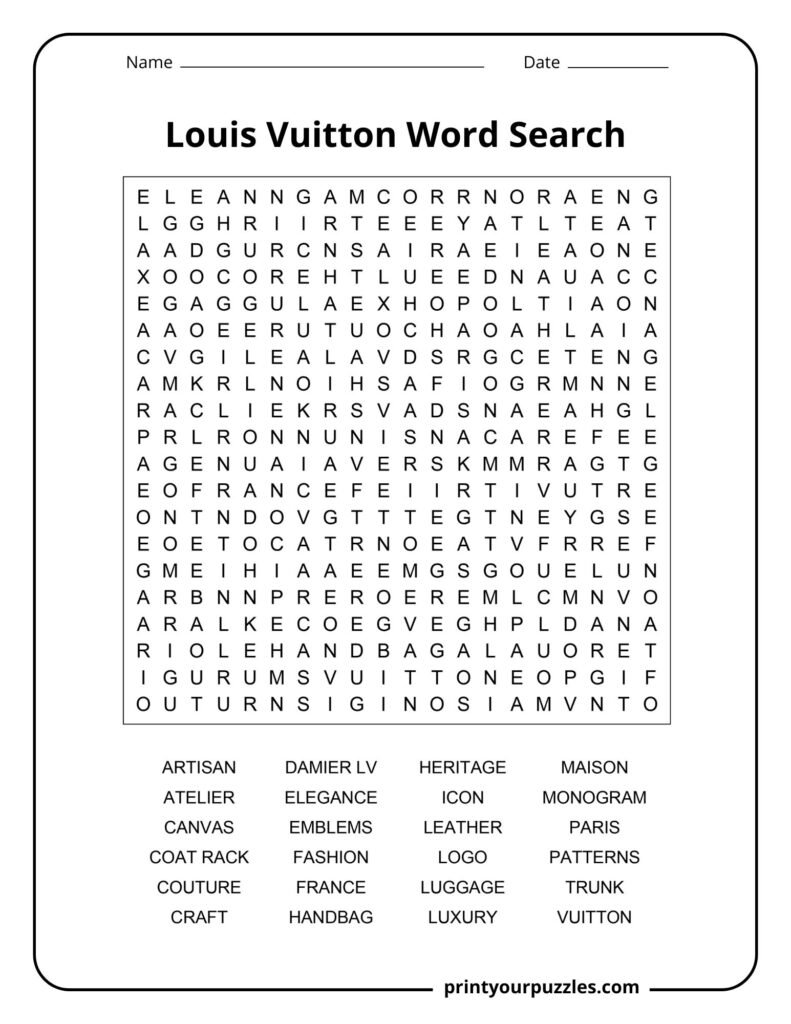
ARTISAN, ATELIER, CANVAS, COAT RACK, COUTURE, CRAFT, DAMIER LV, ELEGANCE, EMBLEMS, FASHION, FRANCE, HANDBAG, HERITAGE, ICON, LEATHER, LOGO, LUGGAGE, LUXURY, MAISON, MONOGRAM, PARIS, PATTERNS, TRUNK, VUITTON
Louis Vuitton was founded in Paris in 1854, when Louis Vuitton opened his first trunk-making workshop on Rue Neuve des Capucines, revolutionizing luxury travel goods forever.
His flat-topped, airtight trunks replaced traditional rounded lids, making them stackable and waterproof, perfectly suited for modern steam and rail travel during the 19th century.
Georges Vuitton, Louis’s son, designed the legendary Monogram canvas in 1896 featuring interlocking LV initials and floral motifs, originally created to combat widespread counterfeiting of the brand.
After joining LVMH in 1987, Louis Vuitton expanded into ready-to-wear and accessories, appointing visionary designers like Marc Jacobs in 1997, transforming it into a full luxury fashion powerhouse.
Its unmatched combination of 170-year heritage, exceptional Parisian craftsmanship, iconic designs, and cultural prestige has made Louis Vuitton the world’s most valuable and recognized luxury fashion brand.
Louis Vuitton: The Birth of Modern Luxury by Paul-Gérard Pasols. Pasols masterfully draws on exclusive archive access to trace a humble trunk maker’s journey to global luxury icon, weaving fashion, family dynasty, and Parisian history into one captivating saga.
Before founding his legendary house, young Louis Vuitton walked 400 kilometers from his village to Paris at age 13 to apprentice as a box-maker and packer.
Georges Vuitton created the iconic Monogram pattern in 1896 specifically to prevent copying, yet it ironically became one of the most counterfeited luxury symbols in fashion history.
Louis Vuitton became the personal trunk-maker to Empress Eugénie, wife of Napoleon III, launching the brand into aristocratic and royal circles across Europe during the 1860s.
In the early 1900s, Louis Vuitton crafted specially sealed trunks proven to float for several days, a remarkable feat dramatically demonstrated after the tragic Titanic disaster.
In 1885, Georges Vuitton opened the brand’s first international boutique on Oxford Street, London, marking Louis Vuitton’s ambitious expansion beyond France into the global luxury market.