

Nvidia is a technology company best known for designing powerful chips used in computer graphics, gaming, artificial intelligence, and data centers. It was founded in 1993 by Jensen Huang, Chris Malachowsky, and Curtis Priem, who believed that increasingly advanced computer graphics would become a major part of the technology industry. At the time, 3D gaming was still developing, but the founders saw an opportunity to create specialized processors that could handle visual calculations more efficiently than ordinary computer chips.
The company’s early years were challenging because graphics technology was evolving quickly and several competitors were pursuing similar ideas. Nvidia had to refine its designs and find the right technical direction before gaining wider attention. Its breakthrough came through increasingly powerful graphics processors, and the GeForce brand, introduced in the late 1990s, helped establish Nvidia as a major name among PC gamers and computer enthusiasts.
Nvidia also popularized the term GPU, or graphics processing unit, to describe chips designed to perform many graphics calculations at high speed. As video games became more realistic, GPUs became essential for rendering detailed 3D environments, lighting, textures, and animation. The company continued improving performance while introducing technologies such as programmable graphics and later real-time ray tracing.
A Nvidia word search puzzle can connect this evolution through terms such as GPU, GeForce, graphics, gaming, CUDA, ray tracing, chips, AI, and data centers.
One of Nvidia’s most important strategic moves came with CUDA, introduced in the 2000s. CUDA allowed developers to use GPUs for tasks beyond graphics. Researchers discovered that the same ability to perform many calculations in parallel was extremely useful for scientific computing, machine learning, and artificial intelligence.
This shift dramatically expanded Nvidia’s role. Its processors became important in AI research, cloud computing, robotics, autonomous vehicles, medical science, and large data centers. As modern artificial intelligence systems grew more computationally demanding, Nvidia’s GPUs became especially valuable for training and running advanced models.
From a startup focused on improving 3D graphics to a central company in modern AI computing, Nvidia grew by repeatedly finding new uses for the same core idea: specialized processors capable of handling enormous numbers of calculations at once.
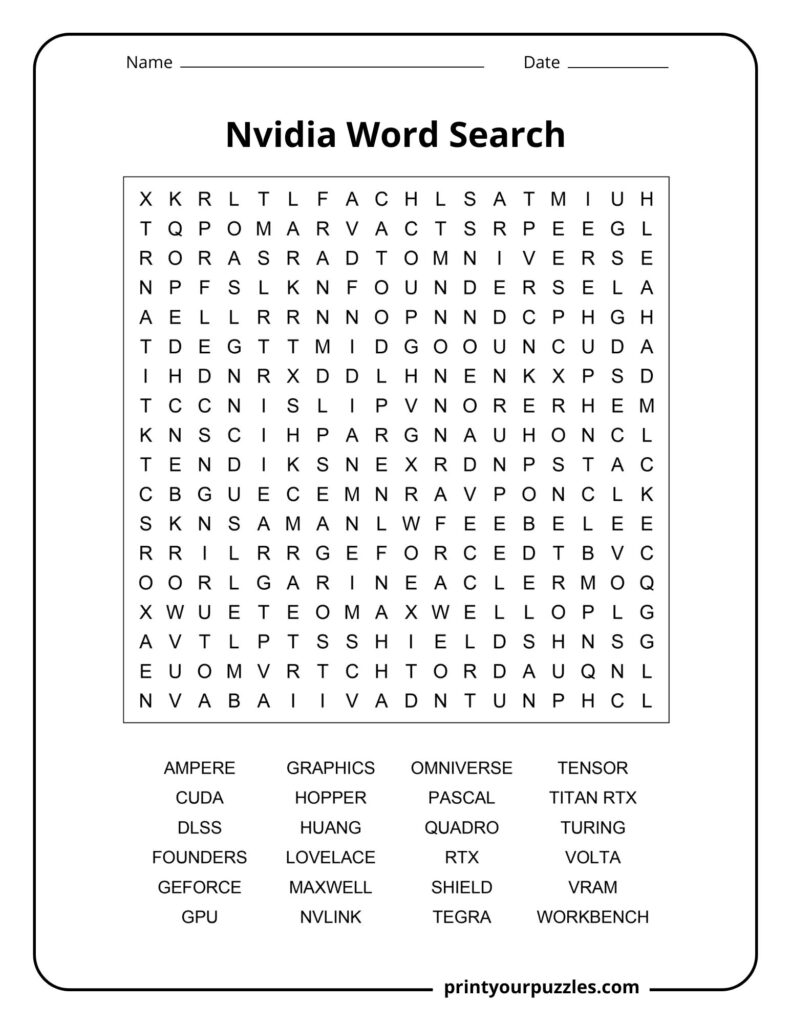
AMPERE, CUDA, DLSS, FOUNDERS, GEFORCE, GPU, GRAPHICS, HOPPER, HUANG, LOVELACE, MAXWELL, NVLINK, OMNIVERSE, PASCAL, QUADRO, RTX, SHIELD, TEGRA, TENSOR, TITAN RTX, TURING, VOLTA, VRAM, WORKBENCH
AMPERE – Named after French physicist André-Marie Ampère, this NVIDIA GPU architecture launched in 2020 powers the RTX 30 series, delivering major leaps in ray tracing and AI performance.
CUDA – Compute Unified Device Architecture, introduced by NVIDIA in 2006, is a parallel computing platform allowing developers to use GPU power for general-purpose processing beyond graphics.
DLSS – Deep Learning Super Sampling uses AI to upscale lower-resolution images in real time, boosting frame rates in games while maintaining high visual quality on RTX GPUs.
FOUNDERS – NVIDIA was founded in 1993 by Jensen Huang, Chris Malachowsky, and Curtis Priem, three engineers who envisioned a future driven by accelerated graphics computing.
GEFORCE – Launched in 1999, GeForce is NVIDIA’s consumer graphics card brand, spanning decades of GPU generations and becoming the world’s most popular discrete graphics platform for gaming.
GPU – Graphics Processing Unit, a specialized processor designed to handle parallel computations rapidly, originally built for rendering graphics but now central to AI, science, and data processing.
GRAPHICS – The core mission of NVIDIA since its founding, graphics acceleration transformed personal computing, enabling realistic visuals in games, professional design, simulation, and film production worldwide.
HOPPER – Named after computing pioneer Grace Hopper, this 2022 NVIDIA architecture powers the H100 GPU, designed specifically for large-scale AI training and high-performance data center workloads.
HUANG – Jensen Huang, NVIDIA’s co-founder and longtime CEO, has led the company since 1993, steering it from a graphics chip startup into a global AI computing powerhouse.
LOVELACE – Named after Ada Lovelace, the pioneering mathematician, this 2022 GPU architecture powers the RTX 40 series, bringing major improvements in efficiency, ray tracing, and AI rendering.
MAXWELL – Introduced in 2014 and named after physicist James Clerk Maxwell, this GPU architecture greatly improved energy efficiency and performance per watt, shaping NVIDIA’s mobile and desktop offerings.
NVLINK – A high-bandwidth GPU interconnect technology developed by NVIDIA that allows multiple GPUs to share memory and communicate far faster than traditional PCIe connections, enabling large AI models.
OMNIVERSE – NVIDIA’s collaborative 3D simulation and design platform, built on Universal Scene Description, enables creators, engineers, and AI agents to work together in shared virtual environments in real time.
PASCAL – Released in 2016 and named after mathematician Blaise Pascal, this GPU architecture introduced the GTX 10 series, achieving breakthrough performance gains and bringing VR-ready graphics to mainstream users.
QUADRO – NVIDIA’s professional GPU brand for workstations, trusted by engineers, architects, and visual effects artists, offering certified drivers, large memory, and precision needed for demanding creative and technical work.
RTX – Ray Tracing Xtreme, introduced with the Turing architecture in 2018, brought real-time ray tracing to consumer GPUs for the first time, simulating realistic light, shadow, and reflections.
SHIELD – NVIDIA SHIELD is a line of Android-based gaming and streaming devices launched in 2013, powered by Tegra chips, designed for portable gaming and home media streaming experiences.
TEGRA – A series of mobile system-on-chip processors by NVIDIA combining CPU, GPU, and memory on one unit, used in smartphones, tablets, automotive systems, and the Nintendo Switch console.
TENSOR – NVIDIA Tensor Cores are specialized processing units inside RTX and data center GPUs that accelerate matrix math operations, dramatically speeding up AI training, inference, and deep learning workloads.
TITAN RTX – Released in 2018, the Titan RTX was NVIDIA’s most powerful consumer GPU at the time, featuring massive memory and Turing architecture cores aimed at creators and AI researchers.
TURING – Named after Alan Turing, this 2018 NVIDIA architecture introduced RTX technology and Tensor Cores to consumer cards for the first time, marking a turning point in real-time rendering.
VOLTA – Launched in 2017 and named after Alessandro Volta, this data center GPU architecture introduced Tensor Cores for deep learning, powering AI research breakthroughs with the V100 accelerator card.
VRAM – Video Random Access Memory is the dedicated high-speed memory on a GPU used to store textures, frame buffers, and other graphics data, directly affecting rendering performance and resolution capability.
WORKBENCH – NVIDIA AI Workbench is a developer tool that simplifies creating, testing, and deploying AI models locally or in the cloud, making advanced AI development accessible and consistent across environments.

AMPERE, CUDA, DLSS, FOUNDERS, GEFORCE, GPU, GRAPHICS, HOPPER, HUANG, LOVELACE, MAXWELL, NVLINK, OMNIVERSE, PASCAL, QUADRO, RTX, SHIELD, TEGRA, TENSOR, TITAN RTX, TURING, VOLTA, VRAM, WORKBENCH
NVIDIA was founded in 1993 by Jensen Huang, Chris Malachowsky, and Curtis Priem, driven by the belief that accelerated graphics computing would transform the personal computer industry.
The RIVA 128, launched in 1997, was NVIDIA’s first major success, delivering fast 3D graphics at an affordable price and establishing the company as a serious GPU competitor.
NVIDIA introduced CUDA in 2006, enabling developers to use GPUs for scientific computing, AI research, and data processing, transforming the company far beyond its gaming origins.
NVIDIA’s GPU architectures — Volta, Hopper, and Ampere — alongside Tensor Cores and the CUDA ecosystem, made their hardware the global standard for training and running AI models.
Explosive demand for AI infrastructure drove NVIDIA’s valuation past three trillion dollars by 2024, making it one of the most valuable publicly traded companies in history.
The Nvidia Way: Jensen Huang and the Making of a Tech Giant by Tae Kim. Kim masterfully traces Nvidia’s improbable journey — from a Denny’s napkin sketch to AI dominance — through 100 interviews, revealing the relentless, contrarian culture that quietly built the world’s most critical chip company.
The company was almost called “NV” internally, standing for “next version,” before the founders settled on NVIDIA, derived from the Latin word invidia, meaning envy.
The NV1, launched in 1995, used an unconventional quadratic rendering approach incompatible with emerging standards, nearly bankrupting the company before the successful RIVA 128 saved it.
Huang has made his signature black leather jacket a personal trademark, wearing it at every keynote and event, turning it into one of tech’s most recognizable style statements.
After investing heavily in Tegra mobile processors for smartphones, NVIDIA lost major contracts to rivals around 2014, pivoting instead toward automotive and AI computing to survive.
Launched in 1999, the GeForce 256 was the first chip NVIDIA marketed as a GPU, coining the term that would define an entire category of computing hardware forever.