
Harriet Tubman’s life tells a powerful story of courage, freedom, and resistance. Born enslaved in Maryland around 1822, she grew up in a world where enslaved people were forced to work, denied basic rights, and separated from family members. Her early life was marked by hardship and violence, but it also helped shape the strength and determination that later made her an important figure in American history.
In 1849, Tubman escaped from slavery and traveled north to freedom. This journey was extremely dangerous, because freedom seekers could be captured and forced back into slavery. Reaching the North gave Tubman safety, but she did not choose to remain there quietly. Instead, she decided to return again and again to help others escape.
Tubman became closely connected with the Underground Railroad, a secret network of routes, safe houses, and helpers used by enslaved people seeking freedom. It was not a real railroad, but many of its terms came from railroad language. People who guided freedom seekers were called “conductors,” and Tubman became the most famous conductor of all.
Her rescue missions required planning, bravery, and secrecy. Tubman returned to the South many times, guiding family members and other enslaved people toward freedom. She faced slave catchers, harsh weather, dangerous travel, and laws such as the Fugitive Slave Act, which made escaping slavery even more difficult. Her courage and determination made her a symbol of hope for many people.
During the Civil War, Tubman also served the Union as a nurse, cook, scout, and spy. She used her knowledge of the land and her ability to move carefully through dangerous areas to help the Union cause. She also helped with the Combahee River Raid in South Carolina, an operation that freed hundreds of enslaved people.
After the Civil War, Tubman continued to serve others and later supported the movement for women’s suffrage. Her legacy connects the history of slavery, abolition, the Civil War, and the long fight for justice and equal rights.
This Harriet Tubman word search helps students review vocabulary connected to freedom, slavery, Underground Railroad, conductor, courage, abolitionist, Maryland, Union, Civil War, and justice. A Harriet Tubman word search can make her remarkable life easier to understand by connecting key terms with her actions, risks, and lasting importance.
Related Word Searches:
Civil War | Emancipation Proclamation | Civil War Women | Abraham Lincoln | Civil Rights Movement | Black History Month
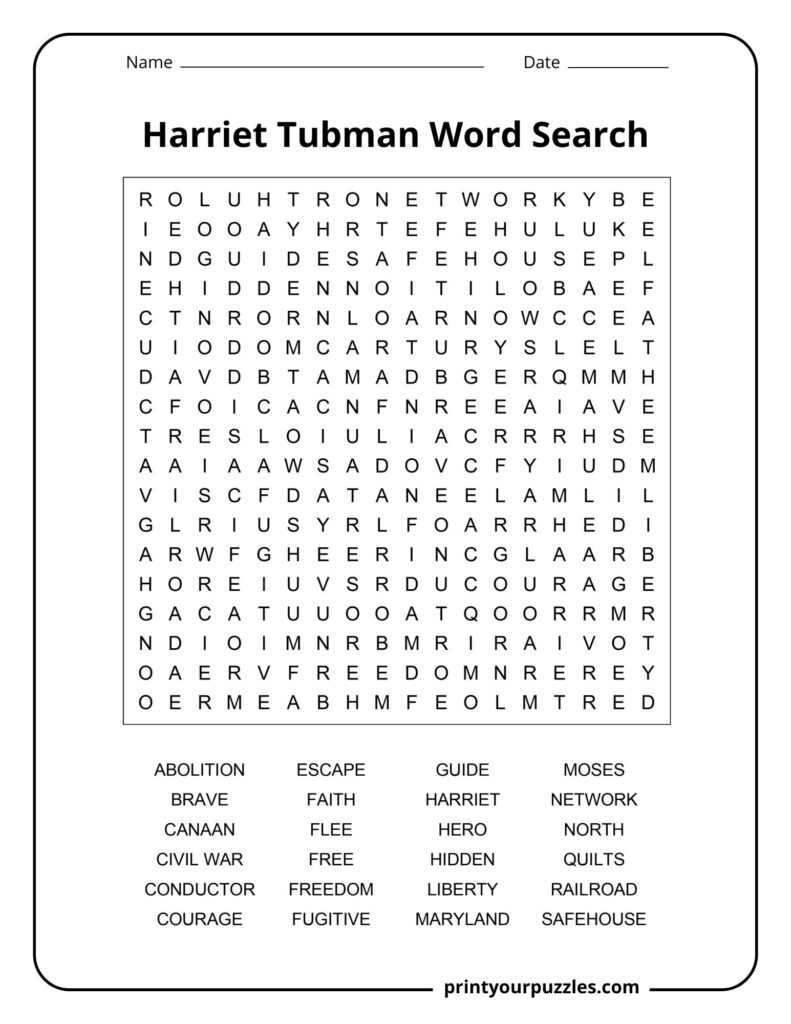
ABOLITION, BRAVE, CANAAN, CIVIL WAR, CONDUCTOR, COURAGE, ESCAPE, FAITH, FLEE, FREE, FREEDOM, FUGITIVE, GUIDE, HARRIET, HERO, HIDDEN, LIBERTY, MARYLAND, MOSES, NETWORK, NORTH, QUILTS, RAILROAD, SAFEHOUSE
ABOLITION – The movement to end slavery in the United States during the 1800s. Harriet Tubman was a key figure who fought tirelessly for the complete elimination of this cruel and inhumane institution.
BRAVE – Harriet Tubman showed extraordinary bravery throughout her life. She risked capture and death repeatedly to rescue enslaved people, never letting fear stop her from doing what was right.
CANAAN – A biblical term used by enslaved people to refer to Canada, the Promised Land of freedom. Many freedom seekers traveled north to Canaan to escape slavery and find safety.
CIVIL WAR – The American conflict fought from 1861 to 1865 between the Union and Confederacy. Harriet Tubman served as a spy, scout, and nurse for the Union Army during this war.
CONDUCTOR – A person who guided enslaved people along the Underground Railroad to freedom. Harriet Tubman was the most famous conductor, leading approximately seventy people to safety over multiple dangerous trips.
COURAGE – The inner strength to face danger despite overwhelming fear. Tubman displayed immense courage by returning to the South multiple times, knowing she could be captured, tortured, or killed.
ESCAPE – Harriet Tubman escaped from slavery in Maryland in 1849, traveling alone through dangerous territory to reach freedom in Pennsylvania. Her successful escape inspired her to help many others.
FAITH – Deep religious belief that guided Harriet Tubman throughout her life. She trusted in God’s protection during her dangerous missions and often spoke of visions and divine guidance leading her path.
FLEE – To run away from danger or captivity. Enslaved people had to flee their plantations secretly at night, traveling through forests and swamps to reach the Underground Railroad and eventual freedom.
FREE – The state of liberty that Harriet Tubman fought to achieve for herself and others. She dedicated her entire life to ensuring that enslaved people could live as free human beings.
FREEDOM – The fundamental right to live without bondage or oppression. Freedom was the driving force behind Tubman’s work on the Underground Railroad and her lifelong activism for equality and justice.
FUGITIVE – An enslaved person who escaped from their owner. Fugitives faced extreme danger because slave catchers actively hunted them, and the Fugitive Slave Act required their return even from free states.
GUIDE – Harriet Tubman served as a guide for enslaved people seeking freedom, leading them through secret routes at night. Her knowledge of the land and stars made her an exceptional navigator.
HARRIET – The first name of Harriet Tubman, born Araminta Ross around 1822 in Maryland. She later chose the name Harriet, possibly in honor of her mother, Harriet Greene Ross.
HERO – A person admired for courage and noble achievements. Harriet Tubman is an American hero who risked everything to fight against slavery and injustice throughout her remarkable and inspiring life.
HIDDEN – Enslaved people had to remain hidden during their journey to freedom, concealed in barns, attics, cellars, and secret rooms. Staying hidden was essential to avoid capture by slave hunters.
LIBERTY – The condition of being free from oppressive restrictions. Harriet Tubman believed every person deserved liberty and spent decades working to secure this basic human right for all enslaved people.
MARYLAND – The eastern shore state where Harriet Tubman was born into slavery. She later returned to Maryland many times to rescue family members and other enslaved people through the Underground Railroad.
MOSES – The nickname given to Harriet Tubman because, like the biblical Moses, she led her people out of bondage to freedom. Enslaved people sang songs about Moses to announce her secret arrivals.
NETWORK – The Underground Railroad was a network of secret routes, safe houses, and abolitionists working together. This organized network helped thousands of enslaved people escape to freedom in the North.
NORTH – The direction enslaved people traveled to reach free states and Canada. Harriet Tubman guided freedom seekers north using the stars, rivers, and secret paths to avoid capture along the way.
QUILTS – Some historians believe quilts with special patterns were hung outside homes to communicate secret messages to escaping enslaved people, indicating safe houses or directions along the Underground Railroad route.
RAILROAD – The Underground Railroad was not an actual railroad but a secret system of routes and safe houses used to help enslaved people escape to freedom in northern states and Canada.
SAFEHOUSE – A secure location along the Underground Railroad where escaping enslaved people could hide, rest, eat, and receive supplies before continuing their dangerous journey northward toward freedom and safety.
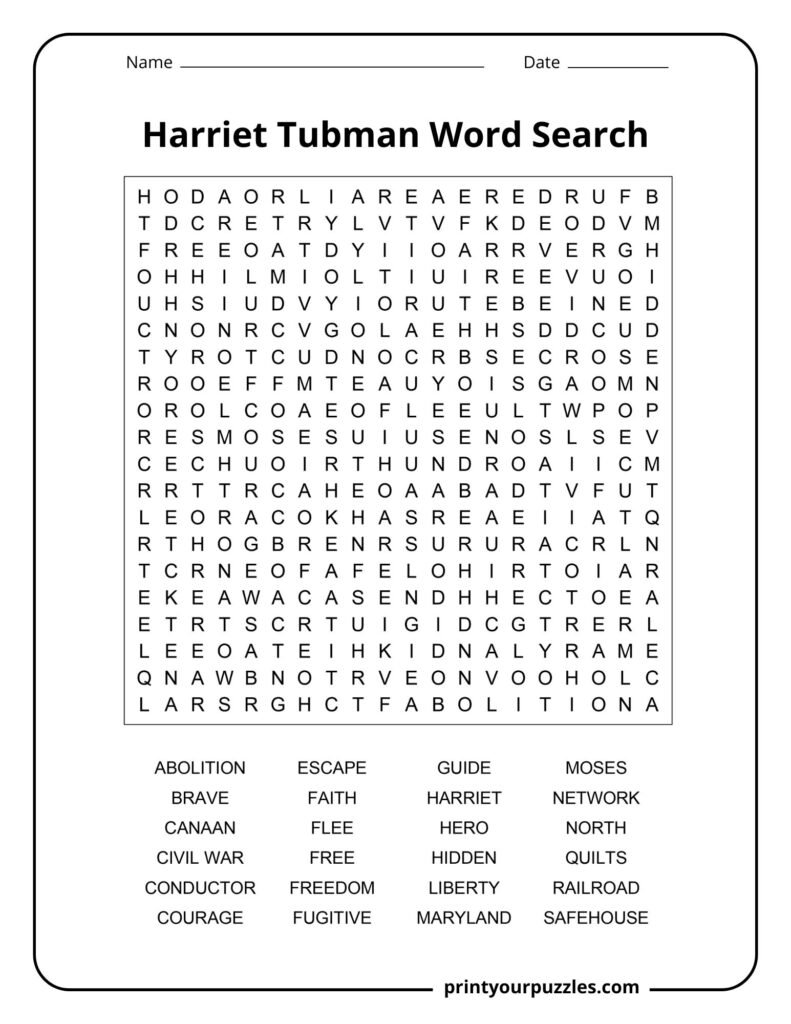
ABOLITION, BRAVE, CANAAN, CIVIL WAR, CONDUCTOR, COURAGE, ESCAPE, FAITH, FLEE, FREE, FREEDOM, FUGITIVE, GUIDE, HARRIET, HERO, HIDDEN, LIBERTY, MARYLAND, MOSES, NETWORK, NORTH, QUILTS, RAILROAD, SAFEHOUSE
Harriet Tubman was an American abolitionist born into slavery around 1822 in Maryland. She escaped and became the most famous conductor of the Underground Railroad, rescuing approximately seventy enslaved people.
The Underground Railroad was a secret network of routes, safe houses, and abolitionists that helped enslaved people escape to freedom in northern states and Canada during the 1800s.
Tubman earned the nickname Moses because, like the biblical figure, she led her people out of bondage. Enslaved people used songs referencing Moses to secretly announce her arrivals.
During the Civil War, Harriet Tubman served the Union Army as a spy, scout, and nurse. She became the first woman to lead an armed military raid in American history.
Tubman is remembered as a symbol of courage and freedom. Her bravery inspired generations of civil rights activists, and she remains one of the most celebrated heroines in American history.
Kate Clifford Larson’s Bound for the Promised Land: Harriet Tubman, Portrait of an American Hero. Larson drew on a trove of new documents and extensive genealogical research to present Tubman as a complex, brilliant, deeply religious woman passionate about freedom. The book is widely regarded by historians as the most rigorously researched modern biography, yet it reads with real narrative momentum.
A slave overseer threw a heavy metal weight that struck her head, causing lifelong seizures, headaches, and vivid dreams that she interpreted as messages from God.
During her approximately thirteen missions on the Underground Railroad, she successfully guided every person to freedom without ever losing anyone under her care and protection.
She gathered crucial intelligence behind Confederate lines and led the Combahee River Raid in 1863, freeing more than seven hundred enslaved people in a single military operation.
Despite her difficult life and health challenges, she lived until 1913, spending her final years in Auburn, New York, where she established a home for elderly African Americans.
She carried a gun for protection against slave catchers and also to discourage any frightened escapees from turning back, as their return could endanger the entire group.