
The California Gold Rush was one of the most important events in the history of the American West. It began after gold was discovered in California in 1848, bringing thousands and then hundreds of thousands of people to the region. Many came with dreams of wealth, adventure, and a better future, hoping that a lucky discovery could change their lives.
The story began in January 1848 at Sutter’s Mill, near Coloma, California. James W. Marshall, a carpenter working for John Sutter, found pieces of gold while helping build a sawmill. At first, Sutter wanted to keep the discovery quiet, but the news spread quickly. By the end of the year, people across the United States and beyond had heard about gold in California.
In 1849, a massive wave of gold seekers arrived. These people became known as the Forty-Niners because so many reached California during that year. They came from the eastern United States, Latin America, Europe, China, and other parts of the world. Some traveled by wagon across the continent, while others sailed around South America or crossed the Isthmus of Panama before continuing by ship to California.
Life in the mining camps was difficult and uncertain. Miners worked long hours in rivers, hills, and muddy camps, using pans, picks, shovels, and sluices to search for gold. Supplies were expensive, housing was rough, and towns could grow almost overnight. Although a few people became rich, many miners found little gold and struggled with hard work, illness, competition, and disappointment.
The Gold Rush changed California very quickly. Its population grew, San Francisco expanded into a major city, and California became a state in 1850. However, the Gold Rush also had serious consequences. Native American communities suffered from violence, disease, displacement, and loss of land. Mining damaged rivers, forests, and landscapes, leaving environmental problems that lasted long after the first discoveries.
This California Gold Rush word search helps students review important vocabulary connected to miners, gold, Forty-Niners, Sutter’s Mill, migration, rivers, tools, camps, and statehood. A California Gold Rush word search can make this dramatic chapter of American history easier to understand by connecting key words with the causes, events, and consequences of the Gold Rush.
Related Word Searches:
Westward Expansion | Oregon Trail | Manifest Destiny | Transcontinental Railroad | Mexican-American War | Abraham Lincoln
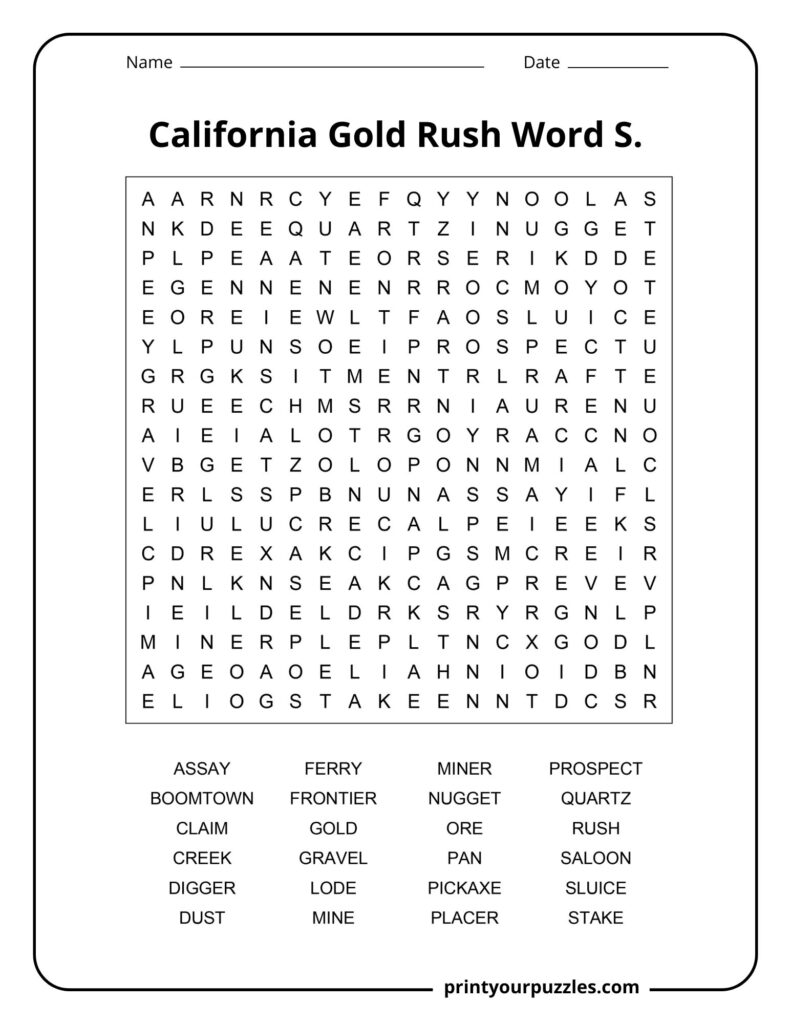
ASSAY, BOOMTOWN, CLAIM, CREEK, DIGGER, DUST, FERRY, FRONTIER, GOLD, GRAVEL, LODE, MINE, MINER, NUGGET, ORE, PAN, PICKAXE, PLACER, PROSPECT, QUARTZ, RUSH, SALOON, SLUICE, STAKE
ASSAY – A chemical test performed to determine the purity and quality of gold or other precious metals found by miners, ensuring the value of their discoveries before selling or trading them.
BOOMTOWN – A town that grew rapidly due to sudden economic activity, especially gold mining. Many California boomtowns appeared overnight and disappeared just as quickly when gold ran out.
CLAIM – A designated piece of land that a miner legally registered as their own to search for gold. Jumping another person’s claim was considered a serious offense in mining camps.
CREEK – A small stream where miners often searched for gold deposits. Creeks carried gold particles downstream from mountain sources, making them popular spots for panning and placer mining.
DIGGER – A term used to describe miners who dug into the earth searching for gold. Diggers worked long, exhausting hours in harsh conditions hoping to strike it rich in California.
DUST – Fine particles of gold found in riverbeds and streams. Gold
dust was so common during the rush that it was often used as currency in stores, saloons, and trading posts.
FERRY – A boat service used to transport miners and supplies across rivers. Ferries became profitable businesses during the Gold Rush, as thousands of people needed to cross waterways to reach mining areas.
FRONTIER – The edge of settled territory in the American West. The California Gold Rush pushed the frontier further westward, attracting adventurers and settlers to previously unexplored and undeveloped lands.
GOLD – The precious yellow metal that sparked the massive migration to California beginning in 1848. Its discovery at Sutter’s Mill triggered one of the largest mass movements in American history.
GRAVEL – Loose rocks and sediment found in riverbeds where gold often settled. Miners sifted through enormous amounts of gravel daily, searching for valuable gold flakes and nuggets hidden within.
LODE – A vein of gold or other metal embedded within solid rock underground. Finding a lode meant potentially striking a rich deposit, though extracting it required more advanced mining equipment.
MINE – An excavation site where miners dug into the earth to extract gold. Mines ranged from simple hand-dug holes to complex underground tunnel systems requiring significant labor and investment.
MINER – A person who searched for and extracted gold from the earth. Miners came from all over the world to California, leaving families and homes behind in pursuit of fortune and opportunity.
NUGGET – A solid lump of gold found in streams or underground deposits. Nuggets varied greatly in size, and discovering a large one could instantly make a miner wealthy beyond their dreams.
ORE – Natural rock or sediment containing gold or other valuable minerals. Ore had to be processed and refined to separate the precious metal from the surrounding worthless rock material.
PAN – A shallow metal dish used to separate gold from sand and gravel in streams. Panning was the simplest and cheapest method of mining, requiring only water, patience, and a steady hand.
PICKAXE – A hand tool with a pointed metal head used by miners to break apart hard rock and earth. It was one of the most essential and recognizable tools of the Gold Rush era.
PLACER – A type of mining that involves extracting gold from surface deposits in riverbeds and streams using water. Placer mining was the most common technique used by individual miners during the rush.
PROSPECT – To search an area for gold or other valuable minerals. Prospectors explored rivers, hills, and valleys across California, testing the soil and water for signs of hidden gold deposits.
QUARTZ – A hard mineral rock that often contained veins of gold within it. Quartz mining required crushing the rock to extract gold, which demanded heavy machinery and greater financial investment.
RUSH – The massive surge of people migrating to California after gold was discovered in 1848. The Gold Rush brought hundreds of thousands of people seeking wealth, forever transforming the American West.
SALOON – A bar or tavern found in mining towns where miners gathered to drink, gamble, and socialize. Saloons were central gathering places and often the heart of social life in boomtowns.
SLUICE – A long wooden channel through which water flows to separate gold from dirt and gravel. Sluice boxes made mining more efficient than simple panning, allowing miners to process more material.
STAKE – To mark and register a piece of land as a mining claim. Staking a claim gave a miner the legal right to work that area and extract any gold found within its boundaries.
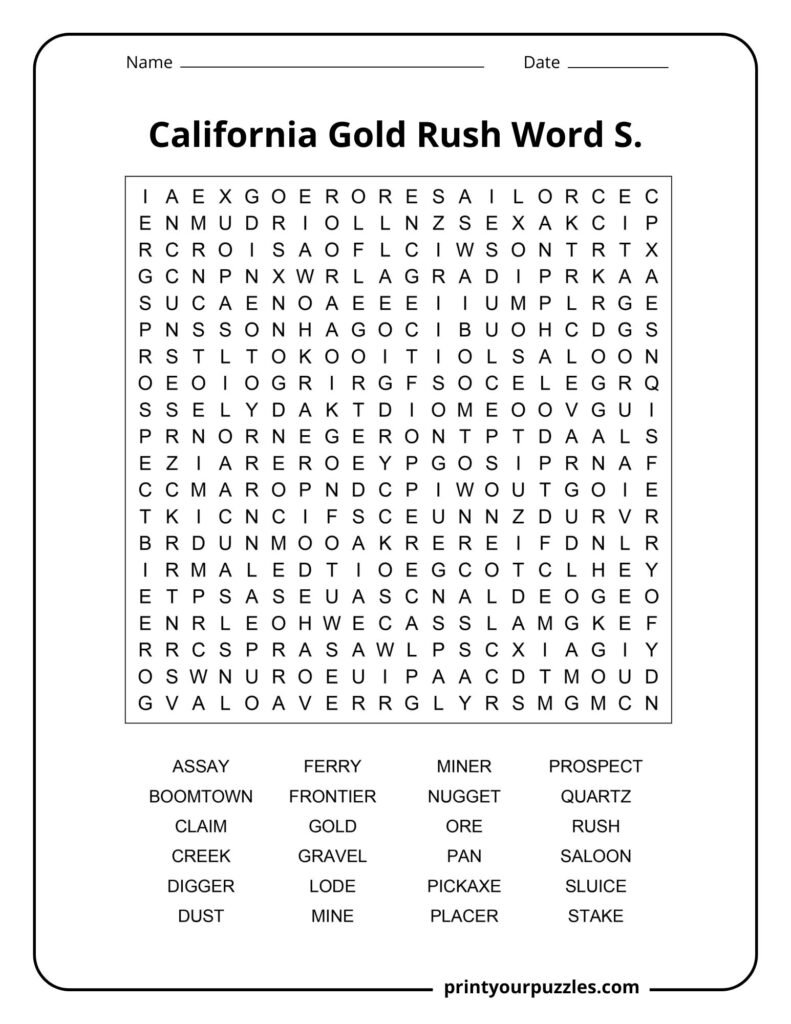
ASSAY, BOOMTOWN, CLAIM, CREEK, DIGGER, DUST, FERRY, FRONTIER, GOLD, GRAVEL, LODE, MINE, MINER, NUGGET, ORE, PAN, PICKAXE, PLACER, PROSPECT, QUARTZ, RUSH, SALOON, SLUICE, STAKE
The California Gold Rush began on January 24, 1848, when James W. Marshall discovered gold at Sutter’s Mill in Coloma, California, sparking a massive wave of migration westward.
The Forty-Niners were the thousands of prospectors and adventurers who traveled to California in 1849 seeking fortune. They came from across the United States and many other countries worldwide.
California’s population exploded from around 14,000 non-native residents in 1848 to over 300,000 by 1855. This rapid growth helped California achieve statehood in 1850, just two years later.
Miners used various techniques including panning, sluice boxes, and placer mining for surface gold. As easily accessible gold diminished, hydraulic and hard rock mining methods became increasingly common.
The Gold Rush gradually declined in the mid-1850s as surface gold became scarce and mining required expensive industrial equipment. By 1857, the era of individual prospectors had essentially ended.
Entrepreneurs like Levi Strauss and Samuel Brannan made fortunes selling supplies, tools, and clothing to miners rather than searching for gold themselves, proving business was more reliable.
Prices skyrocketed in mining towns due to extreme demand. Basic goods like eggs, shovels, and boots were sold at outrageous prices, making daily survival incredibly expensive for miners.
James Marshall found gold while building a sawmill for John Sutter. Ironically, Sutter tried to keep the discovery secret because he feared losing control of his vast land empire.
The Gold Rush attracted people from China, Europe, South America, Australia, and beyond. San Francisco became one of the most culturally diverse cities in the world almost overnight.
Despite dreams of fortune, the vast majority of miners earned very little or went broke. Many ended up working for wages in larger mining operations or abandoned mining altogether.