The Treaty of Paris, signed in 1783, officially ended the Revolutionary War and confirmed the independence of the United States from Great Britain. The agreement marked the conclusion of a conflict that had begun in 1775, when the thirteen American colonies rebelled against British rule. After years of fighting, the American victory at Yorktown in 1781 convinced British leaders that continuing the war would be costly and unlikely to succeed.
Peace negotiations took place in Paris and involved American representatives Benjamin Franklin, John Adams, and John Jay. They negotiated with British officials to establish the terms of peace and define the future relationship between the two countries. The preliminary agreement was completed in 1782, while the final Treaty of Paris was signed on September 3, 1783.
One of the treaty’s most important provisions was Britain’s formal recognition of the United States as a free, sovereign, and independent nation. The agreement also established new national boundaries. The United States gained territory extending from the Atlantic Ocean to the Mississippi River and from the Great Lakes south toward Spanish Florida. This gave the young nation a much larger area than the original thirteen states.
The treaty addressed several other important matters. American fishermen received access to fishing grounds near Canada, while both sides agreed that private debts made before the war should still be paid. The United States also promised to encourage state governments to return property that had been taken from Loyalists, colonists who had remained faithful to Britain. However, this promise was not always carried out.
Although the Treaty of Paris ended the war, it did not solve every disagreement between Britain and the United States. British troops remained in some western forts, and disputes continued over trade, borders, and Loyalist property. These issues created tension during the early years of the new nation.
A printable Treaty of Paris word search can help students become familiar with important terms such as independence, boundaries, Franklin, Loyalists, territory, Britain, and peace. Understanding this vocabulary makes it easier to see how the treaty ended the Revolutionary War, expanded American lands, and established the United States as an independent country.
Related Word Searches:
Revolutionary War | Declaration of Independence | Founding Fathers | Benjamin Franklin | George Washington | Thomas Jefferson
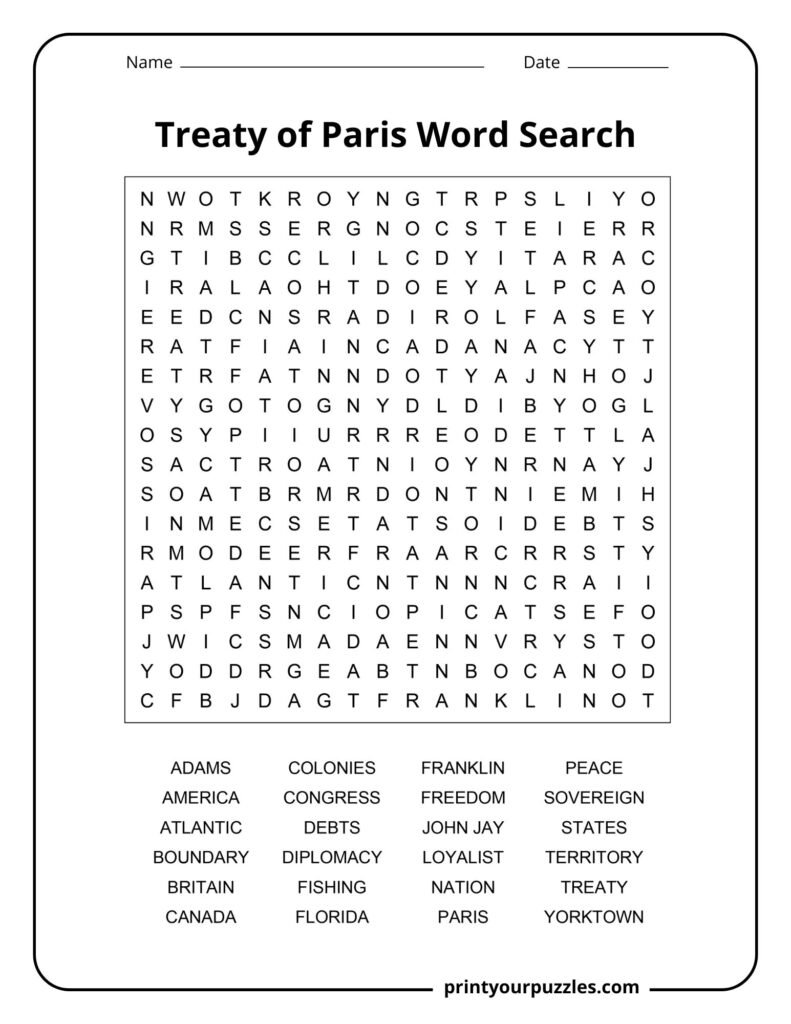
ADAMS, AMERICA, ATLANTIC, BOUNDARY, BRITAIN, CANADA, COLONIES, CONGRESS, DEBTS, DIPLOMACY, FISHING, FLORIDA, FRANKLIN, FREEDOM, JOHN JAY, LOYALIST, NATION, PARIS, PEACE, SOVEREIGN, STATES, TERRITORY, TREATY, YORKTOWN
ADAMS – American diplomat John Adams helped negotiate the treaty, protecting United States interests and supporting favorable terms for independence, territory, fishing rights, lasting peace, and national sovereignty.
AMERICA – The newly independent United States of America gained international recognition through the treaty, ending British claims of political authority over the former thirteen American colonies forever.
ATLANTIC – The Atlantic Ocean formed the eastern boundary of the United States, while the treaty extended American territory westward as far as the distant Mississippi River.
BOUNDARY – The treaty established important national boundaries, giving the United States land from the Atlantic Ocean to the Mississippi River and from Canada toward Spanish Florida.
BRITAIN – Great Britain formally recognized American independence, agreed to end hostilities, and accepted the new national borders after losing its thirteen colonies in the Revolutionary War.
CANADA – Canada remained under British control, while Americans received fishing rights in nearby waters, including access to valuable fishing grounds off Newfoundland and Labrador.
COLONIES – The thirteen colonies had rebelled against British rule and became independent states after the treaty officially confirmed their freedom and ended the long Revolutionary War.
CONGRESS – The Confederation Congress ratified the Treaty of Paris in January 1784, formally approving the historic peace agreement negotiated between American representatives and Great Britain.
DEBTS – The treaty stated that lawful debts owed to British creditors before the war should still be paid, despite the conflict and major changes in national government.
DIPLOMACY – Diplomacy allowed American and British representatives to negotiate peace, settle national boundaries, discuss financial obligations, and establish official relations after many years of military conflict.
FISHING – American fishermen received valuable rights to operate in waters near Canada, including traditional fishing areas off Newfoundland and within the Gulf of Saint Lawrence.
FLORIDA – Florida remained under Spanish control after the war, forming part of the southern boundary of the newly recognized United States under the treaty’s territorial terms.
FRANKLIN – Benjamin Franklin served as a leading American negotiator in Paris, using his diplomatic experience and international reputation to help secure highly favorable peace terms.
FREEDOM – The treaty confirmed the political freedom of the United States, allowing the new nation to govern itself without control from the British monarchy or Parliament.
JOHN JAY – John Jay was an American peace negotiator who insisted on direct talks with Britain and helped secure independence, western territory, and favorable national boundary terms.
LOYALIST – A Loyalist supported Britain during the Revolution; the treaty recommended restoring confiscated property, although many American state governments refused to fully follow this provision.
NATION – The treaty established the United States as an independent nation, recognized by Britain and able to control its government, territory, laws, economy, and international relationships.
PARIS – Paris was the city where American and British representatives negotiated and signed the final peace treaty on September 3, 1783, officially ending the Revolutionary War.
PEACE – Peace officially replaced armed conflict when the treaty ended the Revolutionary War, recognized American independence, and created agreements concerning borders, debts, property, and fishing rights.
SOVEREIGN – The word sovereign described the United States as fully independent, possessing complete authority to govern its people and territory without interference from Great Britain.
STATES – The former colonies became the United States, a new country whose independence, national borders, and political authority were formally recognized by Britain in the agreement.
TERRITORY – The treaty greatly expanded American territory west to the Mississippi River, providing land that would later support settlement, new states, agriculture, trade, and national growth.
TREATY – A treaty is a formal agreement between nations; this one ended the Revolutionary War and defined independence, boundaries, debts, property issues, peace, and fishing rights.
YORKTOWN – The American and French victory at Yorktown in 1781 defeated a major British army and encouraged Britain to begin serious negotiations for peace and American independence.
ADAMS, AMERICA, ATLANTIC, BOUNDARY, BRITAIN, CANADA, COLONIES, CONGRESS, DEBTS, DIPLOMACY, FISHING, FLORIDA, FRANKLIN, FREEDOM, JOHN JAY, LOYALIST, NATION, PARIS, PEACE, SOVEREIGN, STATES, TERRITORY, TREATY, YORKTOWN