
The Revolutionary War was the conflict between the thirteen American colonies and Great Britain that lasted from 1775 to 1783. It began as a struggle over British control, colonial rights, and self-government, and it ended with the creation of the United States as an independent nation.
The causes of the war had been growing for many years. After the French and Indian War, Britain wanted the colonies to help pay its debts through new taxes and trade laws. Many colonists argued that these laws were unfair because they had no elected representatives in the British Parliament. The phrase “no taxation without representation” became a powerful expression of colonial anger.
Before open fighting began, protests and conflicts increased across the colonies. The Stamp Act, Boston Massacre, Boston Tea Party, and Intolerable Acts all raised tensions between Britain and the colonists. Some colonists became Patriots who supported independence, while others remained Loyalists who wanted to stay connected to Britain.
The war began in April 1775 with the battles of Lexington and Concord in Massachusetts. These first clashes showed that the conflict had moved from protest to armed resistance. Soon after, the Continental Congress organized the Continental Army and chose George Washington as its commander.
In 1776, the colonies took a major step by adopting the Declaration of Independence. This document explained why the colonies believed they had the right to separate from Great Britain. It also gave the war a clearer purpose: not only resistance to British policies, but the creation of a new nation based on liberty and self-government.
The Revolutionary War included many difficult battles and turning points. Bunker Hill showed that colonial forces could challenge the British. Saratoga became especially important because it helped convince France to support the American cause. French soldiers, ships, money, and supplies later became essential to victory. In 1781, the American and French victory at Yorktown became the final major military defeat for Britain.
The war officially ended with the Treaty of Paris in 1783, when Britain recognized American independence.
Students can use this Revolutionary War word search to review key vocabulary such as independence, colonies, Britain, Washington, Patriots, Loyalists, battles, Yorktown, treaty, and liberty. These words help connect the causes of the conflict, the people involved, the major turning points, and the consequences that led to the birth of the United States.
Related Word Searches:
Declaration of Independence | Founding Fathers | Boston Tea Party | George Washington | Benjamin Franklin | Thomas Jefferson
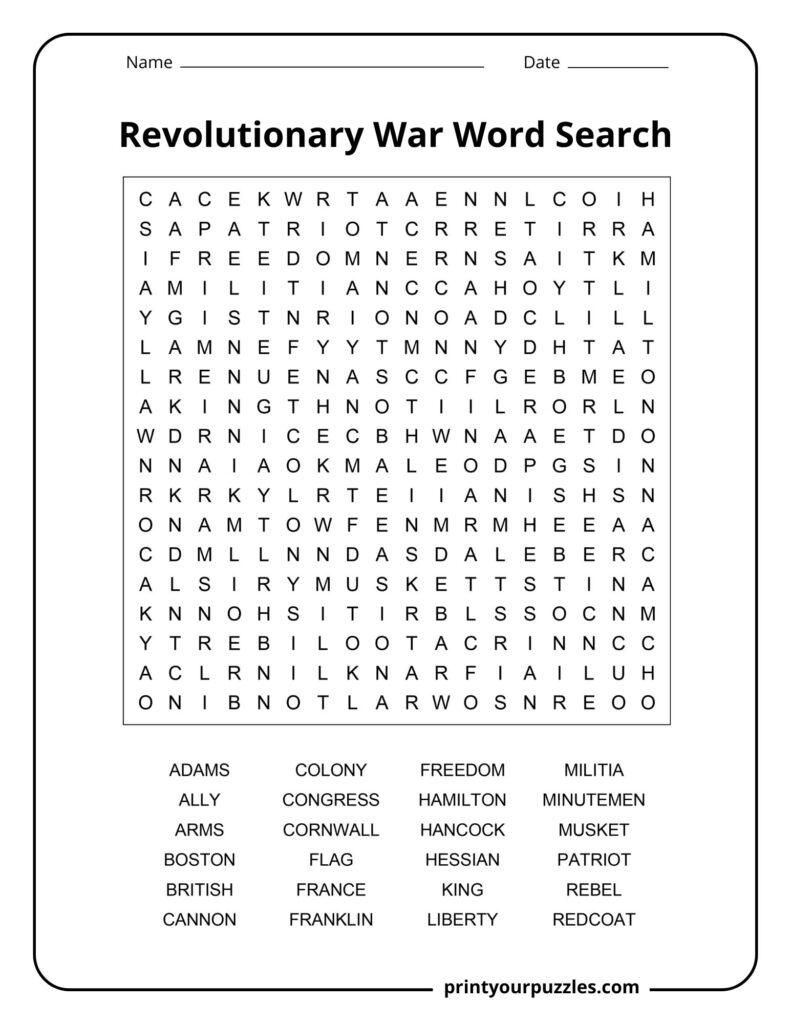
ADAMS, ALLY, ARMS, BOSTON, BRITISH, CANNON, COLONY, CONGRESS, CORNWALL, FLAG, FRANCE, FRANKLIN, FREEDOM, HAMILTON, HANCOCK, HESSIAN, KING, LIBERTY, MILITIA, MINUTEMEN, MUSKET, PATRIOT, REBEL, REDCOAT
ADAMS – John Adams was a Founding Father, key advocate for independence, and the second President of the United States. He helped draft important diplomatic treaties during the Revolutionary War period.
ALLY – A nation or group that supports another in conflict. France became America’s most important ally, providing troops, naval power, and crucial financial aid to the colonial cause.
ARMS – Weapons and military equipment used by soldiers in
battle. Colonists relied on muskets, bayonets, and cannons, often facing shortages of arms and ammunition throughout the war.
BOSTON – A major colonial city in Massachusetts and a center of revolutionary activity. It witnessed key events like the Boston Massacre, the Boston Tea Party, and the British siege.
BRITISH – Referring to Great Britain, the ruling power over the thirteen American colonies. The British army, known as Redcoats, fought to maintain control over colonial territories during the war.
CANNON – A large, heavy artillery weapon that fired iron balls across battlefields and into fortifications. Cannons played decisive roles in sieges and major engagements throughout the Revolutionary War.
COLONY – A territory governed by a distant country. The thirteen British colonies along America’s eastern seaboard united against British rule, eventually declaring independence and forming a new nation.
CONGRESS – The Continental Congress was the governing body of the united colonies. It coordinated the war effort, appointed George Washington as commander, and adopted the Declaration of Independence in 1776.
CORNWALL – Short reference to Lord Cornwallis, the prominent British general. His surrender at the Siege of Yorktown in 1781 effectively ended major combat operations in the American Revolutionary War.
FLAG – A symbol representing a nation or military unit. The early American flag, featuring stars and stripes, became a powerful symbol of unity and independence for the revolutionary cause.
FRANCE – A European nation that became America’s crucial military ally. France provided soldiers, warships, weapons, and money, and its intervention proved decisive in achieving American
victory at Yorktown.
FRANKLIN – Benjamin Franklin was a Founding Father, diplomat, and scientist. As ambassador to France, he successfully secured the French alliance, which was essential to winning American independence.
FREEDOM – The core ideal driving the American Revolution. Colonists fought for freedom from British taxation without representation, seeking self-governance and the protection of individual natural rights.
HAMILTON – Alexander Hamilton served as a young artillery officer and aide to General Washington. After the war, he became the first Secretary of the Treasury and a key Founding Father.
HANCOCK – John Hancock was president of the Continental Congress and the first to sign the Declaration of Independence. His famously large signature became a symbol of American defiance against Britain.
HESSIAN – German mercenary soldiers hired by Britain to fight against the American colonists. Thousands of Hessians served during the war, and many were captured at the Battle of Trenton in 1776.
KING – King George III of Britain ruled during the Revolution. Colonists blamed him for tyrannical policies, and the Declaration of Independence directly listed grievances against his oppressive governance.
LIBERTY – A fundamental principle of the Revolution, meaning the right to self-determination. The cry of liberty inspired colonists to resist British control and fight for an independent democratic republic.
MILITIA – Civilian soldiers who volunteered to fight, often with minimal training. Local militias formed the backbone of early colonial resistance before the Continental Army was formally established.
MINUTEMEN – Elite members of colonial militias ready to fight at a minute’s notice. They famously engaged British troops at the Battles of Lexington and Concord, sparking the Revolutionary War in 1775.
MUSKET – A muzzle-loaded, smoothbore firearm used as the standard infantry weapon during the era. Soldiers on both sides carried muskets, which required reloading after each individual shot fired.
PATRIOT – A colonist who supported independence from Britain. Patriots organized protests, joined militias, and fought against British forces, risking their lives and property for the revolutionary cause.
REBEL – A term used by the British to describe American colonists who rose up against royal authority. The rebels challenged the world’s most powerful empire and ultimately won their independence.
REDCOAT – A nickname for British soldiers, derived from their distinctive red uniform jackets. Redcoats were professional, well-trained troops who fought throughout the colonies during the entire war.
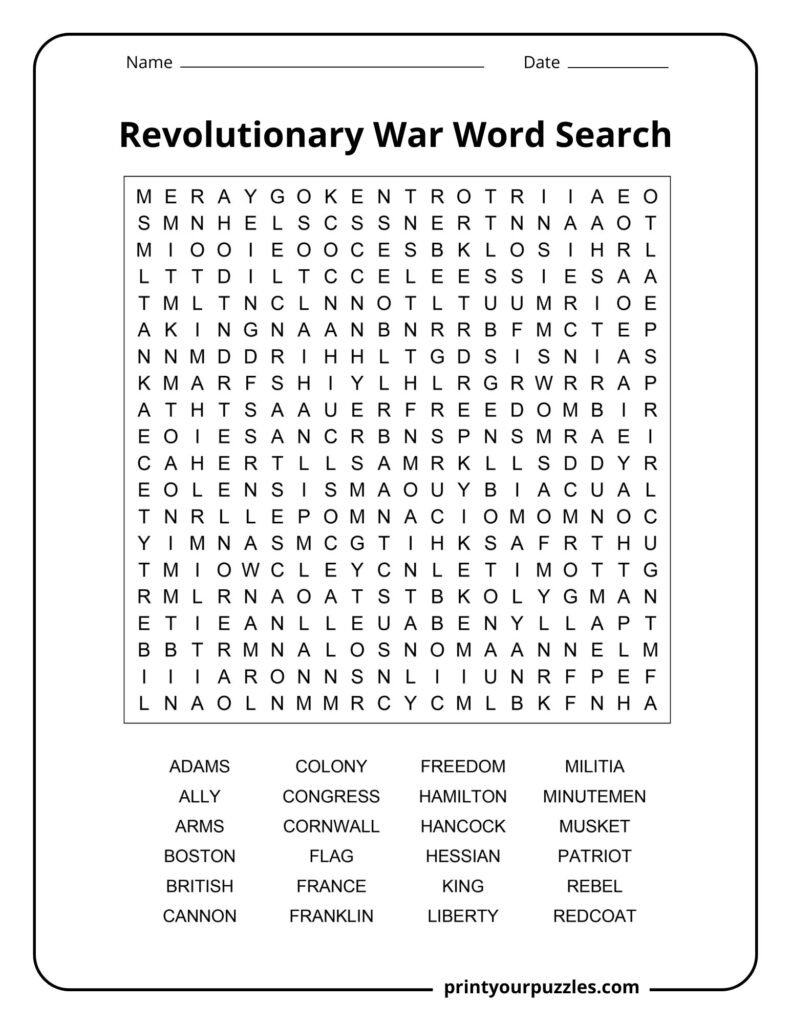
ADAMS, ALLY, ARMS, BOSTON, BRITISH, CANNON, COLONY, CONGRESS, CORNWALL, FLAG, FRANCE, FRANKLIN, FREEDOM, HAMILTON, HANCOCK, HESSIAN, KING, LIBERTY, MILITIA, MINUTEMEN, MUSKET, PATRIOT, REBEL, REDCOAT
The colonists opposed British taxation without representation, restrictive trade laws, and lack of self-governance. Growing tensions after events like the Boston Massacre and Tea Party ultimately ignited armed conflict.
The war began on April 19, 1775, with the Battles of Lexington and Concord in Massachusetts. It officially ended with the Treaty of Paris, signed on September 3, 1783.
George Washington commanded the Continental Army. Benjamin Franklin secured the French alliance. Thomas Jefferson drafted the Declaration of Independence. John Adams and Alexander Hamilton also played vital roles.
France provided essential military support, including troops, warships, weapons, and funding. French naval superiority at Yorktown in 1781 trapped Cornwallis and forced the decisive British surrender ending the war.
The thirteen colonies won independence from Britain, establishing the United States of America. The war inspired democratic movements worldwide and led to the creation of the U.S. Constitution in 1787.
Illnesses like smallpox, typhus, and dysentery killed approximately twice as many soldiers as combat. Unsanitary camp conditions and lack of medical knowledge made disease the deadliest enemy.
That famous story was invented by biographer Mason Weems after Washington’s death to illustrate his honesty. It became one of America’s most beloved and enduring myths.
Deborah Sampson enlisted under the name Robert Shurtliff and served for over a year before being discovered. Several other women also secretly joined the Continental Army.
Many teenagers fought in the Revolution. The Marquis de Lafayette, the famous French officer, was just nineteen when he joined Washington’s army and became a trusted military leader.
After capturing New York and Philadelphia, British commanders missed key opportunities to destroy Washington’s weakened army. Strategic hesitation and overconfidence allowed the Continental forces to survive and regroup.