
Benjamin Franklin’s life connects many important parts of early American history. He is remembered as a Founding Father, but his influence went far beyond politics. Franklin was also a printer, writer, inventor, scientist, diplomat, and public thinker. His curiosity and energy helped him become one of the best-known Americans of the 18th century, and his ideas continue to be studied today.
Franklin began his career in the world of printing and writing. He became famous for publishing newspapers and for creating “Poor Richard’s Almanack”, a popular yearly publication filled with practical advice, humor, and memorable sayings. Through his writing, Franklin encouraged values such as hard work, thrift, learning, and common sense. These ideas made him an influential voice in colonial America.
He was also deeply interested in science and invention. Franklin studied electricity and became famous for his experiments, including his work connected to lightning. His inventions included the lightning rod, bifocals, and the Franklin stove. These creations showed his ability to solve everyday problems with practical ideas.
As a Founding Father, Benjamin Franklin played a major role in the birth of the United States. He supported colonial unity, helped shape the movement for independence, and became one of the most respected voices of the American Revolution. Franklin helped draft the Declaration of Independence, signed the Treaty of Paris that ended the Revolutionary War, and later took part in the Constitutional Convention. Few people were connected to so many key moments in the creation of the nation.
Franklin was also an important diplomat. While in France, he helped gain French support for the American colonies, which became a key factor in the fight against Britain. His intelligence, humor, and reputation made him an effective representative of the American cause.
This Benjamin Franklin Word Search gives students a fun way to explore the life of a man who connected history, science, writing, and public service. As they look for words related to Franklin’s inventions, ideas, writings, and political achievements, they can better understand why he remains such an important figure.
Using a Benjamin Franklin word search is also a helpful classroom activity for learning vocabulary about the American Revolution, early United States history, scientific discovery, and civic responsibility.
Related Word Searches:
Founding Fathers | Declaration of Independence | Bill of Rights | Boston Tea Party | George Washington | Thomas Jefferson
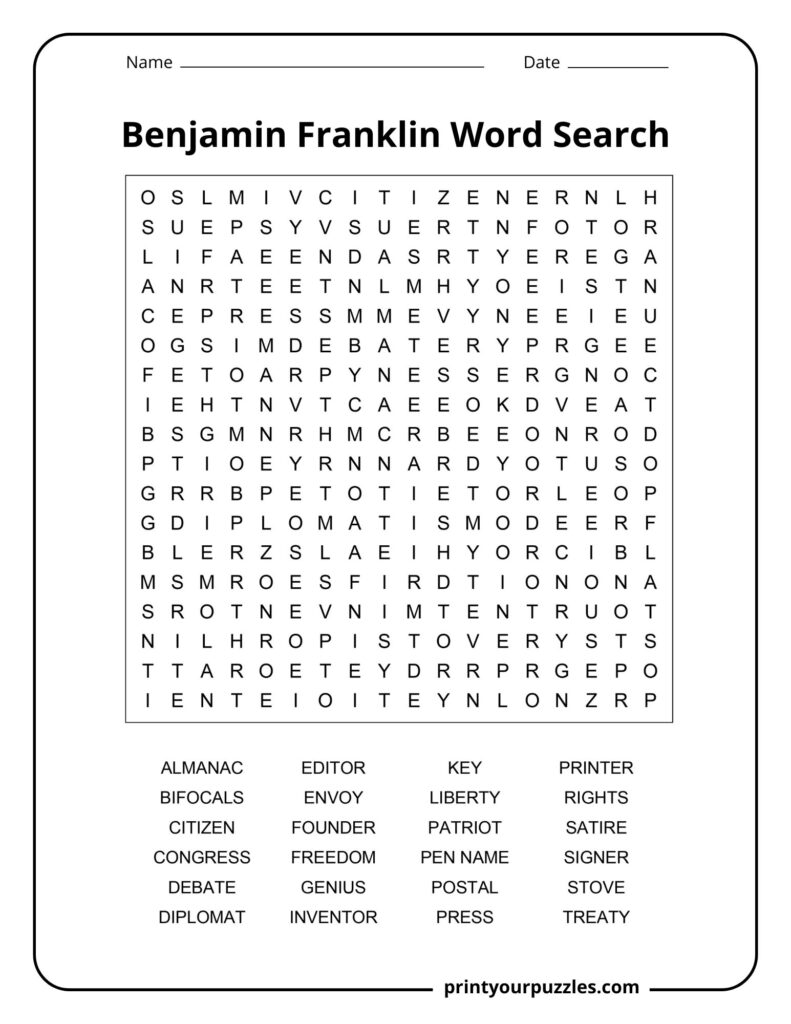
ALMANAC, BIFOCALS, CITIZEN, CONGRESS, DEBATE, DIPLOMAT, EDITOR, ENVOY, FOUNDER, FREEDOM, GENIUS, INVENTOR, KEY, LIBERTY, PATRIOT, PEN NAME, POSTAL, PRESS, PRINTER, RIGHT, SATIRE, SIGNER, STOVE, TREATY
ALMANAC – Franklin published Poor Richard’s Almanack annually from 1732 to 1758, filled with weather forecasts, practical advice, puzzles, and witty proverbs that became famous throughout the American colonies and beyond.
BIFOCALS – Franklin invented these dual-lens eyeglasses around 1784, combining distance and reading lenses into one frame so he wouldn’t need to constantly switch between two separate pairs of glasses.
CITIZEN – Franklin was a model civic leader in Philadelphia, founding institutions like the first public library, a fire company, and a hospital, always working to improve community life for ordinary citizens.
CONGRESS – Franklin served as a delegate to the Continental Congress, helping draft the Declaration of Independence and later representing Pennsylvania at the Constitutional Convention in 1787 as its eldest member.
DEBATE – Franklin was a skilled debater and persuasive communicator whose reasoned arguments influenced major political decisions during the founding era, including crucial compromises at the Constitutional Convention that shaped American governance.
DIPLOMAT – Franklin served as America’s most important diplomat in France, securing the critical military alliance and financial support that proved essential to winning the Revolutionary War against Britain.
EDITOR – Franklin owned and edited the Pennsylvania Gazette, transforming it into the colonies’ most influential newspaper through sharp writing, bold opinions, and innovative use of illustrations and editorial cartoons.
ENVOY – Franklin acted as colonial envoy to London for many years before independence, representing Pennsylvania and other colonies’ interests before Parliament and the British Crown during growing tensions.
FOUNDER – Franklin is one of the few Founding Fathers who signed all three major documents: the Declaration of Independence, the Treaty of Paris, and the United States Constitution, cementing his unique legacy.
FREEDOM – Franklin championed freedom of speech, press, and religion throughout his life, believing these liberties were essential foundations for a democratic society and necessary for human progress and happiness.
GENIUS – Franklin was a true polymath whose brilliance spanned science, politics, writing, and invention. His intellectual curiosity and practical creativity made him one of the most admired minds of the Enlightenment era.
INVENTOR – Beyond bifocals, Franklin invented the lightning rod, the Franklin stove, swim fins, and a glass armonica. He never patented his inventions, believing they should freely benefit everyone.
KEY – Franklin famously used a key attached to a kite string during a 1752 thunderstorm experiment, demonstrating that lightning was electrical in nature, which led to his invention of the lightning rod.
LIBERTY – Franklin dedicated his later years to the cause of American liberty, arguing passionately for colonial independence from Britain and later advocating for the abolition of slavery before his death in 1790.
PATRIOT – Though initially loyal to Britain, Franklin became a devoted patriot after witnessing Parliament’s contempt for colonial rights, ultimately risking his reputation and safety to support American independence.
PEN NAME – Franklin wrote under many pen names, including Richard Saunders and Silence Dogood. These pseudonyms allowed him to express controversial opinions, satirize society, and entertain readers with distinct fictional personas.
POSTAL – Franklin served as Postmaster General for the colonies, dramatically improving mail delivery speed and efficiency by establishing new routes, regular schedules, and better accounting practices across the postal system.
PRESS – Franklin was a master printer who understood the printing press’s power to shape public opinion. He built a publishing empire and championed press freedom as vital to democratic society.
PRINTER – Franklin apprenticed as a printer under his brother James, eventually becoming Philadelphia’s leading printer. This trade gave him financial independence and a platform to influence colonial public discourse.
RIGHTS – Franklin fought to protect individual rights throughout his career, helping draft documents that enshrined fundamental freedoms and arguing that government must exist to serve and protect the people’s natural rights.
SATIRE – Franklin was a gifted satirist who used humor and irony to criticize British policies, social hypocrisy, and political foolishness. His satirical essays were widely read and admired on both sides of the Atlantic.
SIGNER – Franklin signed the Declaration of Independence at age seventy, reportedly quipping that the delegates must all hang together or they would surely hang separately, highlighting the personal danger they faced.
STOVE – Franklin invented the Franklin stove around 1742, an iron fireplace insert that heated rooms more efficiently while using less wood and producing less smoke than traditional open fireplaces common at the time.
TREATY – Franklin negotiated the 1783 Treaty of Paris, which formally ended the Revolutionary War and secured British recognition of American independence, representing one of the greatest diplomatic achievements in American history.
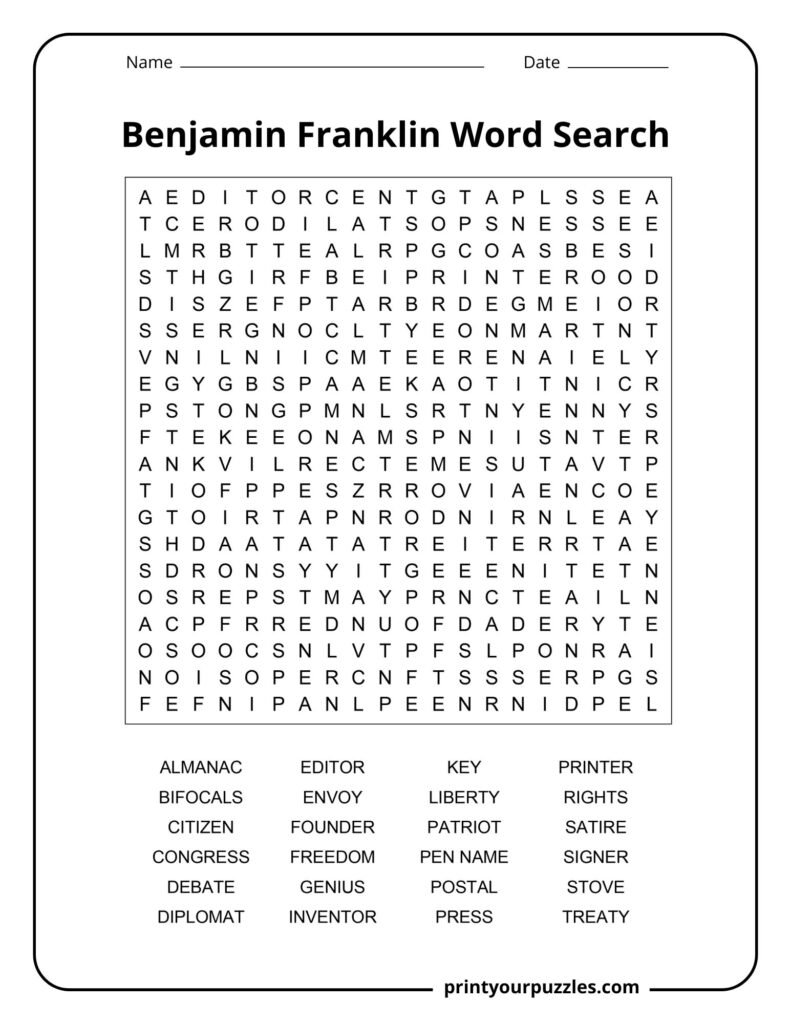
ALMANAC, BIFOCALS, CITIZEN, CONGRESS, DEBATE, DIPLOMAT, EDITOR, ENVOY, FOUNDER, FREEDOM, GENIUS, INVENTOR, KEY, LIBERTY, PATRIOT, PEN NAME, POSTAL, PRESS, PRINTER, RIGHT, SATIRE, SIGNER, STOVE, TREATY
Benjamin Franklin was an American polymath, Founding Father, scientist, inventor, diplomat, writer, and printer. He played a crucial role in shaping the United States through politics, science, and civic leadership.
Franklin invented the lightning rod, bifocals, the Franklin stove, and the glass armonica. He refused to patent any invention, believing knowledge and practical improvements should benefit all of humanity freely.
Franklin helped draft the Declaration of Independence, secured France’s military alliance during the Revolutionary War, and later participated in the Constitutional Convention, signing the Constitution as the oldest delegate present.
Franklin appears on the hundred-dollar bill because of his immense contributions to American independence, diplomacy, science, and civic institutions, even though he never served as President of the United States.
It was an annual publication Franklin wrote from 1732 to 1758 under the pen name Richard Saunders, containing weather forecasts, practical advice, and famous proverbs like “Early to bed, early to rise.”
Benjamin Franklin: An American Life by Walter Isaacson. Isaacson drew on Franklin’s own prolific writings, correspondenceHe captures Franklin’s complexity as a scientist, diplomat, printer, political operator, and self-invented public persona without hagiography.
The First American: The Life and Times of Benjamin Franklin by H.W. Brands. Brands is a bit more analytical and detailed than Isaacson, but still writes with a clear, engaging style. It was a Pulitzer finalist.
Franklin had only two years of formal education. He left school at age ten to work with his father and later became an apprentice in his brother’s printing shop, educating himself through voracious reading.
In 1736, Franklin founded the Union Fire Company in Philadelphia, the first organized volunteer firefighting group in America, inspiring other cities to establish their own fire brigades for community safety.
Franklin was a passionate swimmer since childhood and even invented wooden hand paddles to swim faster. In 1968, he was posthumously inducted into the International Swimming Hall of Fame for his contributions to the sport.
Tired of constantly switching between two pairs of glasses for reading and distance, Franklin cut the lenses in half and combined them into one frame around 1784, creating the first bifocal eyeglasses ever made.
Franklin was the first person to chart the Gulf Stream in the Atlantic Ocean. He studied water temperatures during his transatlantic voyages, helping ships navigate faster and more efficient routes between America and Europe.