Before the United States had political parties, national traditions, or even a clear idea of how the presidency should work, George Washington (1789–1797) became the country’s first president. His leadership helped transform the Constitution from a written plan into a functioning government. For students learning about early American history, the George Washington word search is not only a puzzle about the first president, but also a way to understand how the American presidency began.
George Washington led the nation from 1789 to 1797, during the fragile early years of the republic. The United States had recently won independence from Great Britain, but victory in war did not automatically create a stable country. The federal government needed authority, the economy needed organization, and Americans were still debating how much power the national government should have. Washington had no previous president to follow, so almost every decision helped create a precedent.
One of Washington’s most important achievements was establishing respect for the office of the presidency. He selected a cabinet of advisers, including Thomas Jefferson and Alexander Hamilton, whose disagreements showed the rise of different political views. He supported efforts to strengthen the nation’s finances, create public credit, and give the new government the ability to function effectively.
Washington also faced challenges that tested federal power. During the Whiskey Rebellion, his administration responded to resistance against a federal tax, showing that the national government could enforce its laws. In foreign policy, he tried to keep the United States neutral while Britain and France were at war. This cautious approach reflected his belief that the young country needed time to grow stronger before becoming involved in major European conflicts.
His Farewell Address became one of the most famous messages in American political history. In it, Washington warned against intense political division and permanent foreign alliances. He also made a powerful choice by stepping down after two terms, proving that leadership in a republic did not have to last for life.
Today, George Washington is remembered as the “Father of His Country” because of his role in the American Revolution and the founding of the United States government. This George Washington word search gives students and puzzle lovers a simple way to explore leadership, independence, unity, responsibility, and the peaceful transfer of power.
Keep exploring the Founding and Early Republic Presidents with our John Adams word search, Thomas Jefferson word search, James Madison word search, and the full US Presidents Word Searches collection.
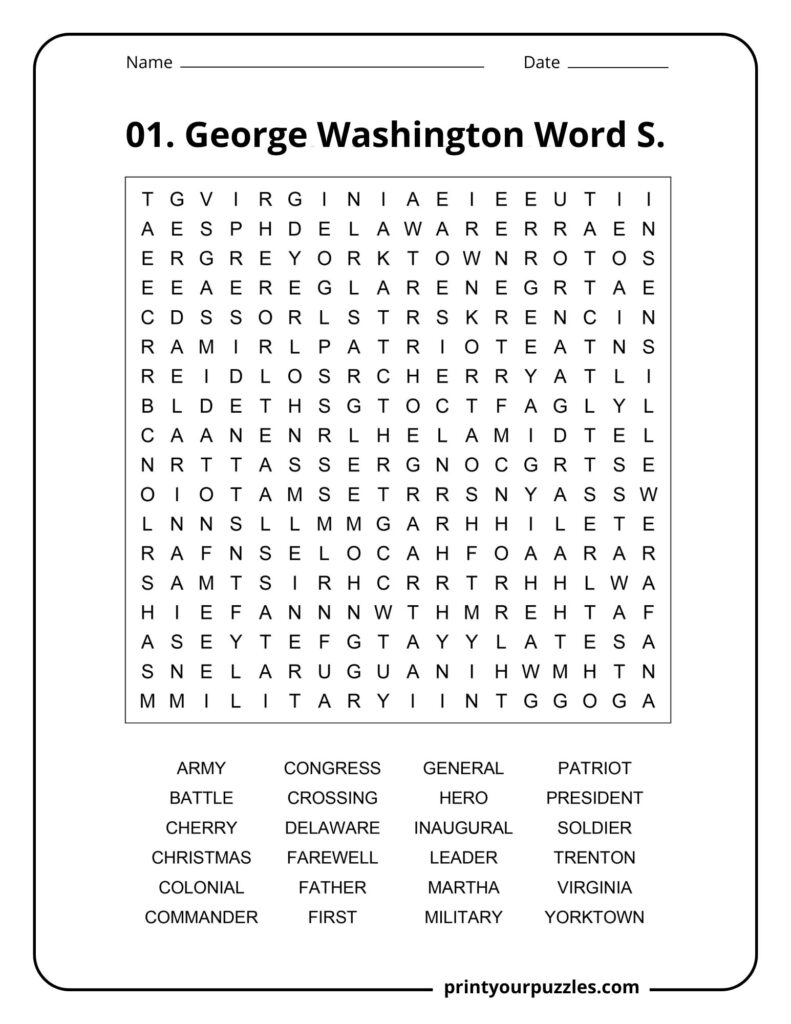
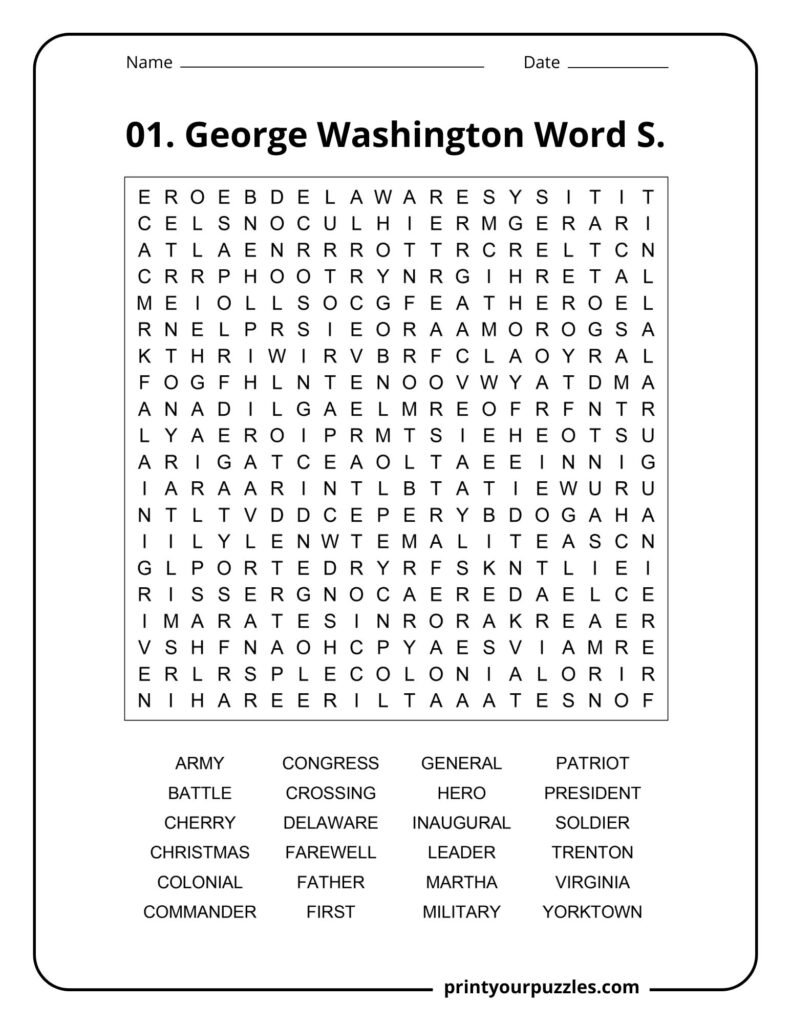
ARMY, BATTLE, CHERRY, CHRISTMAS, COLONIAL, COMMANDER, CONGRESS, CROSSING, DELAWARE, FAREWELL, FATHER, FIRST, GENERAL, HERO, INAUGURAL, LEADER, MARTHA, MILITARY, PATRIOT, PRESIDENT, SOLDIER, TRENTON, VIRGINIA, YORKTOWN
ARMY – Washington commanded the Continental Army during the Revolutionary War, leading colonial forces against British troops through years of difficult campaigns and eventual victory.
BATTLE – Washington fought numerous battles during the Revolution, including victories at Trenton and Yorktown, and defeats at Brandywine, demonstrating resilience and strategic military leadership throughout.
CHERRY – Legend claims young Washington chopped down his father’s cherry tree and confessed, saying “I cannot tell a lie,” symbolizing his honesty and integrity throughout life.
CHRISTMAS – Washington’s surprise attack crossing the Delaware River on Christmas night 1776 resulted in victory at Trenton, boosting morale during the Revolutionary War’s darkest
period.
COLONIAL – Washington lived during colonial America, serving as a Virginia surveyor and militia officer before leading the colonies’ fight for independence from British rule.
COMMANDER – Appointed Commander-in-Chief of the Continental Army in 1775, Washington led American forces throughout the Revolutionary War with determination, courage, and strategic military vision.
CONGRESS – The Continental Congress appointed Washington as army commander and later he worked with Congress as president, establishing executive-legislative relations and constitutional government precedents.
CROSSING – Washington’s famous Delaware River crossing on Christmas 1776 surprised Hessian forces at Trenton, marking a crucial turning point that revived American hope during war.
DELAWARE – The Delaware River crossing on December 25, 1776, became Washington’s most iconic military moment, immortalized in paintings and symbolizing American determination and surprise tactics.
FAREWELL – Washington’s Farewell Address in 1796 warned against political parties and foreign entanglements, establishing important precedents and offering timeless advice for the young nation’s future.
FATHER – Known as the “Father of His Country,” Washington’s leadership during the Revolution and presidency established fundamental principles that shaped America’s character and government.
FIRST – As America’s first president, Washington established crucial precedents including the two-term limit, cabinet system, and proper balance between executive power and democratic governance.
GENERAL – General Washington led the Continental Army for eight years, enduring hardships at Valley Forge and achieving ultimate victory, earning respect as military leader.
HERO – Washington became an American hero through Revolutionary War leadership, voluntary relinquishment of power, and service as president, embodying republican ideals and virtuous leadership.
INAUGURAL – Washington’s first inauguration on April 30, 1789, in New York City established presidential oath traditions and ceremonial protocols still followed in American government today.
LEADER – Washington demonstrated exceptional leadership as military commander and president, setting standards for integrity, judgment, and selfless service that defined American executive authority forever.
MARTHA – Martha Dandridge Custis Washington was his devoted wife, supporting him through military campaigns and serving as America’s first First Lady with grace and dignity.
MILITARY – Washington’s military career spanned decades, from French and Indian War service through Revolutionary War command, shaping his character and leadership abilities profoundly.
PATRIOT – Washington exemplified American patriotism, risking his life and fortune for independence, refusing a crown, and dedicating himself entirely to establishing republican government.
PRESIDENT – Serving two terms as president from 1789 to 1797, Washington established executive branch precedents, maintained neutrality in foreign affairs, and peacefully transferred power.
SOLDIER – Beginning as a young Virginia militia soldier, Washington developed military skills and leadership qualities that proved essential during the Revolutionary War’s challenging years.
TRENTON – The surprise attack at Trenton, New Jersey, on December 26, 1776, delivered a crucial American victory over Hessian forces, revitalizing the Revolutionary cause dramatically.
VIRGINIA – Born and raised in Virginia, Washington called Mount Vernon home, served in Virginia’s militia, and represented Virginia’s interests throughout his political career.
YORKTOWN – The siege of Yorktown in 1781 resulted in British General Cornwallis’s surrender, effectively ending the Revolutionary War and securing American independence under Washington’s command.
ARMY, BATTLE, CHERRY, CHRISTMAS, COLONIAL, COMMANDER, CONGRESS, CROSSING, DELAWARE, FAREWELL, FATHER, FIRST, GENERAL, HERO, INAUGURAL, LEADER, MARTHA, MILITARY, PATRIOT, PRESIDENT, SOLDIER, TRENTON, VIRGINIA, YORKTOWN