
William McKinley’s (1897–1901) presidency marked a turning point between the America of the Gilded Age and the America of the twentieth century. When he entered office, the United States was already an industrial power. By the time his presidency ended, the country had taken a much larger role in world affairs. The William McKinley word search gives students a way to explore a president connected with economic recovery, war, expansion, and the beginning of a more global United States.
McKinley came from Ohio and built his career through law, Civil War service, and Republican politics. He served in Congress for many years and became strongly associated with protective tariffs, which were designed to help American industries by making imported goods more expensive. Later, as governor of Ohio, he gained a reputation as a careful, disciplined, and loyal party leader.
The election of 1896 was one of the most important elections of the late nineteenth century. McKinley defeated William Jennings Bryan in a campaign shaped by debates over the gold standard, silver, farmers, workers, business interests, and the future of the economy. McKinley supported the gold standard and high tariffs, believing that these policies would encourage business confidence, industrial growth, and national prosperity.
At first, economic recovery was a major theme of his presidency. After the Panic of 1893, many Americans wanted stability. McKinley’s calm style and pro-business policies appealed to voters who hoped the country could move beyond depression and uncertainty. But foreign policy soon became the defining issue of his time in office.
In 1898, the United States went to war with Spain after rising tensions over Cuba and the explosion of the USS Maine. The Spanish-American War was brief, but its consequences were enormous. The United States gained control of Puerto Rico, Guam, and the Philippines, while Cuba came under strong American influence. These events raised difficult debates about empire, independence, and whether the United States should govern overseas territories.
McKinley was reelected in 1900, but his second term was cut short when he was assassinated in 1901. Theodore Roosevelt then became president, carrying forward many of the changes that McKinley’s presidency had helped begin.
This William McKinley word search examines tariffs, the gold standard, economic recovery, the Spanish-American War, overseas expansion, and America’s changing place in the world. McKinley’s presidency shows how the United States moved from post-Civil War industrial growth toward a new and more powerful role beyond its own borders.
Continue from the Gilded Age into the Progressive Era with our Grover Cleveland 24th President word search, Theodore Roosevelt word search, William Howard Taft word search, and the full US Presidents Word Searches collection.
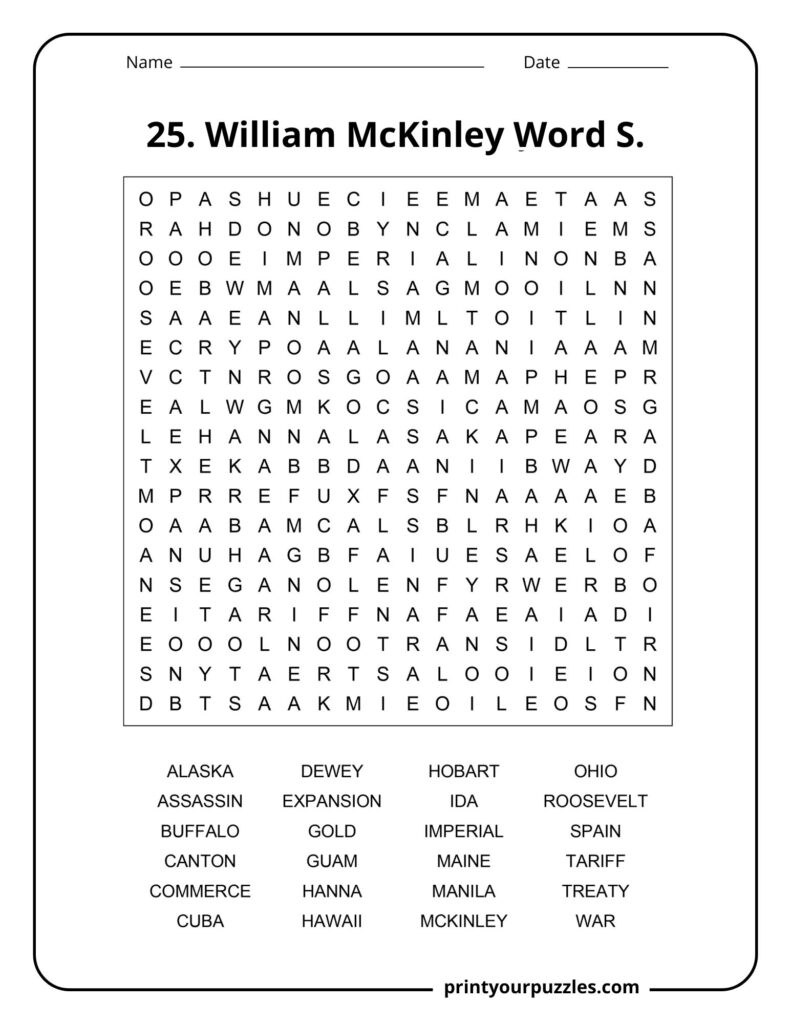
ALASKA, ASSASSIN, BUFFALO, CANTON, COMMERCE, CUBA, DEWEY, EXPANSION, GOLD, GUAM, HANNA, HAWAII, HOBART, IDA, IMPERIAL, MAINE, MANILA, MCKINLEY, OHIO, ROOSEVELT, SPAIN, TARIFF, TREATY, WAR
ALASKA – Territory purchased from Russia in 1867; gold discovered there during McKinley’s presidency in 1896, spurring the Klondike Gold Rush and American settlement.
ASSASSIN – Leon Czolgosz, anarchist who shot President McKinley twice at the Pan-American Exposition in Buffalo, New York, on September 6, 1901, causing his death.
BUFFALO – New York city where McKinley was fatally shot while attending the Pan-American Exposition in 1901; he died there eight days later from gangrene.
CANTON – Ohio city where McKinley lived, practiced law, and conducted his famous “Front Porch Campaign” in 1896; also his final resting place at McKinley Memorial.
COMMERCE – McKinley championed business growth, protective tariffs, and international trade expansion, believing strong commerce was essential for American prosperity and global economic leadership during industrialization.
CUBA – Spanish colony whose independence struggle triggered the Spanish-American War in 1898; American intervention freed Cuba from Spanish rule but established temporary U.S. military occupation.
DEWEY – Admiral George Dewey commanded U.S. naval forces that destroyed the Spanish fleet at Manila Bay in May 1898, making him a national hero overnight.
EXPANSION – McKinley’s presidency marked major territorial growth through the Spanish-American War, acquiring Puerto Rico, Guam, and the Philippines, transforming America into an imperial power.
GOLD – McKinley supported the gold standard for U.S. currency, opposing free silver coinage; the Gold Standard Act of 1900 officially established gold as sole standard.
GUAM – Pacific island territory ceded to the United States by Spain after the Spanish-American War; became an important American naval base and strategic Pacific outpost.
HANNA – Mark Hanna, wealthy Ohio businessman and Republican kingmaker who orchestrated McKinley’s political career, managed his presidential campaigns, and became influential senator and advisor.
HAWAII – Pacific island republic annexed by the United States in 1898 during McKinley’s presidency, becoming a strategic naval base and territory en route to Asia.
HOBART – Garret Hobart served as McKinley’s first vice president from 1897 until his death in 1899; was a trusted advisor and influential figure.
IDA – Ida Saxton McKinley, the president’s devoted wife who suffered from epilepsy and poor health; McKinley attended to her constantly throughout their marriage.
IMPERIAL – McKinley’s foreign policy embraced imperialism, establishing American colonies overseas and projecting military and economic power globally, particularly in the Pacific and
Caribbean regions.
MAINE – USS Maine battleship mysteriously exploded in Havana Harbor in February 1898, killing 266 sailors; “Remember the Maine” became the rallying cry for war.
MANILA – Capital of the Philippines where Admiral Dewey won a decisive naval victory over Spain in Manila Bay, leading to American control of the islands.
MCKINLEY – Twenty-fifth U.S. President who served 1897-1901, led nation through Spanish-American War, promoted prosperity and expansion, assassinated in Buffalo at age fifty-eight.
OHIO – McKinley’s home state where he served as congressman and governor; launched his political career and presidential campaigns from Canton, Ohio’s industrial heartland.
ROOSEVELT – Theodore Roosevelt served as McKinley’s second vice president after leading Rough Riders in Cuba; became president following McKinley’s assassination in September 1901.
SPAIN – European power that lost its colonial empire to the United States in the Spanish-American War of 1898, ceding Cuba, Puerto Rico, Guam, and Philippines.
TARIFF – McKinley’s signature issue; he championed high protective tariffs to shield American industry from foreign competition, most notably the McKinley Tariff Act of 1890.
TREATY – Treaty of Paris signed December 1898 ended Spanish-American War; Spain ceded Philippines, Puerto Rico, and Guam to United States for twenty million dollars.
WAR – Spanish-American War of 1898 lasted only four months but transformed America into world power, acquiring overseas territories and establishing international military presence.
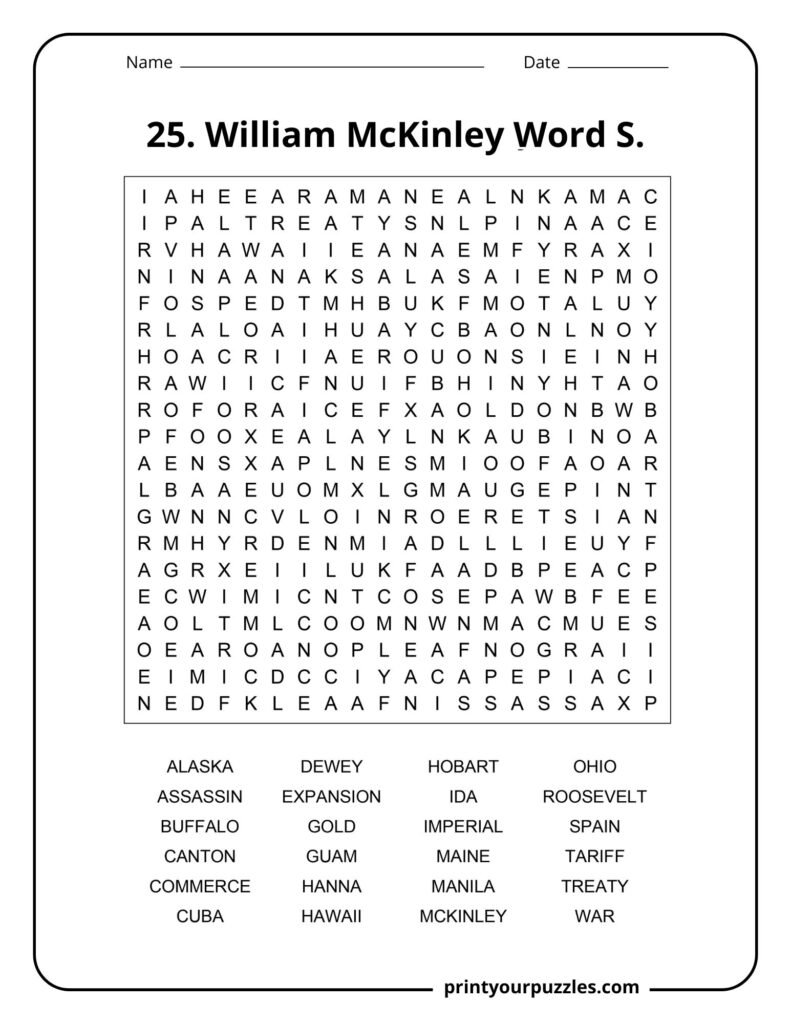
ALASKA, ASSASSIN, BUFFALO, CANTON, COMMERCE, CUBA, DEWEY, EXPANSION, GOLD, GUAM, HANNA, HAWAII, HOBART, IDA, IMPERIAL, MAINE, MANILA, MCKINLEY, OHIO, ROOSEVELT, SPAIN, TARIFF, TREATY, WAR
McKinley was shot by anarchist Leon Czolgosz on September 6, 1901, at Buffalo’s Pan-American Exposition. He died eight days later from gangrene and infection complications.
Leading America to victory in the Spanish-American War, acquiring overseas territories including Puerto Rico, Guam, and the Philippines, transforming the United States into a global imperial power
The mysterious explosion of USS Maine in Havana Harbor, Cuban independence struggles, sensational yellow journalism, and American imperial ambitions combined to push McKinley toward declaring war against Spain.
McKinley strongly supported high protective tariffs to shield American manufacturers, championed the gold standard over free silver coinage, and promoted business expansion and commerce as foundations for prosperity.
McKinley was from Ohio, serving as governor before becoming president. He lived in Canton, Ohio, where he’s buried at the McKinley National Memorial monument.
For official administration records and historical biography, visit the William McKinley page in the White House Archives. If you are planning a trip, visit the McKinley Presidential Library & Museum.
President McKinley: Architect of the American Century by Robert W. Merry. Reappraises a pivotal president who launched America onto the world stage, transforming the nation into a global power before his assassination.
Rather than traveling, McKinley greeted over 750,000 visitors at his Canton home while Mark Hanna organized nationwide rallies, creating an innovative and successful campaign strategy.
In 1899, McKinley became the first sitting president to ride in a gasoline-powered automobile, though he preferred traditional horse-drawn carriages for official transportation throughout his presidency.
Leon Czolgosz hid his revolver beneath a handkerchief while pretending to have an injured hand, allowing him to approach McKinley in the receiving line undetected.
McKinley considered red carnations his lucky flower and wore one daily on his lapel. Moments before being shot, he gave his carnation to a young girl.
Despite suffering from epilepsy and poor health, First Lady Ida McKinley crocheted approximately 3,500 pairs of slippers during her lifetime, donating many to charity for fundraising.