Introduction to the Woodrow Wilson Word Search
Woodrow Wilson’s (1913–1921) presidency began with domestic reform and ended with a world war. Few presidents experienced such a dramatic shift in national focus. At first, Wilson wanted to reshape American government through Progressive Era laws on banking, tariffs, business regulation, and workers’ rights. By the end of his time in office, he was trying to influence the future of international peace. The Woodrow Wilson word search gives students a way to explore a president whose ideas reached from Washington, D.C., to the battlefields and peace talks of World War I.
Wilson came to politics after a career in education. He had been a professor, president of Princeton University, and governor of New Jersey before winning the presidency in 1912. That election was unusual because the Republican Party split between William Howard Taft and Theodore Roosevelt, allowing Wilson, a Democrat, to win with a minority of the popular vote. His victory opened the door to one of the most active reform periods of the Progressive Era.
His domestic program was known as the New Freedom. Wilson supported the Federal Reserve Act, which created the modern central banking system of the United States. He also backed the Clayton Antitrust Act, designed to strengthen rules against unfair business practices, and supported tariff reduction through the Underwood Tariff. These reforms changed banking, business regulation, and federal economic policy in lasting ways.
World War I changed everything. Wilson first tried to keep the United States neutral, but German submarine warfare, the Zimmerman Telegram, and other pressures eventually led the country into war in 1917. After the fighting ended, Wilson promoted his Fourteen Points and strongly supported the creation of the League of Nations, hoping it would prevent future wars. His vision was ambitious, but the U.S. Senate rejected membership in the League, weakening one of his central goals.
Wilson’s legacy also includes serious contradictions. His administration expanded segregation in parts of the federal government, and his record on civil rights is widely criticized. At the same time, his wartime leadership and international ideas made him one of the most influential presidents of the early twentieth century.
This Woodrow Wilson word search examines Progressive reform, banking, antitrust policy, World War I, the League of Nations, civil rights contradictions, and the difficult relationship between democracy at home and democracy abroad. Wilson’s presidency shows how a leader can be visionary, powerful, and deeply flawed at the same time.
Complete the Gilded Age and Progressive Era Presidents group with our Theodore Roosevelt word search, William Howard Taft word search, William McKinley word search, and the full US Presidents Word Searches collection.
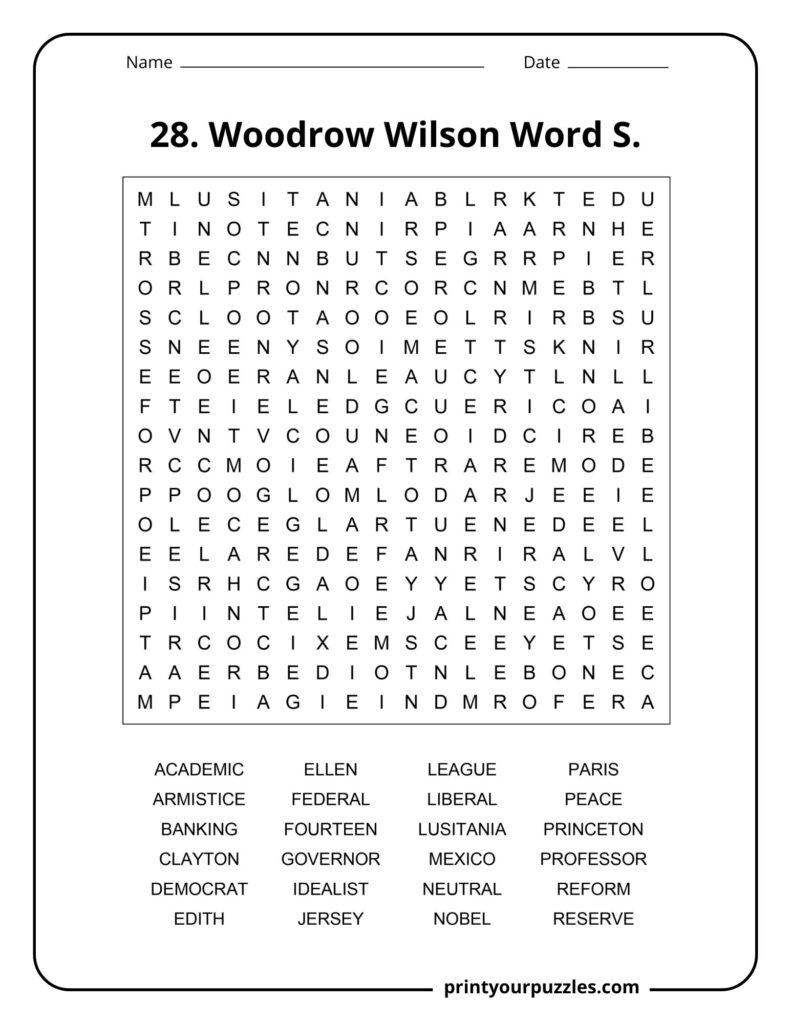
Medium Difficulty Word Search
Words to Find:
ACADEMIC, ARMISTICE, BANKING, CLAYTON, DEMOCRAT, EDITH, ELLEN, FEDERAL, FOURTEEN, GOVERNOR, IDEALIST, JERSEY, LEAGUE, LIBERAL, LUSITANIA, MEXICO, NEUTRAL, NOBEL, PARIS, PEACE, PRINCETON, PROFESSOR, REFORM, RESERVE
All Words Defined
ACADEMIC – Wilson served as Princeton University’s president before entering politics, bringing scholarly expertise and educational reform principles to his political career and presidency.
ARMISTICE – The November 11, 1918 agreement ending World War I hostilities, negotiated under Wilson’s leadership, marking a pivotal moment in his presidency and global history.
BANKING – Wilson reformed America’s financial system by establishing the Federal Reserve in 1913, creating centralized banking oversight to stabilize the economy and prevent panics.
CLAYTON – The Clayton Antitrust Act of 1914 strengthened monopoly regulations, protected labor unions from antitrust prosecution, and advanced Wilson’s progressive agenda against corporate power.
DEMOCRAT – Wilson’s political party affiliation; he was only the second Democratic president elected since the Civil War, breaking Republican dominance in national politics.
EDITH – Edith Bolling Galt became Wilson’s second wife in 1915. She controversially managed presidential affairs after his 1919 stroke, acting as gatekeeper.
ELLEN – Ellen Axson Wilson, his first wife and mother of three daughters, supported his career until her death in 1914, deeply affecting Wilson emotionally.
FEDERAL – Refers to the Federal Reserve System, Wilson’s landmark 1913 achievement creating America’s central banking system to regulate monetary policy and financial stability nationwide.
FOURTEEN – Wilson’s Fourteen Points outlined his vision for post-WWI peace, including self-determination, open diplomacy, free trade, and the League of Nations formation.
GOVERNOR – Wilson served as New Jersey’s progressive governor from 1911-1913, implementing reforms that launched his national reputation and presidential campaign.
IDEALIST – Wilson’s foreign policy emphasized moral diplomacy, selfdetermination, and international cooperation, often prioritizing principles over practical political realities in global affairs.
JERSEY – New Jersey, where Wilson governed progressively before his presidency, passing labor reforms, utility regulations, and anti-corruption measures that established his reform credentials.
LEAGUE – The League of Nations was Wilson’s proposed international organization for collective security and peace, though the U.S. Senate rejected American membership.
LIBERAL – Wilson championed progressive reforms including labor protections, banking regulation, tariff reduction, and antitrust legislation as part of his “New Freedom” agenda.
LUSITANIA – British passenger ship sunk by German submarine in 1915, killing 128 Americans. This tragedy intensified American anger toward Germany and influenced intervention.
MEXICO – Wilson intervened militarily in Mexican affairs, including the 1914 Veracruz occupation and 1916 Pershing expedition, pursuing his “moral diplomacy” with mixed results.
NEUTRAL – Wilson maintained American neutrality during WWI’s early years, winning 1916 reelection with the slogan “He Kept Us Out of War” before entering in 1917.
NOBEL – Wilson received the 1919 Nobel Peace Prize for his efforts creating the League of Nations and promoting international peace through his Fourteen Points.
PARIS – The 1919 Paris Peace Conference negotiated WWI’s end. Wilson personally attended, advocating his peace vision but making significant compromises with Allied leaders.
PEACE – Central to Wilson’s legacy: his Fourteen Points, League of Nations advocacy, and belief that collective security could prevent future wars through international cooperation.
PRINCETON – Wilson taught political science and served as Princeton University’s president (1902-1910), implementing academic reforms before transitioning to political leadership.
PROFESSOR – Before politics, Wilson was a respected academic, teaching at Bryn Mawr, Wesleyan, and Princeton, writing extensively on government, history, and political science.
REFORM – Wilson’s presidency focused on progressive reforms: banking regulation, tariff reduction, antitrust enforcement, labor protections, and democratizing American economic and political systems.
RESERVE – The Federal Reserve Act of 1913 established America’s central banking system, providing Wilson’s administration tools to manage currency, credit, and economic stability.
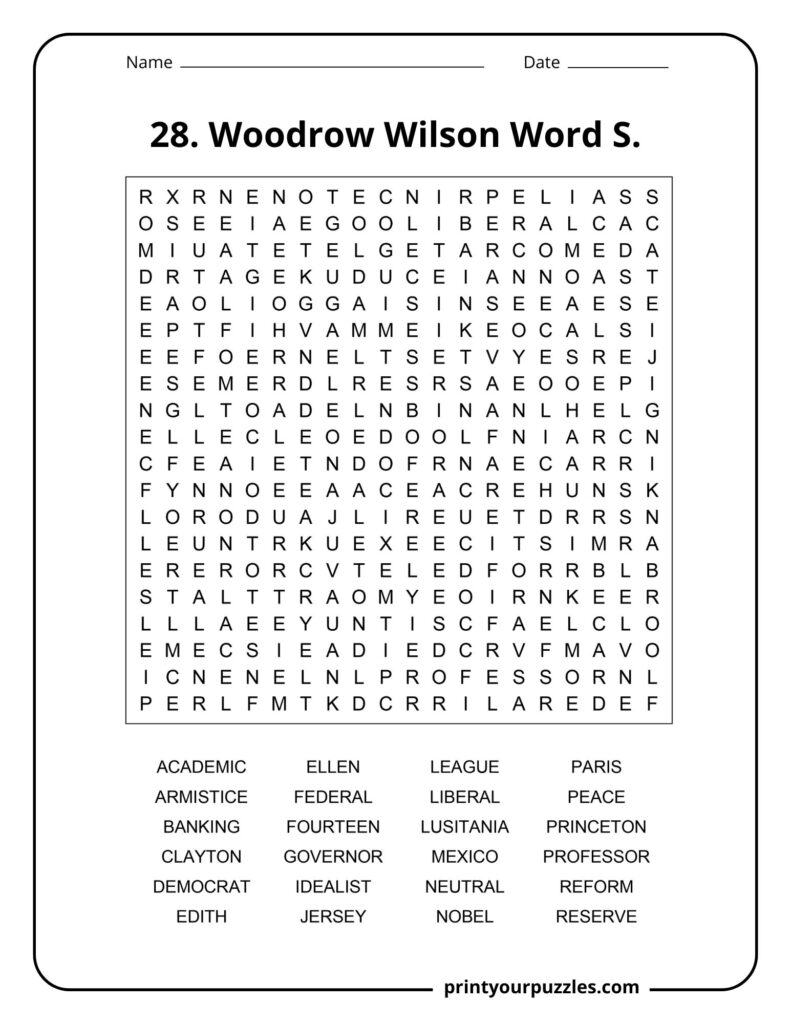
Hard Difficulty Word Search
Words to Find:
ACADEMIC, ARMISTICE, BANKING, CLAYTON, DEMOCRAT, EDITH, ELLEN, FEDERAL, FOURTEEN, GOVERNOR, IDEALIST, JERSEY, LEAGUE, LIBERAL, LUSITANIA, MEXICO, NEUTRAL, NOBEL, PARIS, PEACE, PRINCETON, PROFESSOR, REFORM, RESERVE
7 Key FAQs About Woodrow Wilson
5 Curious "Did You Know?" Facts About Woodrow Wilson