
Rutherford B. Hayes (1877–1881) reached the presidency after one of the most disputed elections in American history. The election of 1876 was so close and controversial that the final result was not settled until just before Inauguration Day. When Hayes entered the White House, he carried the burden of a political bargain, a divided nation, and the difficult question of what should happen after Reconstruction. The Rutherford B. Hayes word search gives students a useful starting point for understanding a president shaped by compromise and transition.
Hayes came from Ohio and had a strong record of public service before becoming president. He worked as a lawyer, fought for the Union during the Civil War, served in Congress, and became governor of Ohio. His reputation for honesty helped him appeal to voters at a time when many Americans were concerned about corruption in government after the scandals of the Grant years.
The election of 1876 defined his presidency before it even began. Hayes, the Republican candidate, ran against Democrat Samuel J. Tilden. Tilden won more popular votes, but disputed electoral votes in several states created a constitutional crisis. A special commission eventually awarded the contested votes to Hayes, giving him the presidency by a single electoral vote. Many Democrats accepted the result only after political negotiations, often connected with the Compromise of 1877.
One major consequence was the end of federal Reconstruction in the South. Hayes removed remaining federal troops from Southern states, a decision that marked the end of strong federal protection for African American rights in the region. While Hayes personally supported education and civil rights, the withdrawal of troops allowed Southern white leaders to regain political control and begin building systems that restricted Black freedom and voting power.
Hayes also focused on civil service reform. He wanted government jobs to be based more on merit than political loyalty, challenging the spoils system that rewarded party supporters. His efforts did not completely transform federal employment, but they helped prepare the way for later reforms.
He chose not to run for a second term, keeping a promise he had made. This Rutherford B. Hayes word search examines election controversy, Reconstruction’s end, civil rights, reform, political compromise, and the complicated shift from Civil War politics into the Gilded Age.
Continue into the Gilded Age and Progressive Era Presidents with our James A. Garfield word search, Chester A. Arthur word search, Grover Cleveland 22nd President word search, and the full US Presidents Word Searches collection.
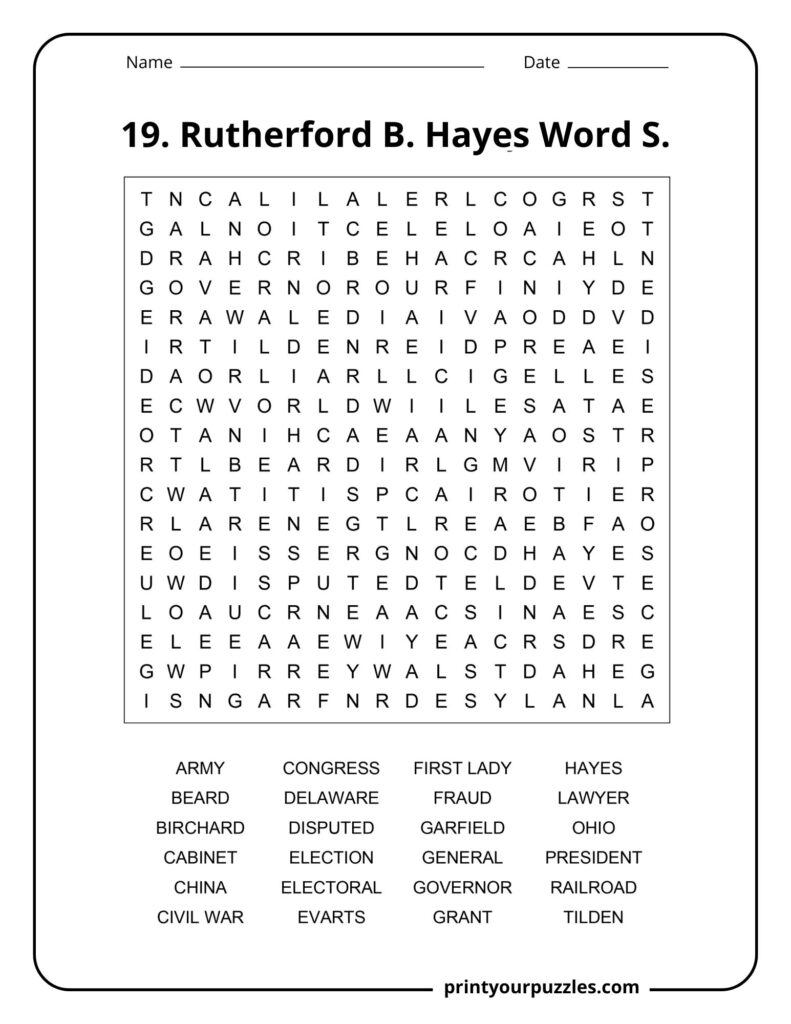
ARMY, BEARD, BIRCHARD, CABINET, CHINA, CIVIL WAR, CONGRESS, DELAWARE, DISPUTED, ELECTION, ELECTORAL, EVARTS, FIRST LADY, FRAUD, GARFIELD, GENERAL, GOVERNOR, GRANT, HAYES, LAWYER, OHIO, PRESIDENT, RAILROAD, TILDEN
ARMY – Hayes served in the Union Army during the Civil War, rising through ranks due to his bravery and leadership in multiple battles and military campaigns.
BEARD – Hayes wore a distinctive full beard throughout his presidency, reflecting the popular facial hair style of the era among American political and military leaders.
BIRCHARD – Hayes’ middle name, honoring his maternal uncle Sardis Birchard who raised him after his father’s death and significantly influenced his early life and education.
CABINET – Hayes’ presidential Cabinet included reformers who helped him pursue civil service reform and end Reconstruction, including William Evarts as Secretary of State.
CHINA – Hayes supported increased diplomatic relations with China and opposed restrictions on Chinese immigration, advocating for fair treatment of Chinese immigrants in America during his presidency.
CIVIL WAR – Hayes fought bravely in the Civil War for the Union, was wounded multiple times, and earned promotion to major general before entering politics.
CONGRESS – Hayes worked with Congress to end Reconstruction, faced Democratic opposition, and advocated for civil service reform despite resistance from political machines and patronage systems.
DELAWARE – Hayes was born in Delaware, Ohio in 1822, where he spent his childhood before attending college and eventually becoming a lawyer and politician.
DISPUTED – The 1876 presidential election was disputed due to contested results in several Southern states, creating a constitutional crisis that threatened national stability and unity.
ELECTION – The 1876 election between Hayes and Samuel Tilden was one of the most controversial in American history, requiring a special commission to determine the winner.
ELECTORAL – An Electoral Commission of fifteen members was created to resolve the disputed 1876 election, ultimately awarding all contested electoral votes to Hayes by one vote.
EVARTS – William Evarts served as Hayes’ Secretary of State, handling foreign affairs and supporting the president’s efforts to restore dignity and reform to government operations.
FIRST LADY – Lucy Hayes was the First Lady, nicknamed “Lemonade Lucy” for banning alcohol from the White House, and was the first presidential wife with a college degree.
FRAUD – Allegations of electoral fraud surrounded the 1876 election in Southern states, with both parties accused of intimidation, ballot manipulation, and irregularities affecting election outcomes.
GARFIELD – James Garfield succeeded Hayes as president in 1881, after Hayes chose not to seek reelection, keeping his promise to serve only one term.
GENERAL – Hayes achieved the rank of brevet major general during the Civil War through distinguished service and bravery in numerous battles throughout the conflict.
GOVERNOR – Hayes served as Governor of Ohio for three terms before becoming president, establishing his reputation as an honest reformer and effective administrator.
GRANT – Ulysses S. Grant preceded Hayes as president, and the scandals of Grant’s administration motivated Hayes to pursue civil service reform and restore governmental integrity.
HAYES – Rutherford Birchard Hayes served as the nineteenth President of the United States from 1877 to 1881, focusing on civil service reform and ending Reconstruction.
LAWYER – Hayes practiced law in Cincinnati before entering politics, defending fugitive slaves and establishing himself as a capable attorney with strong antislavery convictions.
OHIO – Hayes represented Ohio throughout his political career, serving as congressman, governor, and president, always maintaining strong connections to his home state.
PRESIDENT – Hayes served as the nineteenth President from 1877-1881, working to heal post-Civil War divisions, reform civil service, and restore faith in government.
RAILROAD – The Great Railroad Strike of 1877 was a major crisis during Hayes’ presidency, requiring federal troops to restore order during nationwide labor unrest.
TILDEN – Samuel Tilden was Hayes’ Democratic opponent in the 1876 election. He won the popular vote by over 250,000 votes but lost the presidency through the Electoral Commission decision.
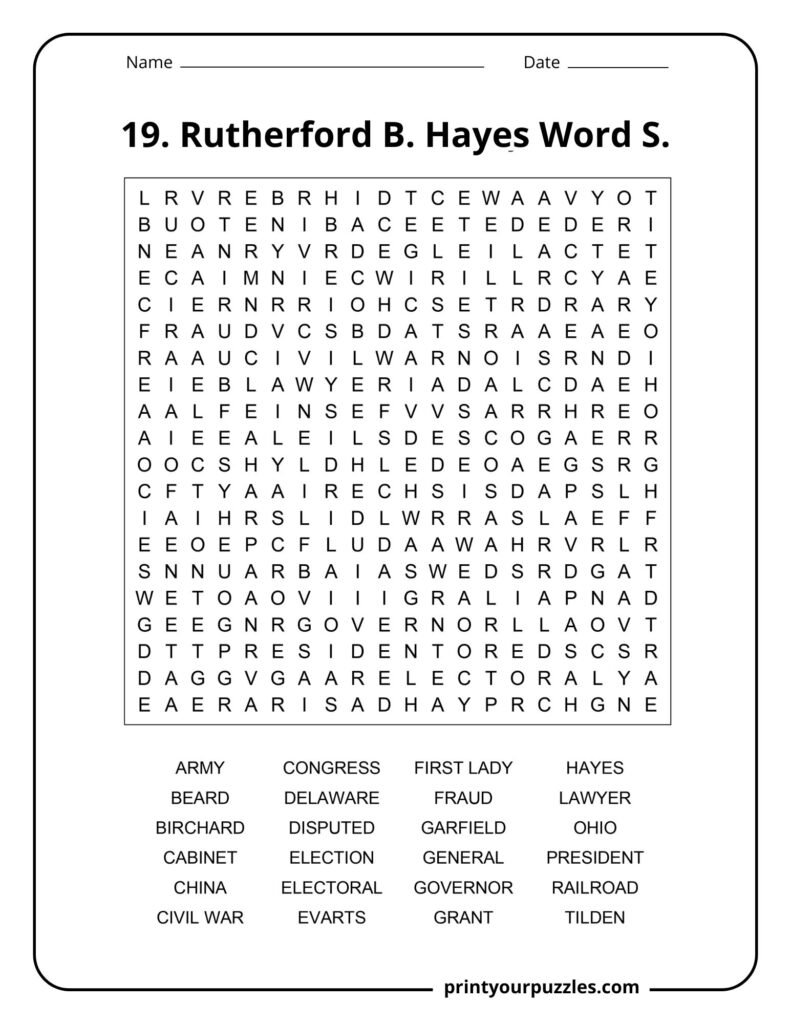
ARMY, BEARD, BIRCHARD, CABINET, CHINA, CIVIL WAR, CONGRESS, DELAWARE, DISPUTED, ELECTION, ELECTORAL, EVARTS, FIRST LADY, FRAUD, GARFIELD, GENERAL, GOVERNOR, GRANT, HAYES, LAWYER, OHIO, PRESIDENT, RAILROAD, TILDEN
Hayes lost the popular vote to Samuel Tilden but won the presidency through an Electoral Commission that awarded him all disputed electoral votes from Southern states, resulting in widespread accusations of fraud.
The Compromise of 1877 resolved the disputed election by giving Hayes the presidency in exchange for withdrawing federal troops from the South, effectively ending Reconstruction and federal protection for African Americans.
First Lady Lucy Hayes banned alcoholic beverages from the White House, earning the nickname “Lemonade Lucy.” She was also the first presidential wife to hold a college degree.
Hayes focused on civil service reform, attempting to end the patronage system by implementing merit-based appointments. He also worked to restore public confidence in government following Grant’s scandal-plagued administration.
No, Hayes pledged to serve only one term and kept his promise, declining to seek reelection in 1880. He was succeeded by James Garfield and retired to Ohio.
For official administration records and historical biography, visit the Rutherford B. Hayes page in the Trump White House Archives. If you are looking for research materials, visit the official Hayes Presidential Library & Museums.
Rutherford B. Hayes: Warrior and President by Ari Hoogenboom. The most comprehensive biography of a president who won the most disputed election in U.S. history and championed civil service reform.
In 1877, Hayes became the first president to have a telephone in the White House. Alexander Graham Bell personally demonstrated the device, though initially few people had phones to call.
Because Inauguration Day fell on Sunday in 1877, Hayes took the oath of office privately on Saturday to avoid any gap in presidential authority, then repeated it publicly on Monday.
In 1878, Hayes opened the White House grounds for children to roll Easter eggs after Congress banned the activity from Capitol grounds, establishing a beloved annual tradition continuing today.
Hayes demonstrated remarkable bravery in combat, suffering five battlefield wounds including a serious arm injury at South Mountain. He refused to leave his troops despite these injuries.
Hayes won the presidency with 185 electoral votes to Tilden’s 184, making it the closest electoral college margin in history and one of five elections where the popular vote winner lost.