
The Progressive Era was a period of reform in the United States that lasted from the 1890s to the 1920s. It came after the rapid industrial growth of the Gilded Age, when factories, railroads, cities, and big businesses expanded quickly. This growth created wealth and opportunity, but it also brought serious problems that many Americans believed needed to be fixed.
Industrialization changed daily life for millions of people. Cities became crowded, immigrants arrived in large numbers, and many workers faced long hours, low wages, unsafe factories, and little protection. Child labor, poverty, poor housing, pollution, political corruption, and the power of monopolies became major concerns. Progressives believed that society could improve through education, laws, government action, and public pressure.
Journalism played an important role in the Progressive Era. Investigative writers known as muckrakers exposed problems that many people had ignored. Upton Sinclair revealed dangerous conditions in the meatpacking industry, Ida Tarbell wrote about the power of Standard Oil, and Jacob Riis showed the difficult living conditions of poor families in city tenements. Their work helped inspire public debate and reform.
Labor and workplace issues were also central to the period. Reformers pushed for safer factories, shorter working hours, better wages, and limits on child labor. Tragic events such as the Triangle Shirtwaist Factory fire showed the need for stronger safety rules and better protections for workers.
Progressives also worked to limit the power of big business and reduce corruption in government. Theodore Roosevelt became closely connected with trust-busting, which aimed to break up or regulate powerful monopolies. Political reforms such as the direct election of senators, initiative, referendum, and recall were designed to give citizens more influence and make government more accountable.
Women played a major role in Progressive reform movements. Many worked for better schools, public health, labor protections, temperance, and voting rights. The women’s suffrage movement helped lead to the 19th Amendment in 1920. However, the Progressive Era also had limits, and many reforms did not fully protect African Americans, Native Americans, immigrants, and other groups equally.
Students can use this Progressive Era word search to review key terms such as reform, muckrakers, suffrage, labor, factories, trusts, Roosevelt, corruption, cities, amendments, and social change. By working with a Progressive Era Word Search, learners can connect the vocabulary to the problems reformers faced, the changes they supported, and the lasting impact of this period in United States history.
Related Word Searches:
Gilded Age | Theodore Roosevelt | Woodrow Wilson | Pullman Strike | Boston Police Strike | Roaring Twenties
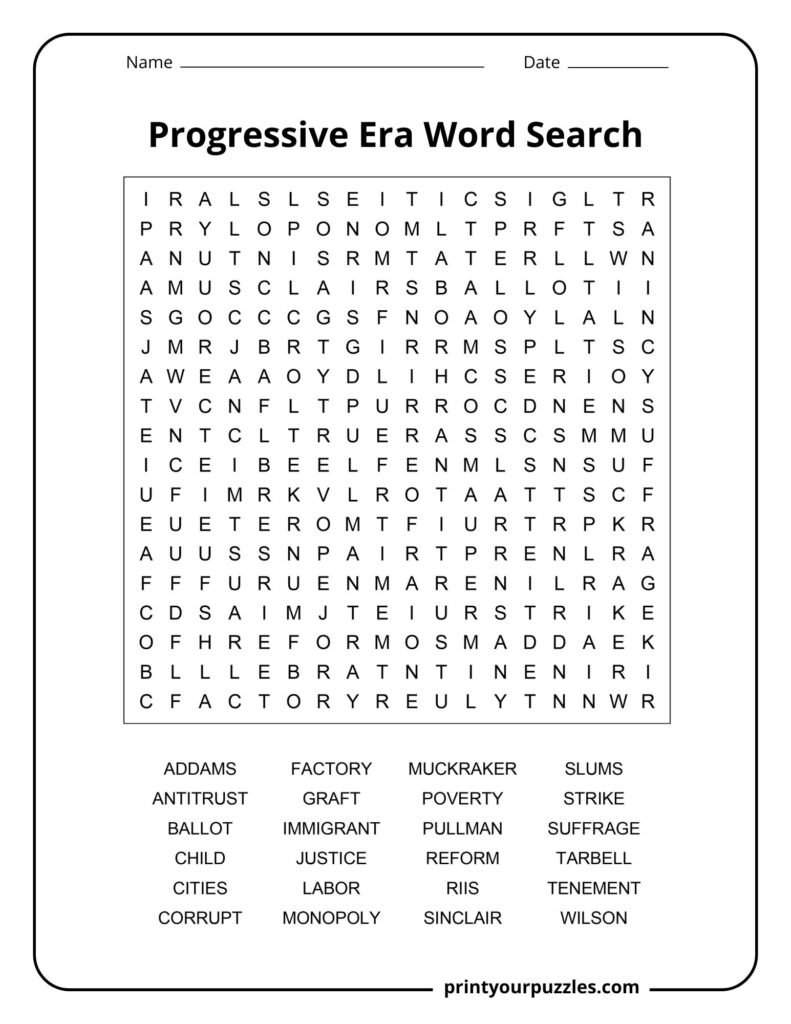
ADDAMS, ANTITRUST, BALLOT, CHILD, CITIES, CORRUPT, FACTORY, GRAFT, IMMIGRANT, JUSTICE, LABOR, MONOPOLY, MUCKRAKER, POVERTY, PULLMAN, REFORM, RIIS, SINCLAIR, SLUMS, STRIKE, SUFFRAGE, TARBELL, TENEMENT, WILSON
ADDAMS – Jane Addams founded Hull House in Chicago, pioneering the settlement house movement to assist immigrants and urban poor while advocating for social reforms and women’s rights.
ANTITRUST – Laws designed to break up monopolies and regulate large corporations, preventing unfair business practices and promoting competition. Sherman Antitrust Act was a key example of this legislation.
BALLOT – Progressive reforms included secret ballot initiatives, direct primaries, and voting reforms to reduce political corruption and increase citizen participation in democratic processes and elections.
CHILD – Child labor was a major Progressive concern. Reformers fought to end exploitative practices, establishing minimum age requirements and compulsory education laws protecting young workers.
CITIES – Rapid urbanization created overcrowding, sanitation problems, and poverty. Progressives focused on municipal reform, improving city services, housing conditions, and implementing professional city management systems.
CORRUPT – Political corruption through bribery, cronyism, and machine politics plagued American cities. Progressives worked to expose dishonest officials and implement reforms promoting transparency and accountability.
FACTORY – Industrial factories often featured dangerous working conditions, long hours, and low wages. Progressive reformers advocated for workplace safety regulations, reasonable hours, and workers’ rights.
GRAFT – Political graft involved officials accepting bribes or kickbacks for favors. Muckrakers exposed these practices, leading to reforms designed to eliminate corruption from government operations.
IMMIGRANT – Millions of immigrants arrived from Southern and Eastern Europe, facing discrimination and harsh conditions. Settlement houses and reformers worked to assist with assimilation and improve lives.
JUSTICE – Social justice was a central Progressive goal, seeking fair treatment for workers, immigrants, women, and the poor through legal reforms, equal rights advocacy, and elimination of exploitation.
LABOR – Labor movements fought for workers’ rights including fair wages, reasonable hours, safe conditions, and collective bargaining power. Unions grew stronger during this reform era.
MONOPOLY – Large business trusts controlled entire industries, eliminating competition and raising prices. Trust-busting efforts aimed to restore competitive markets and protect consumers from exploitation.
MUCKRAKER – Investigative journalists who exposed corruption, unsafe conditions, and social injustices through powerful writing. Examples include Ida Tarbell, Upton Sinclair, and Jacob Riis exposing problems.
POVERTY – Widespread urban poverty resulted from industrialization, low wages, and poor conditions. Progressives studied poverty’s causes and implemented programs addressing economic inequality and hardship.
PULLMAN – The 1894 Pullman Strike involved railroad workers protesting wage cuts and high rents. Federal troops broke the strike, highlighting tensions between labor and capital.
REFORM – Progressive reforms targeted political corruption, social problems, and economic inequality through legislation, grassroots movements, and government action improving American society and democracy.
RIIS – Jacob Riis was a photojournalist who documented tenement life in “How the Other Half Lives,” exposing urban poverty and spurring housing reforms through powerful images.
SINCLAIR – Upton Sinclair wrote “The Jungle,” exposing meatpacking industry horrors. His investigative work exemplified muckraking journalism and led to important food safety regulations and reforms.
SLUMS – Overcrowded urban neighborhoods with poor sanitation, inadequate housing, and poverty. Reformers worked to improve living conditions through housing codes, sanitation improvements, and social programs.
STRIKE – Workers organized strikes to demand better wages, hours, and conditions. While often met with violence, strikes brought attention to labor issues and pressured employers.
SUFFRAGE – The women’s suffrage movement fought for voting rights, culminating in the Nineteenth Amendment’s 1920 ratification. Leaders included Susan B. Anthony and Elizabeth Cady Stanton.
TARBELL – Ida Tarbell was a muckraking journalist who exposed Standard Oil’s monopolistic practices in detailed investigative articles, contributing to antitrust actions against the powerful company.
TENEMENT – Crowded, poorly maintained apartment buildings housing working-class families in cities. Reformers like Jacob Riis documented terrible conditions, leading to improved housing codes and regulations.
WILSON – Woodrow Wilson served as Progressive Era president (1913-1921), implementing reforms including Federal Reserve creation, antitrust legislation, and labor protections through his New Freedom program.
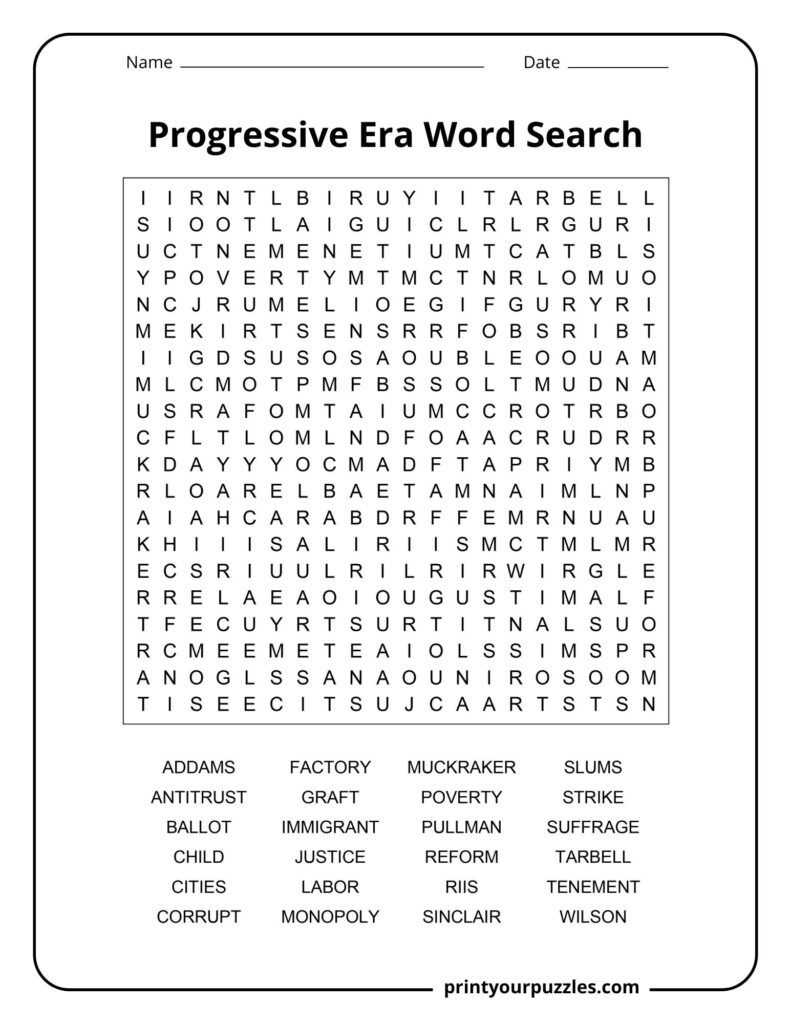
ADDAMS, ANTITRUST, BALLOT, CHILD, CITIES, CORRUPT, FACTORY, GRAFT, IMMIGRANT, JUSTICE, LABOR, MONOPOLY, MUCKRAKER, POVERTY, PULLMAN, REFORM, RIIS, SINCLAIR, SLUMS, STRIKE, SUFFRAGE, TARBELL, TENEMENT, WILSON
The Progressive Era was a period of widespread social activism and political reform in America aimed at addressing problems caused by industrialization, urbanization, immigration, and political corruption.
Key figures included President Theodore Roosevelt, Jane Addams, Ida Tarbell, Upton Sinclair, Jacob Riis, and suffragists like Susan B. Anthony who fought for voting rights and social change.
Progressives achieved women’s suffrage, child labor laws, food safety regulations, antitrust legislation, workplace safety standards, direct election of senators, and income tax implementation through constitutional amendments.
Muckrakers were investigative journalists who exposed corruption, unsafe conditions, and social injustices through powerful writing and photography, inspiring public outcry and demanding government action and reform.
The Progressive Era gradually ended around 1920 as World War I shifted national priorities, reform momentum slowed, and the country entered a more conservative period during the Roaring Twenties.
After President McKinley‘s assassination in 1901, Roosevelt championed Progressive reforms including trust-busting, conservation efforts, and consumer protection, earning his reputation as the “trust buster president.”
This tragedy, caused by locked exit doors and inadequate safety measures, sparked outrage and led to sweeping workplace
In 1931, Addams received this honor for her pioneering social work at Hull House, peace activism, and tireless advocacy for immigrants, women’s rights, and social justice.
Many Progressives supported the Eighteenth Amendment banning alcohol, believing it would reduce domestic violence, poverty, and crime. The “noble experiment” ultimately failed and was repealed in 1933.
As a frontier territory, Wyoming led the nation in women’s rights. Several western states followed before the Nineteenth Amendment finally granted nationwide women’s suffrage in 1920.