Introduction to the Chinese Revolution Word Search
The Chinese Revolution transformed China from an imperial system into a modern republic and later a Communist state. This long period of upheaval began with the collapse of the Qing dynasty in 1911 and ended with the Communist victory in 1949. During these decades, China experienced political instability, foreign invasion, civil war, economic crisis, and intense competition between rival movements seeking to control the country’s future.
By the early twentieth century, the Qing dynasty had been weakened by corruption, military defeats, foreign influence, and growing public dissatisfaction. The 1911 Revolution, also called the Xinhai Revolution, overthrew the dynasty and ended more than two thousand years of imperial rule. Sun Yat-sen became a leading symbol of the new Republic of China, although the country soon struggled to build a stable central government.
After the death of Yuan Shikai, regional warlords controlled different parts of China. Two major political forces then emerged: the Nationalist Party, or Kuomintang, and the Chinese Communist Party, founded in 1921. Chiang Kai-shek became the principal Nationalist leader, while Mao Zedong gradually rose within the Communist movement. The two groups first cooperated against the warlords but turned against each other in 1927.
The conflict between Nationalists and Communists led to years of violence and retreat. Between 1934 and 1935, Communist forces completed the Long March, a difficult journey across mountains, rivers, and remote territory while escaping Nationalist armies. Although many participants died, the march became a powerful story of endurance and strengthened Mao’s leadership.
Japan’s invasion of China forced the two rival groups into another temporary alliance. From the 1930s through World War II, Chinese cities and rural areas suffered occupation, destruction, hunger, and mass civilian casualties. After Japan’s defeat in 1945, the civil war resumed. Communist support among many rural communities, Nationalist corruption, inflation, and military failures helped shift the balance of power.
Modern communication technologies played an important role in the revolution. Railways, telegraphs, radio, newspapers, photography, political posters, and mass printing helped leaders spread ideas, organize supporters, report victories, and shape public opinion. These tools anticipated the enormous role that television, the internet, and social media now play in political campaigns, revolutions, and government propaganda.
In 1949, Mao Zedong proclaimed the People’s Republic of China, while Chiang Kai-shek and the Nationalist government withdrew to Taiwan.
Through this Chinese Revolution word search, students can explore vocabulary connected to the Qing dynasty, Sun Yat-sen, Mao, Chiang Kai-shek, Nationalists, Communists, the Long March, civil war, propaganda, Taiwan, and the founding of modern China.
Related Word Searches:
Ancient China | Korean War | Russian Revolution | Cuban Revolution | Truman Doctrine | Decolonization Era
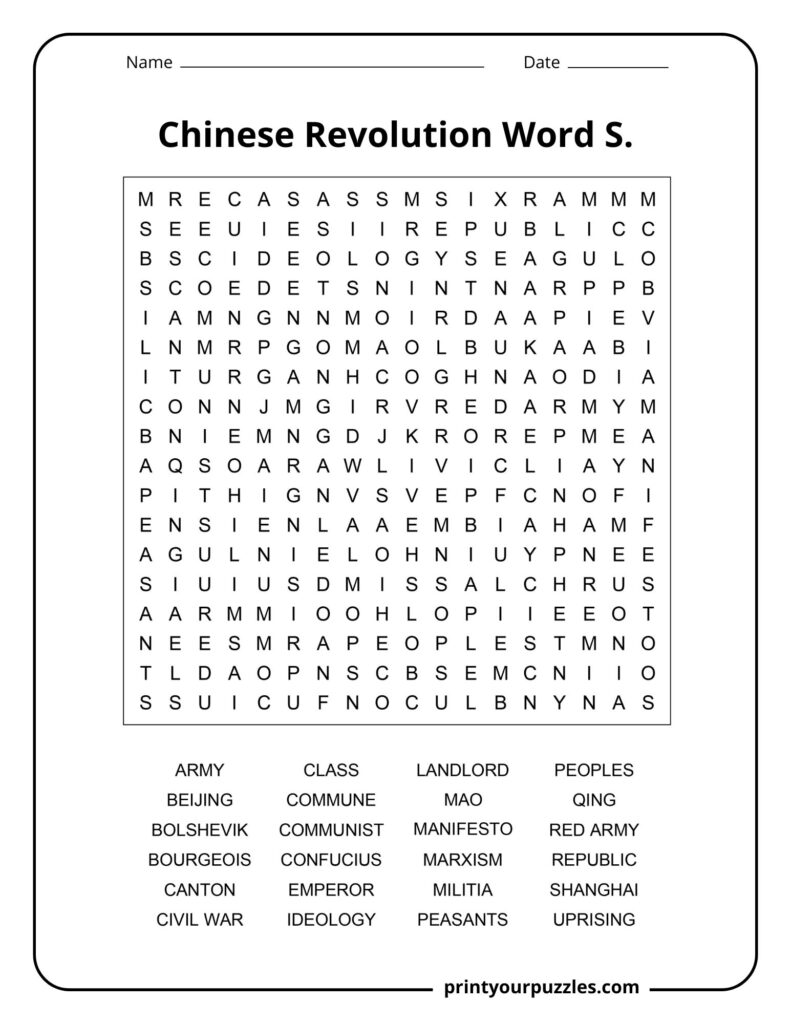
Medium Difficulty Word Search
Words to Find
ARMY, BEIJING, BOLSHEVIK, BOURGEOIS, CANTON, CIVIL WAR, CLASS, COMMUNE, COMMUNIST, CONFUCIUS, EMPEROR, IDEOLOGY, LANDLORD, MANIFESTO, MAO, MARXISM, MILITIA, PEASANTS, PEOPLES, QING, RED ARMY, REPUBLIC, SHANGHAI, UPRISING
All Words Defined
ARMY – A large organized military force trained to fight on land, playing a crucial role in revolutionary movements and the establishment of communist power in China.
BEIJING – Capital city of China, historically known as Peking, serving as the political and cultural center where communist leaders proclaimed the People’s Republic in 1949.
BOLSHEVIK – Revolutionary Marxist faction from Russia whose successful 1917 uprising inspired Chinese revolutionaries to adopt similar radical strategies to overthrow existing governmental structures.
BOURGEOIS – The middle and upper class who owned property and means of production, considered enemies of the revolution by communist ideology for exploiting the working class.
CANTON – Southern Chinese city, known today as Guangzhou, that served as an early revolutionary base where nationalist and communist forces initially cooperated against warlords and imperialists.
CIVIL WAR – Armed conflict between Nationalist Kuomintang forces and Communist Party armies lasting from 1927 to 1949, ultimately resulting in Communist victory and national transformation.
CLASS – Social and economic groupings such as peasants, workers, and bourgeoisie that Marxist ideology identified as fundamental divisions driving revolutionary struggle and historical change.
COMMUNE – Collective community where people shared resources, labor, and property equally, representing a key socialist organizational unit promoted during Mao’s Great Leap Forward campaign.
COMMUNIST – Follower of the political ideology advocating collective ownership and the elimination of class distinctions, forming the core of the party that ultimately governed China.
CONFUCIUS – Ancient Chinese philosopher whose traditional teachings on hierarchy, family loyalty, and social order were challenged and attacked by revolutionary leaders seeking radical societal transformation.
EMPEROR – The supreme ruler of Imperial China, whose authority was considered divine until revolutionary forces abolished the monarchy and established a modern republican government structure.
IDEOLOGY – A system of political beliefs and ideas, particularly Marxism-Leninism adapted by Mao Zedong, that guided the Chinese Communist Party’s revolutionary goals and governance principles.
LANDLORD – Wealthy landowners who controlled vast agricultural territories and exploited peasant farmers, becoming primary targets of communist land reform policies and revolutionary class struggle campaigns.
MANIFESTO – A public declaration of political intentions and principles, most notably Karl Marx’s Communist Manifesto, which profoundly influenced Chinese revolutionary leaders and their transformative political programs.
MAO – Mao Zedong, founding leader of the People’s Republic of China, whose revolutionary ideology and military strategies guided the Communist Party to victory over Nationalist forces in 1949.
MARXISM – Political and economic theory developed by Karl Marx advocating class struggle, collective ownership, and the overthrow of capitalism, forming the ideological foundation of the Chinese Revolution.
MILITIA – Civilian armed groups organized locally to support revolutionary military operations, providing crucial grassroots defense and enforcement capabilities for Communist forces throughout the revolutionary period.
PEASANTS – Rural farming population forming the overwhelming majority of China’s people, whose poverty and exploitation by landlords made them the primary social force driving communist revolutionary success.
PEOPLES – Referring collectively to the citizens of China, whose collective identity was enshrined in the name of the new state, the People’s Republic, founded in 1949.
QING – The last imperial dynasty ruling China from 1644 to 1912, whose corruption, weakness, and inability to resist foreign powers created the political instability that ultimately fueled revolutionary movements.
RED ARMY – The military force of the Chinese Communist Party, later renamed the People’s Liberation Army, that fought Nationalist forces and Japanese invaders throughout the revolutionary period.
REPUBLIC – A form of government where power belongs to elected representatives of the people, first established in China in 1912 after the fall of the Qing Dynasty.
SHANGHAI – China’s largest and most cosmopolitan city, serving as a major industrial and commercial center where early communist organizations formed and significant revolutionary events dramatically unfolded.
UPRISING – A rebellion or revolt against established authority, representing the numerous armed insurrections and mass mobilizations that characterized the long struggle toward communist revolutionary victory in China.
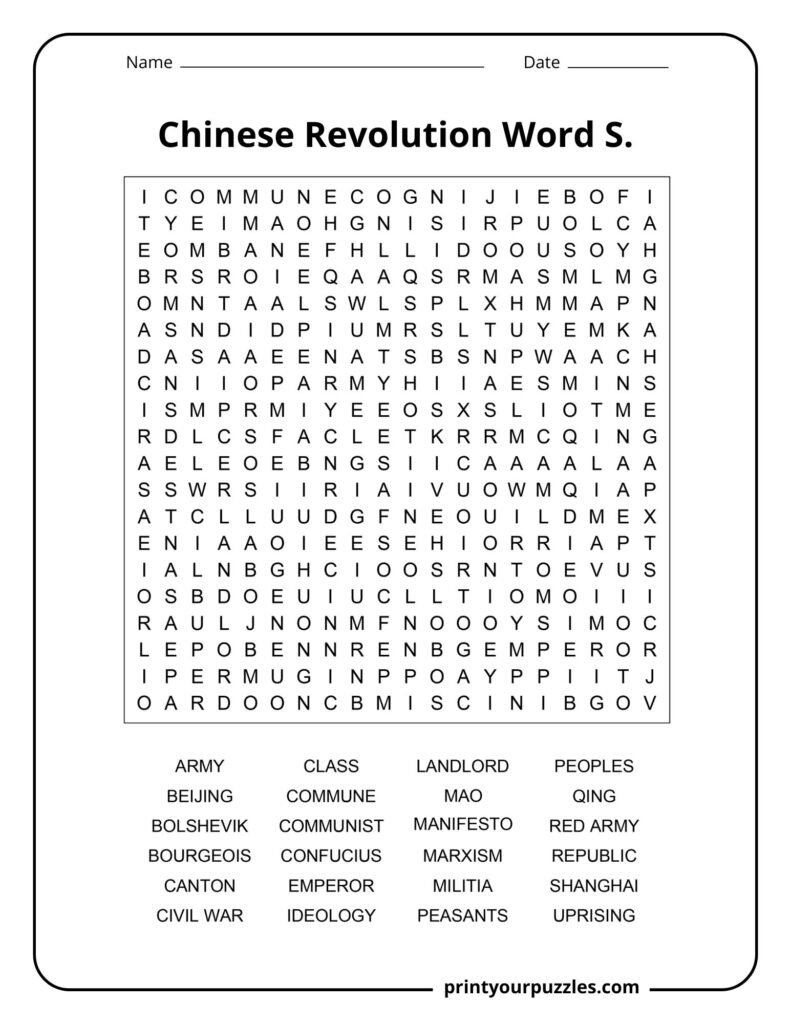
Hard Difficulty Word Search
Words to Find
ARMY, BEIJING, BOLSHEVIK, BOURGEOIS, CANTON, CIVIL WAR, CLASS, COMMUNE, COMMUNIST, CONFUCIUS, EMPEROR, IDEOLOGY, LANDLORD, MANIFESTO, MAO, MARXISM, MILITIA, PEASANTS, PEOPLES, QING, RED ARMY, REPUBLIC, SHANGHAI, UPRISING
6 Key FAQs About the Chinese Revolution
5 Curious "Did You Know?" Facts About the Chinese Revolution