Introduction to the Russian Revolution Word Search
The Russian Revolution was one of the most important political upheavals of the twentieth century. It took place mainly in 1917, although its causes had been developing for decades. The revolution ended the rule of Tsar Nicholas II, destroyed the Russian monarchy, and eventually brought the Bolsheviks to power. It also led to civil war and the creation of the Soviet Union in 1922.
Before the revolution, Russia was an autocracy in which the tsar held enormous political authority. Most people had little influence over government, while social and economic inequality remained severe. Millions of peasants lived in poverty, and growing numbers of industrial workers faced long hours, low wages, crowded housing, and dangerous factory conditions.
Public anger had already exploded during the Revolution of 1905. On Bloody Sunday, troops fired on peaceful demonstrators in St. Petersburg, damaging the image of the monarchy. Nicholas II later created the Duma, or parliament, but he continued to restrict its power. Many Russians believed that the government had failed to provide meaningful reform.
World War I pushed the empire into a deeper crisis. Russian armies suffered enormous casualties and repeated military defeats, while shortages of food, fuel, and supplies caused hardship at home. Inflation increased, transportation systems struggled, and confidence in the tsar collapsed. In early 1917, strikes and demonstrations in Petrograd were joined by mutinous soldiers, forcing Nicholas II to abdicate.
The Provisional Government replaced the monarchy but soon lost support. It continued Russia’s involvement in the war and failed to solve urgent problems involving land, food, and workers’ rights. At the same time, councils known as soviets represented workers and soldiers. Vladimir Lenin and the Bolsheviks gained popularity by promising “Peace, Land, and Bread.”
In the October Revolution, the Bolsheviks seized important locations in Petrograd and overthrew the Provisional Government. A civil war followed between the Bolshevik Red Army and several anti-Bolshevik White forces. Railways, telegraphs, newspapers, printing presses, armored trains, photography, radio, and political posters helped both sides move troops, spread propaganda, and organize support.
The Bolsheviks won the civil war and established a new Communist state. The revolution transformed government, land ownership, industry, education, and daily life, but it also brought violence, censorship, repression, and economic disruption.
With our Russian Revolution word search, students can explore vocabulary connected to Nicholas II, Lenin, the Bolsheviks, soviets, Petrograd, the Duma, the Red Army, the White Army, communism, abdication, and the events of 1917.
Related Word Searches:
Chinese Revolution | Cuban Revolution | Iranian Revolution | Cold War | Berlin Wall | Truman Doctrine
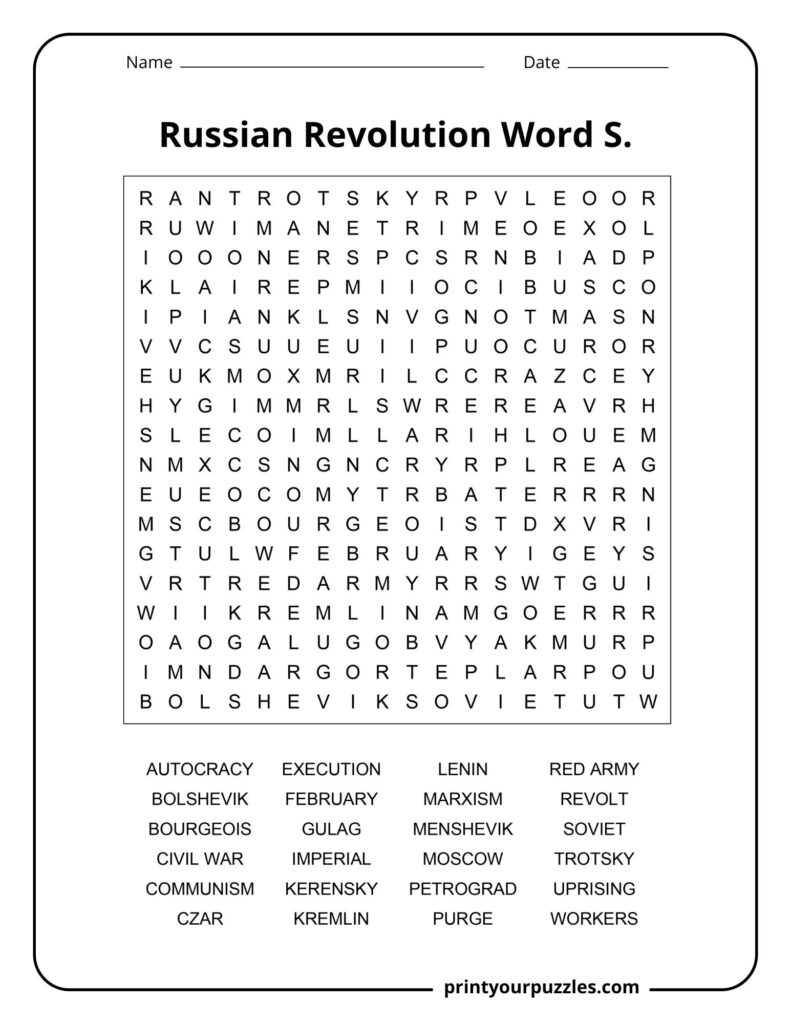
Medium Difficulty Word Search
Words to Find
AUTOCRACY, BOLSHEVIK, BOURGEOIS, CIVIL WAR, COMMUNISM, CZAR, EXECUTION, FEBRUARY, GULAG, IMPERIAL, KERENSKY, KREMLIN, LENIN, MARXISM, MENSHEVIK, MOSCOW, PETROGRAD, PURGE, RED ARMY, REVOLT, SOVIET, TROTSKY, UPRISING, WORKERS
All Words Defined
AUTOCRACY – A system of government where a single person holds absolute and unrestricted political power over an entire nation.
BOLSHEVIK – A member of the radical Marxist faction led by Lenin that seized power in Russia during the October Revolution of 1917.
BOURGEOIS – The middle class in capitalist society, owning means of production and often opposed by the working class in Marxist theory.
CIVIL WAR – The armed conflict between the Red Army and White Army forces that devastated Russia from 1917 to 1922.
COMMUNISM – A political ideology advocating collective ownership of production means, classless society, and equal distribution of wealth among all citizens.
CZAR – The title given to the emperor of Russia, symbolizing absolute monarchical rule that the revolution ultimately overthrew and abolished.
EXECUTION – The killing of political enemies and opponents, most notably the murder of Tsar Nicholas II and his entire family in 1918.
FEBRUARY – The 1917 revolution that erupted in February, forcing Tsar Nicholas II to abdicate and ending three centuries of Romanov dynastic rule.
GULAG – The Soviet system of forced labor camps where political prisoners and enemies of the state were sent under Stalin’s brutal regime.
IMPERIAL – Relating to the Russian Empire and its Tsarist ruling structure, which collapsed under revolutionary pressure and widespread social discontent in 1917.
KERENSKY – Alexander Kerensky, the moderate socialist who led the Provisional Government after February 1917 before being overthrown by the Bolsheviks in October.
KREMLIN – The historic fortress complex in Moscow that became the seat of Soviet governmental power after the Bolsheviks transferred the capital from Petrograd.
LENIN – Vladimir Ilyich Lenin, the revolutionary Marxist leader who led the Bolshevik Party and founded the Soviet state after the October Revolution.
MARXISM – The political and economic theory of Karl Marx advocating class struggle, worker revolution, and the eventual abolition of capitalist private property.
MENSHEVIK – The moderate socialist faction that opposed the Bolsheviks, favoring a gradual democratic approach to socialism rather than immediate violent revolutionary seizure of power.
MOSCOW – Russia’s historic city that became the new Soviet capital in 1918, replacing Petrograd as the political and administrative center of the new state.
PETROGRAD – The Russian capital city, formerly Saint Petersburg, where the key revolutionary events of both 1917 revolutions dramatically unfolded and changed history forever.
PURGE – The systematic elimination of political opponents within the Communist Party and Soviet society, reaching its peak during Stalin’s Great Terror of the 1930s.
RED ARMY – The military force created by the Bolsheviks in 1918, led by Trotsky, that defeated the White Army during the devastating Russian Civil War.
REVOLT – The mass popular uprising of workers, soldiers, and peasants against the Tsarist regime and later the Provisional Government throughout revolutionary Russia in 1917.
SOVIET – A revolutionary council of workers, soldiers, and peasants that became the fundamental governing unit of the new Bolshevik political and social system.
TROTSKY – Leon Trotsky, the brilliant Marxist theorist and military organizer who played a decisive role in the October Revolution and founded the Red Army.
UPRISING – A spontaneous or organized rebellion against established authority, reflecting the widespread popular anger toward inequality, war, and oppression in Tsarist Russian society.
WORKERS – The industrial proletariat whose revolutionary struggle against capitalist exploitation formed the social and ideological backbone of the entire Bolshevik revolutionary movement.
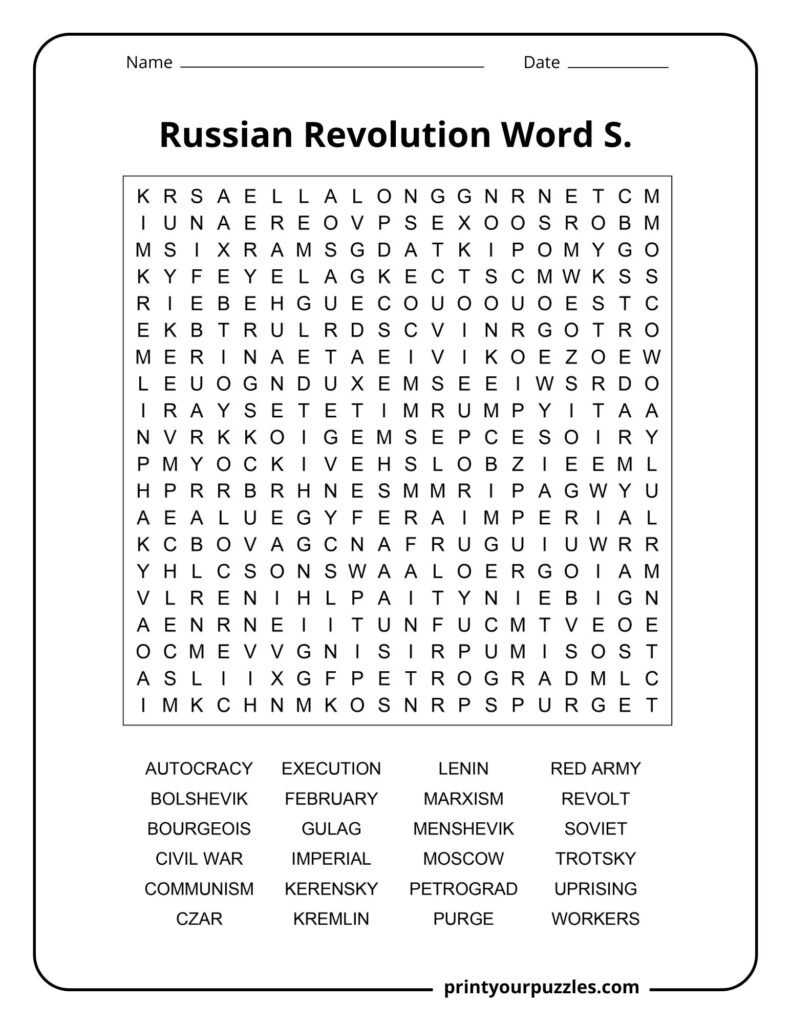
Hard Difficulty Word Search
Words to Find
AUTOCRACY, BOLSHEVIK, BOURGEOIS, CIVIL WAR, COMMUNISM, CZAR, EXECUTION, FEBRUARY, GULAG, IMPERIAL, KERENSKY, KREMLIN, LENIN, MARXISM, MENSHEVIK, MOSCOW, PETROGRAD, PURGE, RED ARMY, REVOLT, SOVIET, TROTSKY, UPRISING, WORKERS
6 Key FAQs About the Russian Revolution
5 Curious "Did You Know?" Facts About the Russian Revolution