

The Dot-Com Boom was a period of extraordinary excitement about the internet and digital business during the mid-to-late 1990s. It reached its peak around 1999 and early 2000, before collapsing during the dot-com crash between 2000 and 2002. During these years, investors, entrepreneurs, and consumers believed the internet would transform nearly every part of business and daily life.
The name “dot-com” came from the commercial .com domain used by many internet companies. Thousands of startups were created around websites, e-commerce, search engines, online advertising, email services, digital media, and web hosting. As personal computers, browsers, and household internet access became more common, companies rushed to build new online services and attract users.
Investors poured enormous amounts of money into internet businesses. Venture capital firms funded startups with ambitious ideas, while the stock market rewarded technology companies with rapidly rising share prices. Initial public offerings, or IPOs, often attracted intense attention, and some newly listed companies gained huge valuations almost immediately. In many cases, however, those valuations were based more on expected future growth than on actual profits.
The culture of the boom encouraged rapid expansion and risk-taking. Startups spent heavily on advertising, office space, salaries, and customer acquisition. Website traffic, market share, and brand recognition were often treated as more important than sustainable revenue. A belief spread that traditional business rules no longer applied in the new digital economy.
Some companies, including Amazon, eBay, Yahoo, and Google, built business models that survived and later became enormously influential. The period also helped establish technologies and habits that remain central today, including online shopping, search engines, digital advertising, email marketing, online marketplaces, web hosting, and digital payments. These developments helped prepare the way for streaming, cloud computing, social media, remote work, and smartphone-based services.
The bubble began to burst when investors started questioning unrealistic valuations and unprofitable business models. Funding declined, stock prices fell, and many companies ran out of money. The crash led to bankruptcies, layoffs, lost investments, and the disappearance of numerous startups. The Nasdaq suffered particularly severe losses as confidence in internet stocks collapsed.
Even so, the Dot-Com Boom left a lasting technological legacy. The infrastructure, software, and business ideas created during the period helped shape the modern digital economy.
With our Dot-Com Boom Word Search, students can explore vocabulary connected to startups, investors, venture capital, websites, IPOs, e-commerce, the Nasdaq, online advertising, bubbles, crashes, and the rapid growth of the internet.
Related Word Searches:
Bill Clinton | George W. Bush | Microsoft | Apple | Google | IBM

AD BANNER, AMAZON, BANDWIDTH, BROWSER, BUBBLE, CLICK, DOMAIN, EBAY, EMAIL, FUNDING, GOOGLE, HOSTING, IPO, JAVA, NASDAQ, NETSCAPE, PORTAL, SEARCH, SERVER, STARTUP, TRAFFIC, VENTURE, WEBCAST, YAHOO
AD BANNER – A rectangular online advertisement displayed on websites during the Dot Com Boom, designed to attract clicks and promote internet companies, products, or digital services.
AMAZON – Online bookstore founded by Amazon that rapidly expanded into many products during the Dot Com Boom, becoming one of the internet’s most successful businesses.
BANDWIDTH – The amount of data transferred through an internet connection, crucial during the Dot Com Boom as websites required faster speeds for growing online traffic.
BROWSER – Software used to access and view websites on the internet, becoming extremely popular in the 1990s as millions of people first explored the web.
BUBBLE – Economic situation where internet company values rose rapidly beyond realistic levels before collapsing in the early 2000s during the Dot Com crash.
CLICK – Action of selecting a link or advertisement online with a computer mouse, becoming an important measurement for internet advertising and website popularity.
DOMAIN – Unique internet address used to identify a website, highly valuable during the Dot Com Boom as businesses rushed to establish online identities.
EBAY – Online auction marketplace launched during the internet boom, allowing users to buy and sell products worldwide through competitive bidding and direct sales.
EMAIL – Electronic messaging system that became one of the internet’s most widely used communication tools during the rapid expansion of online technology.
FUNDING – Financial investment provided to internet startups by venture capitalists and investors hoping to profit from rapidly growing online businesses during the Dot Com era.
GOOGLE – Internet search engine founded in 1998 that quickly became dominant by providing fast and accurate search results during the height of the Dot Com Boom.
HOSTING – Service that stores websites on internet servers, allowing businesses and individuals during the Dot Com Boom to publish and maintain online content.
IPO – Initial Public Offering where private internet companies sold shares to the public, often generating huge excitement and investor speculation during the Dot Com Boom.
JAVA – Popular programming language widely used for websites and internet applications during the late 1990s because of its flexibility and cross-platform compatibility.
NASDAQ – American stock exchange heavily associated with technology companies, experiencing dramatic rises and sharp declines during the Dot Com Boom and crash.
NETSCAPE – Early internet browser company whose successful stock market launch symbolized the beginning of widespread investor enthusiasm for internet businesses in the 1990s.
PORTAL – Website designed as a starting point for internet users, offering search tools, news, email, and links to many online services and resources.
SEARCH – Process of finding information online using internet search engines, becoming increasingly important as the number of websites rapidly expanded during the Dot Com Boom.
SERVER – Powerful computer system that stores and delivers websites or online services to users across the internet, essential for growing Dot Com businesses.
STARTUP – Newly created company focused on innovative internet products or services, often seeking rapid growth and investor funding during the Dot Com Boom years.
TRAFFIC – Number of visitors accessing a website, closely monitored during the Dot Com Boom because high traffic often attracted advertisers and investors.
VENTURE – Investment activity where financiers supported risky internet startups with hopes of large future profits during the explosive growth of the Dot Com era.
WEBCAST – Live or recorded audio and video broadcast delivered through the internet, becoming increasingly popular as internet technology improved during the late 1990s.
YAHOO – Popular internet portal and search company that became one of the most recognized online brands during the Dot Com Boom of the 1990s.
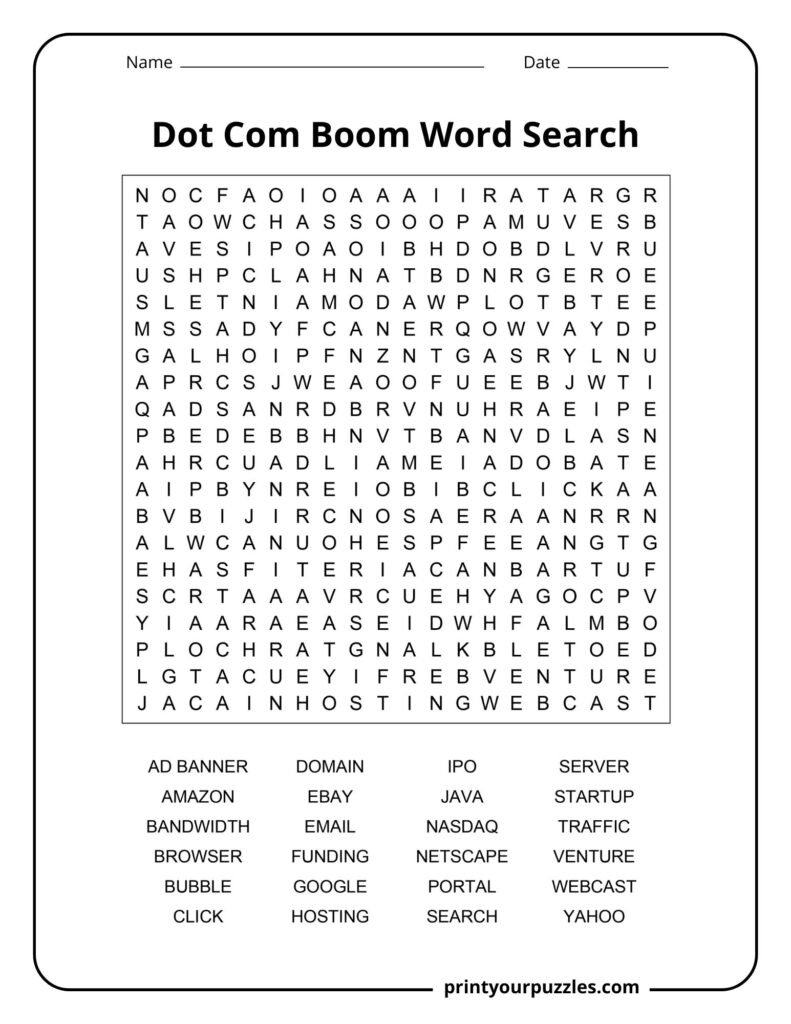
AD BANNER, AMAZON, BANDWIDTH, BROWSER, BUBBLE, CLICK, DOMAIN, EBAY, EMAIL, FUNDING, GOOGLE, HOSTING, IPO, JAVA, NASDAQ, NETSCAPE, PORTAL, SEARCH, SERVER, STARTUP, TRAFFIC, VENTURE, WEBCAST, YAHOO
The Dot Com Boom was a period during the late 1990s when internet companies rapidly grew, attracting huge investments and creating excitement around online businesses and technology.
Investors believed the internet would completely transform shopping, communication, and business, leading to massive funding for startups and rapid expansion of online companies worldwide.
Many internet companies lacked profits or sustainable business models, causing investor confidence to collapse when unrealistic expectations and excessive spending became impossible to maintain.
Companies like Amazon and Google survived by building strong business models, improving services, and adapting successfully after the market crash.
The Dot Com Boom accelerated internet adoption, transformed communication and shopping habits, encouraged digital innovation, and laid the foundation for today’s technology-driven global economy.
Dot.con: How America Lost Its Mind and Money in the Internet Era by John Cassidy. New Yorker economist-journalist Cassidy traces the dot-com bubble from ARPANET to NASDAQ collapse — blending rigorous financial analysis with vivid character portraits of Bezos, Greenspan, and Silicon Valley’s true believers in effortlessly readable prose.
During the late 1990s, internet startups used expensive television commercials to gain attention quickly, believing popularity and website traffic would eventually create massive financial success.
Amazon started as an online bookstore in 1994 before expanding into electronics, clothing, groceries, streaming services, and becoming a global technology giant.
During the Dot Com Boom, excitement around internet businesses became so intense that some companies gained huge investments without realistic business plans or profits.
When internet companies failed to meet expectations, technology stock prices collapsed dramatically, causing one of the biggest financial downturns in modern market history.
Most people used dial-up connections in the 1990s, meaning websites often loaded slowly while users listened to the famous modem connection sounds.