
Ancient Greece was one of the most influential civilizations of the ancient world. Greek civilization began developing during the second millennium BCE, but the period commonly known as Ancient Greece lasted from around 800 BCE to 146 BCE, when Greece came under Roman control. It developed across a mountainous mainland, hundreds of islands, and the coasts surrounding the Aegean Sea. Because travel over land was difficult, Greek communities often grew independently as city-states. At the same time, the sea encouraged fishing, trade, exploration, and contact with other cultures throughout the Mediterranean.
The city-state, or polis, became the center of Greek political and social life. Athens, Sparta, Corinth, and Thebes each developed their own laws, traditions, and forms of government. During the fifth century BCE, Athens became famous for an early form of democracy in which eligible male citizens could debate and vote directly on public decisions. However, women, enslaved people, and foreigners were excluded from political participation.
Sparta followed a very different path. Its society emphasized military discipline, physical training, obedience, and service to the state. The contrast between democratic Athens and militarized Sparta reflected the diversity of the Greek world. Greek city-states sometimes united against common enemies, especially during the Persian Wars in the early fifth century BCE, but rivalry later led Athens and Sparta into the long Peloponnesian War from 431 to 404 BCE.
Greek influence expanded greatly under Alexander the Great, king of Macedon. Between 334 and 323 BCE, he conquered a vast empire stretching from Greece and Egypt to Persia and parts of India. His campaigns spread Greek language, art, architecture, philosophy, and customs across a wide area. After his death, the Hellenistic period continued until 31 BCE, blending Greek traditions with those of Egypt, Persia, and Asia.
Religion and mythology shaped Greek culture. Greeks worshipped many gods and goddesses, including Zeus, Athena, Apollo, Poseidon, Aphrodite, and Artemis. Temples, festivals, sacrifices, and oracles played important roles in public life. The Olympic Games were traditionally first recorded in 776 BCE and were held in honor of Zeus, while drama developed through religious festivals. Greek myths also explained natural forces, heroic adventures, human behavior, and the relationship between mortals and the gods.
Ancient Greek thinkers and inventors made achievements that still influence modern life. Socrates, Plato, and Aristotle shaped philosophy, logic, ethics, politics, and education. Greek mathematicians advanced geometry, while physicians such as Hippocrates encouraged careful observation of illness. The Greeks also developed theater, historical writing, maps, cranes, water mills, alarm devices, mechanical machines, and improvements in engineering and astronomy. Their ideas helped shape modern democracy, medicine, science, architecture, sports, and literature.
Through this Ancient Greece word search, students can explore vocabulary connected to city-states, democracy, mythology, philosophy, warfare, inventions, art, and daily life. These terms show how a civilization that flourished more than two thousand years ago created political ideas, scientific methods, stories, buildings, and cultural traditions that remain influential today.
Related Word Searches:
Peloponnesian War | Ancient Rome | Ancient Egypt | Ancient Mesopotamia | Egyptian Gods | Silk Road
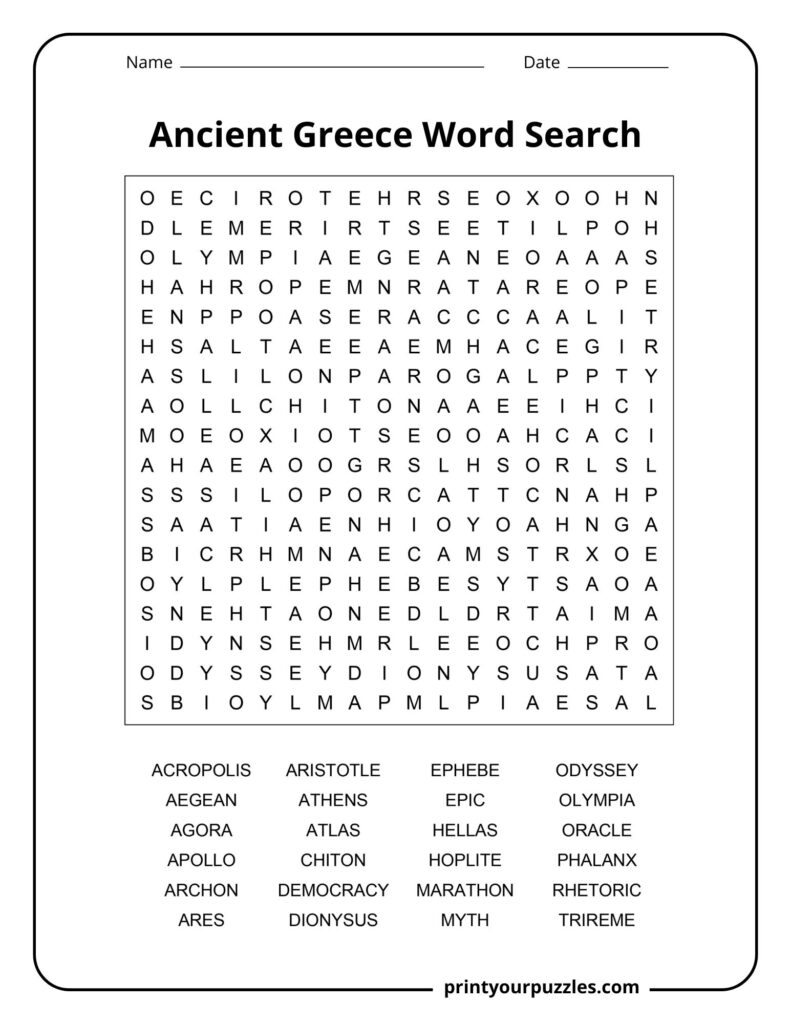
ACROPOLIS, AEGEAN, AGORA, APOLLO, ARCHON, ARES, ARISTOTLE, ATHENS, ATLAS, CHITON, DEMOCRACY, DIONYSUS, EPHEBE, EPIC, HELLAS, HOPLITE, MARATHON, MYTH, ODYSSEY, OLYMPIA, ORACLE, PHALANX, RHETORIC, TRIREME
ACROPOLIS – A fortified hilltop citadel at the center of ancient Greek cities, most famously in Athens, where the Parthenon temple was built to honor the goddess Athena.
AEGEAN – The sea located between Greece and Turkey, vital for trade, communication, and naval power among ancient Greek city-states and civilizations throughout antiquity.
AGORA – An open public space in ancient Greek cities serving as a marketplace and gathering place where citizens met to trade goods, discuss politics, and socialize freely.
APOLLO – One of the most important Olympian gods, associated with the sun, music, poetry, art, prophecy, and healing, worshipped widely across the ancient Greek world.
ARCHON – A chief magistrate in ancient Greek city-states, particularly Athens, responsible for overseeing civic administration, religious duties, and judicial matters within the government.
ARES – The Greek god of war and conflict, son of Zeus and Hera, representing the brutal and violent aspects of battle, often portrayed as fierce and aggressive.
ARISTOTLE – A highly influential ancient Greek philosopher and scientist, student of Plato and tutor of Alexander the Great, whose writings shaped Western philosophy, logic, and science enormously.
ATHENS – The most powerful and culturally rich city-state of ancient Greece, birthplace of democracy, philosophy, and dramatic arts, and home to remarkable architectural achievements.
ATLAS – A Titan in Greek mythology condemned by Zeus to carry the heavens on his shoulders for eternity, often depicted supporting a celestial sphere in ancient artwork.
CHITON – A simple garment worn by ancient Greeks, consisting of a rectangular piece of linen or wool fastened at the shoulders, commonly worn by both men and women.
DEMOCRACY – A revolutionary political system developed in ancient Athens around the fifth century BC, allowing male citizens to participate directly in governmental decisions and civic life.
DIONYSUS – The Greek god of wine, festivity, theater, and ecstasy, whose cult celebrations inspired the development of dramatic arts and theatrical festivals in ancient Greece.
EPHEBE – A young male citizen of ancient Greece, typically aged between eighteen and twenty, undergoing mandatory military training and civic education before full adult citizenship was granted.
EPIC – A long narrative poem celebrating heroic deeds and legendary figures, exemplified by Homer’s Iliad and Odyssey, foundational works of ancient Greek literary and cultural tradition.
HELLAS – The ancient Greek name for Greece itself, used by Greeks to refer to their homeland and collective cultural identity, still used in the modern Greek language today.
HOPLITE – A heavily armed ancient Greek citizen-soldier who fought in tight infantry formations called phalanxes, carrying a large shield, long spear, and wearing bronze armor.
MARATHON – A small plain northeast of Athens where Greeks famously defeated the Persian army in 490 BC, later lending its name to the modern long-distance running race.
MYTH – A traditional sacred story in ancient Greek culture explaining the origins of the world, natural phenomena, and human existence through gods, heroes, and supernatural beings.
ODYSSEY – Homer’s epic poem recounting the ten-year journey of the hero Odysseus returning home to Ithaca after the fall of Troy, facing gods, monsters, and great hardships.
OLYMPIA – A sacred sanctuary in the western Peloponnese where the ancient Olympic Games were held every four years in honor of Zeus, uniting Greek city-states peacefully.
ORACLE – A sacred site or priestess through whom the gods communicated divine guidance to humans, with the Oracle of Delphi being the most revered throughout the ancient Greek world.
PHALANX – A powerful military formation used by ancient Greek hoplites, consisting of soldiers standing in tight rows with overlapping shields and extended spears, creating an almost impenetrable wall.
RHETORIC – The art of persuasive speaking and writing, highly valued in ancient Greek democracy and philosophy, taught by sophists and mastered by great orators like Demosthenes and Pericles.
TRIREME – A fast and powerful ancient Greek warship propelled by three rows of oarsmen on each side, used effectively in famous naval battles such as Salamis against Persia.
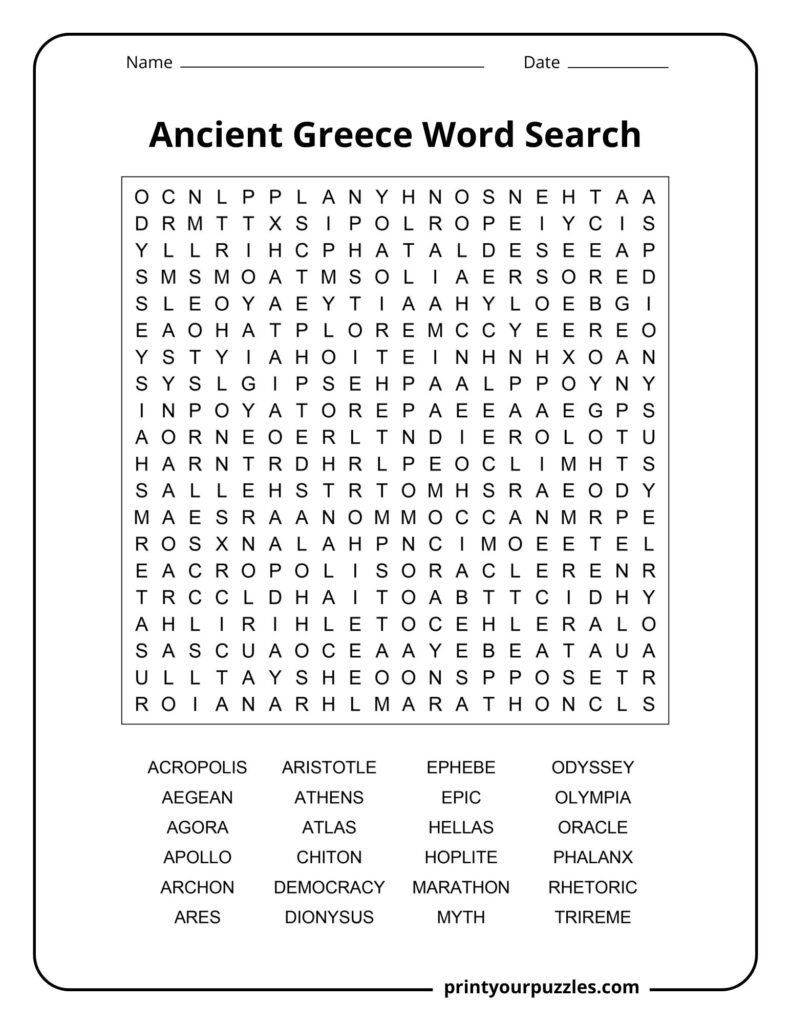
ACROPOLIS, AEGEAN, AGORA, APOLLO, ARCHON, ARES, ARISTOTLE, ATHENS, ATLAS, CHITON, DEMOCRACY, DIONYSUS, EPHEBE, EPIC, HELLAS, HOPLITE, MARATHON, MYTH, ODYSSEY, OLYMPIA, ORACLE, PHALANX, RHETORIC, TRIREME
Ancient Greece was a civilization flourishing from around 800 BC to 146 BC, composed of independent city-states sharing a common language, religion, and culture across the Mediterranean region.
The twelve Olympian gods, including Zeus, Hera, Athena, Apollo, and Poseidon, were central to Greek religion, each governing different aspects of nature, human life, and the cosmos.
Ancient Greece gave humanity democracy, philosophy, mathematics, theater, the Olympic Games, and foundational principles of architecture, science, and literature that continue shaping modern Western civilization profoundly today.
Most Greeks lived as farmers, merchants, or craftsmen. Men participated in public life while women managed households. Education, athletics, religious festivals, and lively agora gatherings structured everyday social existence.
Constant warfare between city-states, particularly the devastating Peloponnesian War between Athens and Sparta, weakened Greece significantly, eventually leaving it vulnerable to conquest by Macedonia and later Rome.
Persian Fire: The First World Empire and the Battle for the West by Tom Holland. Holland, a Cambridge-trained classicist and winner of the Classical Association prize, turns the world-altering Greco-Persian Wars into a gripping, novelistic thriller without sacrificing scholarly rigour.
Greek engineer Ctesibius designed a water clock around 250 BC that used rising water to trigger a whistle sound, waking people at a predetermined time each morning.
Male athletes performed entirely unclothed at the Olympics, believing the naked human body represented ideal beauty and honor, while married women were forbidden from even watching the competitions.
Without modern toothpaste, Greeks mixed powdered charcoal, oyster shells, and flavoring agents like mint to clean their teeth, a surprisingly effective method according to modern dental researchers.
Despite inventing democracy, Athens only granted voting rights to free adult males, completely excluding women, slaves, and foreigners, who together represented the vast majority of the total population.
Greek mythology associated red hair with dangerous supernatural power, believing that redheaded individuals would transform into fearsome blood-drinking creatures called Empusas after dying, reflecting widespread cultural superstitions of the time.