
Ancient Egypt was one of the longest-lasting and most influential civilizations in world history. It developed in northeastern Africa along the Nile River, whose annual floods left behind rich soil for farming. The river also provided water, fish, transportation, and a natural route for trade. Surrounded by deserts, Egypt was protected from many invasions, while the Nile connected communities and helped cities grow.
Ancient Egypt was originally divided into Upper Egypt in the south and Lower Egypt in the north. Around 3100 BCE, the two regions were united, traditionally under King Narmer. This unification began a civilization that continued for approximately 3,000 years. Egyptian history is often divided into the Old Kingdom, Middle Kingdom, and New Kingdom, with periods of stability separated by times of political weakness or foreign rule.
Egypt was governed by pharaohs, who were both political rulers and religious leaders. Egyptians believed the pharaoh helped preserve order and maintain a connection between the people and the gods. Famous rulers included Khufu, associated with the Great Pyramid of Giza; Hatshepsut, one of Egypt’s most successful female pharaohs; Tutankhamun, whose tomb was discovered nearly intact; and Ramses II, known for military campaigns and monumental building projects.
Religion influenced nearly every part of Egyptian life. Egyptians worshipped many gods and goddesses, including Ra, Osiris, Isis, Horus, and Anubis. They believed strongly in the afterlife and preserved bodies through mummification so that the spirit could continue its journey. Tombs were filled with food, jewelry, tools, paintings, and other objects that the dead might need. Pyramids, temples, obelisks, statues, and the Great Sphinx reflected both religious belief and extraordinary engineering ability.
Ancient Egyptian society included priests, scribes, soldiers, farmers, artisans, merchants, servants, and enslaved people. Most Egyptians worked in agriculture, growing crops such as wheat, barley, flax, onions, and dates. Scribes were especially important because they could read and write hieroglyphics. These symbols appeared on monuments, tombs, temple walls, and papyrus documents. Centuries later, the Rosetta Stone helped scholars understand the ancient writing system.
The Egyptians also made important advances that still influence life today. They produced papyrus as a practical writing material, developed durable inks, and created a 365-day calendar based on the solar year. They used sundials and water clocks to measure time and improved irrigation, surveying, mathematics, medicine, shipbuilding, glassmaking, locks, and surgical instruments. Although some discoveries also appeared independently in other civilizations, Egyptian knowledge contributed greatly to later scientific and practical development.
Students can use this Ancient Egypt word search to review vocabulary connected to the Nile, pharaohs, pyramids, gods, mummification, hieroglyphics, inventions, government, and daily life. These words help reveal how Ancient Egypt built a remarkable civilization whose monuments, discoveries, beliefs, and artistic achievements continue to fascinate and influence the modern world.
Related Word Searches:
Egyptian Gods | Ancient Mesopotamia | Ancient Greece | Ancient Rome | Silk Road | Stone Age
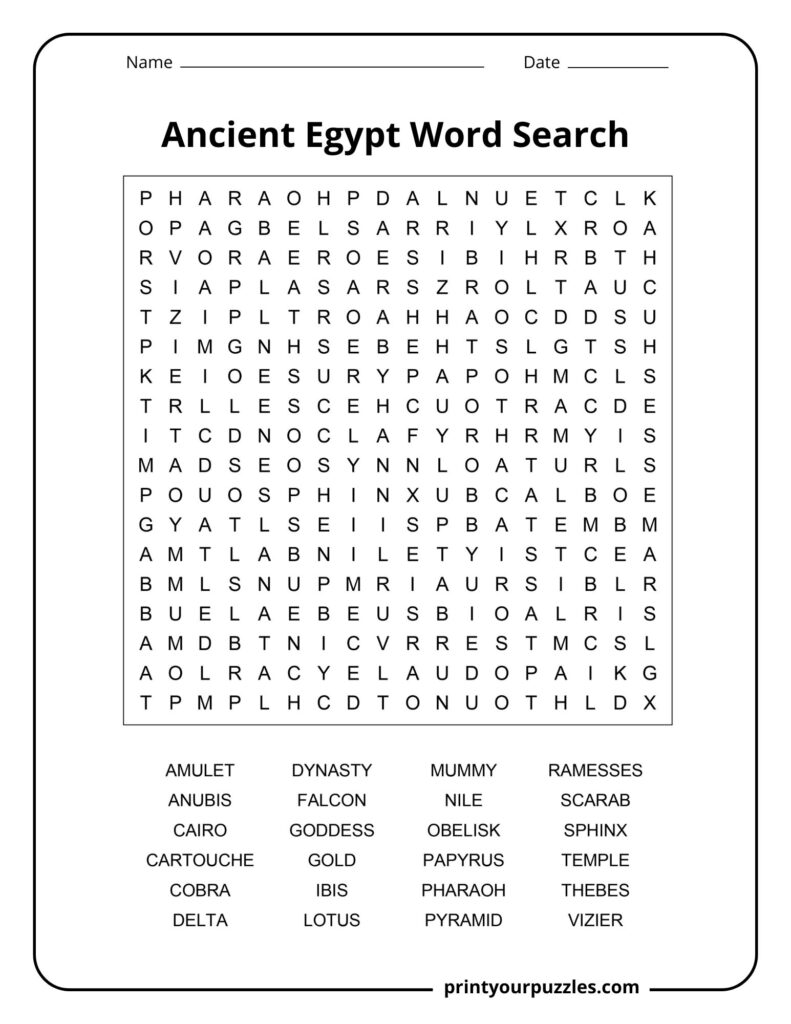
AMULET, ANUBIS, CAIRO, CARTOUCHE, COBRA, DELTA, DYNASTY, FALCON, GODDESS, GOLD, IBIS, LOTUS, MUMMY, NILE, OBELISK, PAPYRUS, PHARAOH, PYRAMID, RAMESSES, SCARAB, SPHINX, TEMPLE, THEBES, VIZIER
AMULET – A small magical charm worn or carried by ancient Egyptians to protect the bearer from evil spirits, bad luck, and harm, often shaped like gods or sacred symbols.
ANUBIS – The jackal-headed god of the dead and embalming, responsible for guiding souls to the afterlife and weighing their hearts against the feather of truth and justice.
CAIRO – The modern capital of Egypt, built near the ancient city of Memphis, standing today as a massive metropolis close to the famous Giza pyramids and countless archaeological treasures.
CARTOUCHE – An oval-shaped frame used in ancient Egyptian hieroglyphics to enclose and highlight the royal names of pharaohs, symbolizing protection and eternal life for the ruler named within.
COBRA – A sacred snake in ancient Egypt, known as the uraeus, worn on the headdresses of pharaohs as a symbol of divine authority, royal power, and protection against all enemies.
DELTA – The triangular, fertile region where the Nile River fans out into the Mediterranean Sea, forming rich agricultural land that sustained ancient Egyptian civilization for thousands of remarkable years.
DYNASTY – A sequence of rulers belonging to the same family or bloodline, with ancient Egypt organized into thirty-one dynasties spanning over three thousand years of continuous and remarkable civilization.
FALCON – A sacred bird associated with the sky god Horus, symbolizing divine kingship and protection in ancient Egypt, frequently depicted in art and worshipped as a powerful and holy creature.
GODDESS – A female divine being worshipped in ancient Egypt, with dozens of goddesses like Isis, Hathor, and Bastet representing love, magic, fertility, war, and protection across Egyptian religious life.
GOLD – Considered the flesh of the gods in ancient Egypt, gold was highly prized for crafting jewelry, royal masks, and sacred objects, symbolizing eternity, divine power, and incorruptible perfection.
IBIS – A long-beaked wading bird sacred to Thoth, the god of wisdom and writing, frequently mummified as a religious offering and depicted throughout ancient Egyptian art and sacred temple decorations.
LOTUS – A water flower holding deep symbolic meaning in ancient Egypt, representing creation, rebirth, and the sun, since it closes at night and reopens each morning just like the rising sun.
MUMMY – A carefully preserved human or animal body prepared through elaborate embalming rituals, with organs removed and the body wrapped in linen bandages to ensure survival into the eternal afterlife.
NILE – The longest and most important river in the world for ancient Egyptians, providing water, fertile soil through annual floods, fish, and transportation, making all Egyptian civilization entirely possible and sustainable.
OBELISK – A tall, four-sided stone pillar tapering to a pyramid-shaped top, erected at temple entrances to honor the sun god Ra, inscribed with hieroglyphics celebrating royal achievements and divine glory.
PAPYRUS – A tall reed plant grown along the Nile used to produce one of the world’s earliest writing surfaces, allowing ancient Egyptians to record religious texts, administrative records, and literary works.
PHARAOH – The all-powerful ruler of ancient Egypt, considered both a god and a king, responsible for maintaining cosmic order, leading armies, building monuments, and mediating between the human and divine worlds.
PYRAMID – A massive stone tomb built for pharaohs and important royals, designed with a square base rising to a pointed peak, serving as both a burial chamber and a gateway to eternal life.
RAMESSES – The name of eleven Egyptian pharaohs, most famously Ramesses II called the Great, one of ancient Egypt’s most powerful and celebrated rulers, known for military conquests and extraordinary monumental building projects.
SCARAB – A dung beetle considered sacred in ancient Egypt, symbolizing rebirth, transformation, and the rising sun, widely used as an amulet, seal, and decorative motif throughout Egyptian art and jewelry.
SPHINX – A mythical creature with a human head and lion’s body, most famously represented by the Great Sphinx of Giza, serving as a powerful guardian of sacred spaces and royal tombs.
TEMPLE – A grand stone structure built to honor and house the gods of ancient Egypt, serving as a center for religious rituals, daily offerings, priestly ceremonies, and the spiritual life of communities.
THEBES – A magnificent ancient Egyptian city located along the Nile, serving as the capital during the New Kingdom period and home to spectacular monuments including Karnak, Luxor Temple, and the Valley of the Kings.
VIZIER – The most powerful government official in ancient Egypt after the pharaoh, responsible for overseeing administration, justice, taxation, and daily management of the entire kingdom on behalf of the ruling pharaoh.
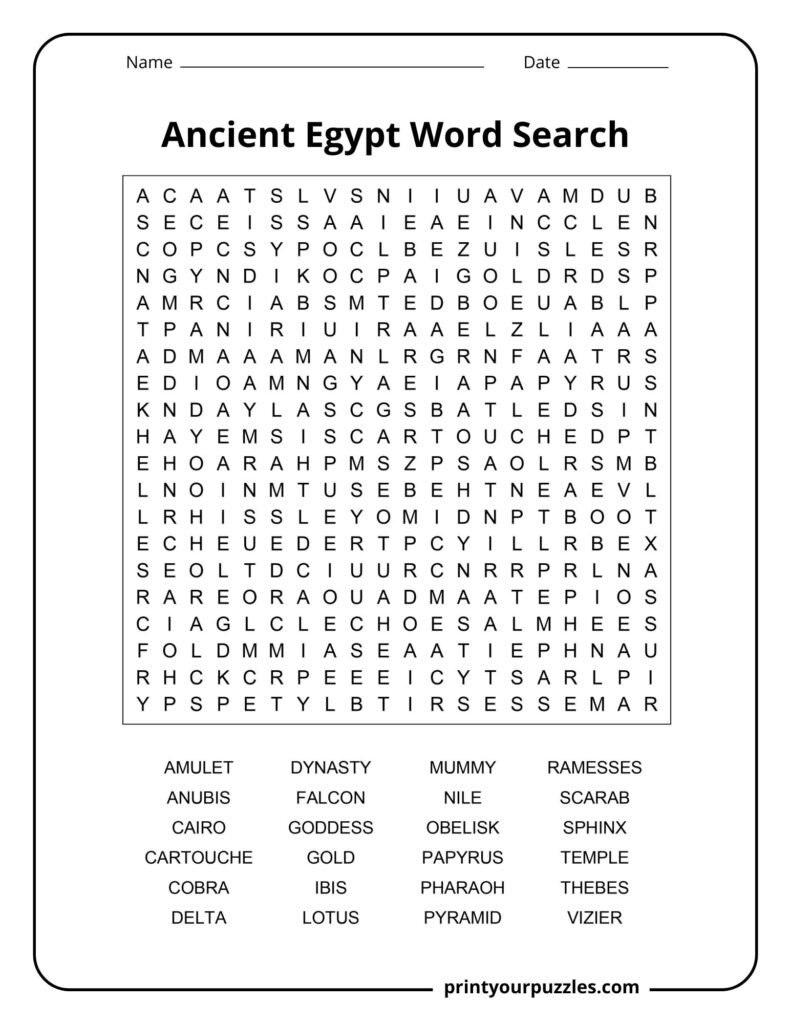
AMULET, ANUBIS, CAIRO, CARTOUCHE, COBRA, DELTA, DYNASTY, FALCON, GODDESS, GOLD, IBIS, LOTUS, MUMMY, NILE, OBELISK, PAPYRUS, PHARAOH, PYRAMID, RAMESSES, SCARAB, SPHINX, TEMPLE, THEBES, VIZIER
The pharaoh was considered both a god and king, maintaining cosmic order, leading armies, constructing monuments, and acting as the essential bridge between humans and the divine world.
Embalmers removed internal organs, dried the body with natron salt, wrapped it in linen bandages, and placed it in a decorated coffin to ensure preservation for eternal afterlife.
Pyramids served as monumental royal tombs, protecting the pharaoh’s body and treasures while providing a sacred pathway for the ruler’s soul to ascend and join the gods in eternity.
Ancient Egyptians used hieroglyphics, a complex system combining pictorial symbols and phonetic signs, carved on temple walls, written on papyrus, and used for religious, administrative, and historical purposes.
The Nile was absolutely vital, providing fresh water, fertile agricultural soil through annual flooding, fish for food, and a major transportation route connecting all Egyptian communities and cities.
The Rise and Fall of Ancient Egypt by Toby Wilkinson. Wilkinson, a Cambridge Egyptologist fluent in hieroglyphs, combines sweeping narrative with cutting-edge archaeology, vividly exposing Egypt’s ruthless politics and propaganda behind its timeless, monumental grandeur.
Hieroglyphics date back over 5,000 years, combining hundreds of pictorial symbols to record religious texts, royal decrees, historical events, and everyday administrative information across ancient Egyptian civilization.
Recent archaeological evidence confirms pyramid builders were actually paid, well-fed Egyptian laborers who received medical care, lived in organized villages, and were deeply respected for their extraordinary construction work.
Cats were associated with the goddess Bastet, protected homes from snakes and rodents, and were so revered that killing one, even accidentally, could be punishable by death.
Egyptian women could own property, initiate divorce, conduct business, testify in court, and inherit wealth independently, giving them significantly more legal freedom than women in most other ancient civilizations.
Thousands of years before penicillin was discovered, Egyptian physicians applied moldy bread to infected wounds, instinctively harnessing the natural antibacterial properties of mold to treat patients and prevent deadly infections.