
Ancient China developed one of the world’s oldest and most influential civilizations. Its early communities grew near the Yellow River and the Yangtze River, where fertile soil supported farming and permanent settlements. These rivers helped people produce food and build towns, but they could also cause destructive floods. Over time, strong rulers united different regions, created organized governments, and established traditions that shaped Chinese society for thousands of years.
Much of Ancient Chinese history is divided into dynasties, or periods ruled by particular families. The Shang Dynasty became known for bronze work, writing, warfare, and religious ceremonies. The Zhou Dynasty introduced the Mandate of Heaven, the belief that rulers received the right to govern because they ruled fairly and protected the people. According to this idea, a dynasty could lose its authority if its leaders became cruel, corrupt, or ineffective.
In 221 BCE, Qin Shi Huang became the first emperor to unite China under one central government. The Qin Dynasty standardized writing, currency, weights, and measurements, making it easier to govern and trade across the empire. Qin Shi Huang also ordered the construction of roads, defensive walls, and a vast tomb guarded by thousands of life-sized Terracotta Army figures. Although the Qin Dynasty was short, its influence was enormous.
The Han Dynasty followed and became one of Ancient China’s most successful periods. Han rulers expanded the empire, strengthened government, supported education, and encouraged trade along the Silk Road. This network of routes connected China with Central Asia, the Middle East, and Europe. Silk, spices, metals, and other goods were exchanged, but ideas, technologies, religions, and customs also traveled between cultures.
Ancient Chinese life was shaped by family, farming, education, government, and belief. Confucianism emphasized respect, responsibility, learning, and proper behavior. Daoism encouraged harmony with nature, while Legalism supported strict laws and powerful government.
Chinese scholars, engineers, and craftspeople created inventions that continue to influence modern life. Paper transformed writing and education, while the compass later improved navigation. Gunpowder changed warfare and celebrations, and printing made it possible to reproduce texts more efficiently.
Other important achievements included silk production, iron tools, wheelbarrows, early seismographs, and advances in medicine, astronomy, agriculture, and engineering.
Students can use this Ancient China word search to review vocabulary connected to dynasties, emperors, rivers, philosophy, inventions, trade, government, and daily life. These words help reveal how Ancient China became a powerful civilization whose ideas, discoveries, and traditions continue to influence the world today.
Related Word Searches:
Ancient Japan | Silk Road | Ancient Mesopotamia | Ancient Egypt | Ancient Greece | Ancient Rome
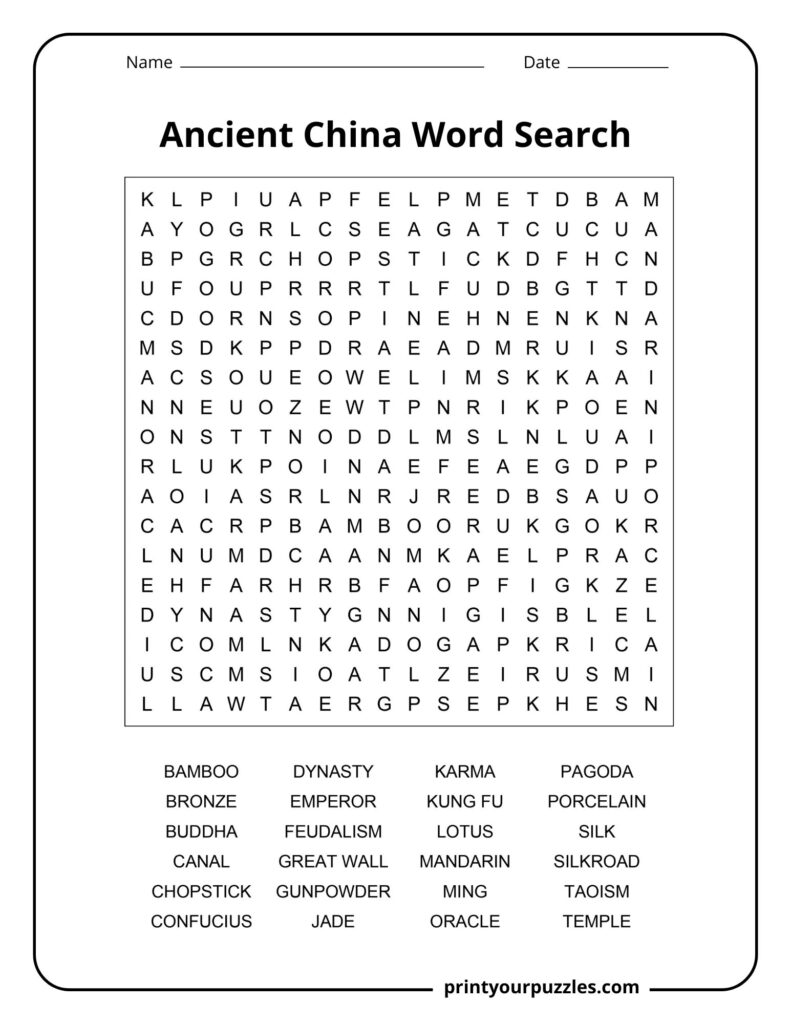
BAMBOO, BRONZE, BUDDHA, CANAL, CHOPSTICK, CONFUCIUS, DYNASTY, EMPEROR, FEUDALISM, GREAT WALL, GUNPOWDER, JADE, KARMA, KUNG FU, LOTUS, MANDARIN, MING, ORACLE, PAGODA, PORCELAIN, SILK, SILKROAD, TAOISM, TEMPLE
BAMBOO – A fast-growing plant widely used in Ancient China for construction, writing, food, and tools, playing a central role in daily life and culture.
BRONZE – A metal alloy of copper and tin mastered by ancient Chinese craftsmen to create weapons, ritual vessels, and decorative objects during early dynasties.
BUDDHA – The enlightened spiritual figure whose teachings founded Buddhism, a religion that spread throughout Ancient China influencing art, philosophy, and daily life profoundly.
CANAL – An artificially built waterway used in Ancient China to transport goods, connect rivers, and irrigate farmland, supporting trade and agricultural development across regions.
CHOPSTICK – Traditional eating utensils used in Ancient China, made from bamboo or wood, reflecting Chinese dining customs and cultural identity passed down through countless generations.
CONFUCIUS – A highly influential Chinese philosopher whose teachings on ethics, family, loyalty, and social harmony shaped government, education, and culture throughout Ancient China for centuries.
DYNASTY – A succession of rulers from the same family governing Ancient China, with each dynasty leaving lasting contributions to culture, technology, law, and territorial expansion.
EMPEROR – The supreme ruler of Ancient China, considered the Son of Heaven, holding absolute power over government, military, religion, and the lives of all citizens.
FEUDALISM – A social and political system in Ancient China where lords controlled land and peasants worked it in exchange for protection, forming a strict hierarchical society.
GREAT WALL – A massive fortification stretching thousands of kilometers built to protect Ancient China from northern nomadic invasions, representing extraordinary engineering skill and collective human effort.
GUNPOWDER – A revolutionary explosive mixture invented in Ancient China by alchemists, initially used in fireworks and later transforming military warfare across Asia and the world.
JADE – A precious green stone deeply revered in Ancient China as a symbol of purity, virtue, and immortality, used in jewelry, ceremonial objects, and royal ornaments.
KARMA – A spiritual concept adopted from Buddhism and Hinduism in Ancient China, referring to the moral consequences of one’s actions affecting present and future life experiences.
KUNG FU – A traditional Chinese martial art developed over centuries in Ancient China, combining physical discipline, mental focus, and spiritual philosophy rooted in Taoist and Buddhist principles.
LOTUS – A sacred flower in Ancient China symbolizing purity, spiritual enlightenment, and rebirth, frequently depicted in Buddhist art, poetry, architecture, and religious ceremonies throughout history.
MANDARIN – The official spoken language and dialect of Ancient China’s imperial court, also referring to high-ranking government officials selected through rigorous civil service examinations under imperial rule.
MING – A prosperous Chinese dynasty known for restoring Han Chinese rule, constructing the Forbidden City, completing the Great Wall, and launching remarkable naval exploration expeditions worldwide.
ORACLE – Sacred bones or shells used in Ancient China by priests to communicate with ancestors and divine the future, representing the earliest known form of Chinese writing.
PAGODA – A tiered tower with multiple eaves built in Ancient China as a Buddhist religious structure, serving as a place of worship, meditation, and sacred relic storage.
PORCELAIN – A refined ceramic material invented in Ancient China, prized worldwide for its beauty, translucency, and durability, becoming a major trade export known globally as china.
SILK – A luxurious fabric produced from silkworm cocoons, originally a closely guarded secret of Ancient China, becoming the most valuable trade commodity along the Silk Road.
SILKROAD – An ancient network of trade routes connecting China to Central Asia, the Middle East, and Europe, facilitating the exchange of goods, ideas, and cultural traditions.
TAOISM – An ancient Chinese philosophy and spiritual tradition founded by Laozi, emphasizing living in harmony with nature, simplicity, balance, and the natural flow of the universe.
TEMPLE – A sacred architectural structure built throughout Ancient China as a place of worship, offering ceremonies, and spiritual reflection dedicated to gods, ancestors, and Buddhist deities.
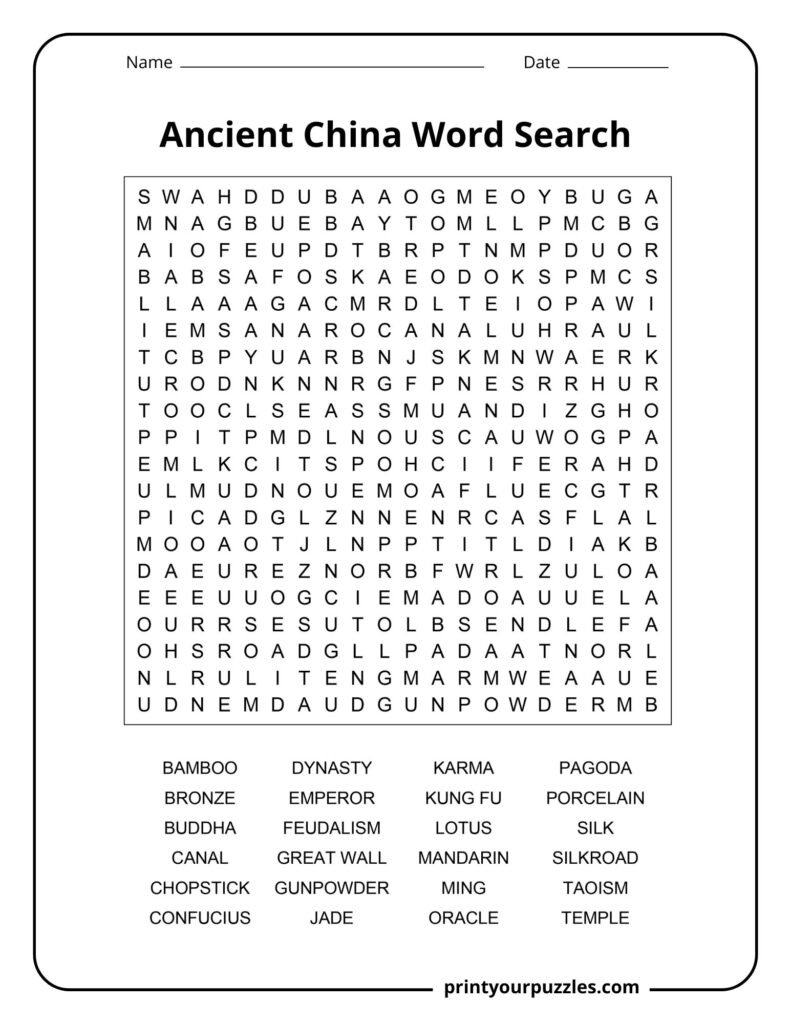
BAMBOO, BRONZE, BUDDHA, CANAL, CHOPSTICK, CONFUCIUS, DYNASTY, EMPEROR, FEUDALISM, GREAT WALL, GUNPOWDER, JADE, KARMA, KUNG FU, LOTUS, MANDARIN, MING, ORACLE, PAGODA, PORCELAIN, SILK, SILKROAD, TAOISM, TEMPLE
Gunpowder, paper, printing, and the compass are considered the four great inventions, revolutionizing communication, warfare, and navigation across the world permanently.
Confucius was a philosopher whose teachings on ethics, respect, and social harmony deeply shaped Chinese government, education, family values, and cultural identity for centuries.
The imperial system lasted over 2,000 years, beginning with Emperor Qin Shi Huang in 221 BC and ending with the fall of the Qing Dynasty in 1912.
The Silk Road was a vast trade network connecting China to Europe, exchanging silk, spices, jade, glassware, ideas, religions, and cultural traditions across continents.
The Great Wall was constructed to defend Ancient China against northern nomadic tribes, protect trade routes, and reinforce imperial border control across thousands of kilometers.
The Early Chinese Empires: Qin and Han by Mark Edward Lewis. Wood masterfully weaves rigorous British Library scholarship with vivid anecdotes — poems, recipes, and cultural details — making ancient China’s founding era feel alive and utterly accessible.
The Chinese created an early frozen dessert mixing snow, rice, and milk around 200 BC, centuries before ice cream became popular in Europe.
Chinese scholars recorded the use of paper for hygiene as early as 589 AD, making China the birthplace of one of history’s most essential daily products.
According to legend, Emperor Shen Nong discovered tea in 2737 BC when leaves accidentally fell into his boiling water, creating the world’s most consumed beverage.
Acupuncture, involving inserting fine needles into specific body points, was practiced in Ancient China to balance energy flow and treat numerous physical and mental health conditions.
The Han Dynasty established an organized postal relay system using horses and messengers to deliver official documents across vast imperial territories efficiently, predating modern postal services by millennia.