
Religion shaped nearly every part of life in Ancient Egypt, from government and farming to family traditions, festivals, and burial practices. Egyptians believed that divine forces controlled the sun, the Nile, fertility, storms, healing, death, and rebirth. Their religion was polytheistic, meaning that they worshipped many gods and goddesses whose importance could change from one city or period to another.
Egyptian deities were often shown as humans, animals, or figures combining both forms. These appearances reflected their powers and qualities. Horus was linked with the falcon and the sky, Anubis with the jackal and the protection of the dead, and Bastet with the cat, the home, and family safety. These images made the gods easy to recognize in temples, tombs, statues, and paintings.
Ra was one of the most important gods in Egyptian religion. He represented the sun, creation, light, and royal authority. Egyptians believed that Ra traveled across the sky during the day and passed through the underworld at night before rising again. His daily journey symbolized renewal, order, and the continuing cycle of life.
One of the best-known Egyptian myths told the story of Osiris, Isis, Horus, and Seth. Osiris was murdered by his brother Seth, but Isis used her magical powers to restore him. Their son Horus later fought Seth for the right to rule. This story connected death, resurrection, family loyalty, kingship, and the victory of order over chaos.
Other important gods included Thoth, associated with writing and wisdom; Hathor, linked with love, music, and joy; Sekhmet, connected with war, destruction, and healing; and Ma’at, who represented truth, justice, and balance. Pharaohs were expected to protect ma’at and maintain harmony between the people, the gods, and the natural world.
Temples were considered homes of the gods. Priests cared for sacred statues, performed rituals, burned incense, and presented food and drink as offerings. Beliefs about the afterlife were equally important. Egyptians thought the dead would be judged before Osiris, where the heart was weighed against the feather of Ma’at. A balanced heart allowed the person to enter the afterlife.
Symbols connected with Egyptian religion remain widely recognized today. The ankh represented life, the Eye of Horus offered protection, and scarab amulets symbolized rebirth.
Through this Egyptian Gods Word Search, students can explore the deities, myths, symbols, temples, beliefs, and rituals that shaped Ancient Egyptian culture and still influence art, literature, museums, movies, and popular imagination.
Related Word Searches:
Ancient Egypt | Ancient Greece | Ancient Mesopotamia | Ancient Rome | Stone Age | Silk Road
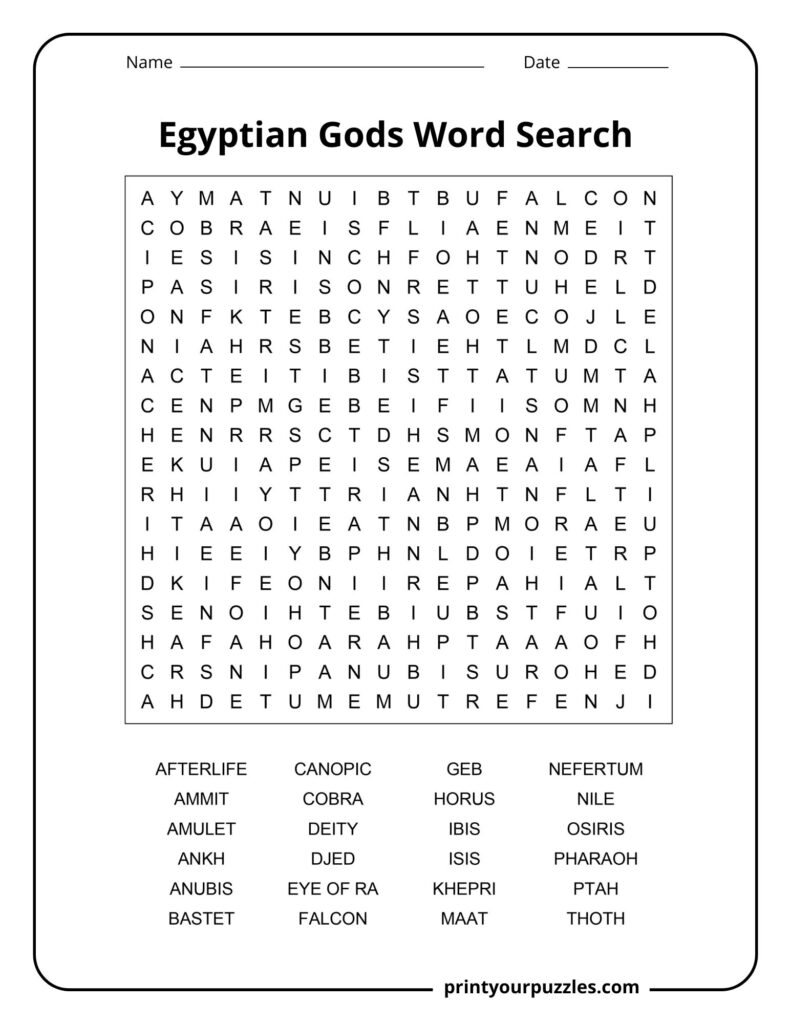
AFTERLIFE, AMMIT, AMULET, ANKH, ANUBIS, BASTET, CANOPIC, COBRA, DEITY, DJED, EYE OF RA, FALCON, GEB, HORUS, IBIS, ISIS, KHEPRI, MAAT, NEFERTUM, NILE, OSIRIS, PHARAOH, PTAH, THOTH
AFTERLIFE – The realm where souls journey after death, ruled by Osiris. Egyptians believed in eternal existence beyond death, preparing tombs and mummies to ensure safe passage.
AMMIT – A fearsome hybrid creature with lion, hippopotamus and crocodile parts. She devoured souls deemed unworthy during the divine judgment ceremony, condemning them to eternal oblivion.
AMULET – Sacred protective charm worn by both living and dead Egyptians. These magical objects bearing divine symbols shielded their owners from evil forces, illness and misfortune.
ANKH – Ancient Egyptian symbol representing life and immortality, shaped like a cross with a loop. Gods carried it to symbolize their power to grant life to humans.
ANUBIS – Jackal-headed god who guided souls through the underworld and oversaw mummification. He weighed hearts against the feather of Maat during the sacred judgment of souls.
BASTET – Beloved cat goddess representing home, fertility and protection. Originally depicted as a lioness, she later became a gentle cat, worshipped across Egypt as a nurturing deity.
CANOPIC – Sacred jars used during mummification to store and preserve the internal organs of the deceased. Each jar was protected by one of the four sons of Horus.
COBRA – The sacred serpent symbolizing royalty, protection and divine power. The cobra goddess Wadjet appeared on pharaoh’s crown, ready to spit fire at any approaching enemy.
DEITY – A divine being worshipped and honored in ancient Egyptian religion. Egypt had hundreds of deities, each governing specific aspects of nature, human life and cosmic order.
DJED – Ancient pillar symbol associated with Osiris, representing stability, strength and endurance. This sacred column was ritually raised during festivals to ensure cosmic order and divine protection.
EYE OF RA – Powerful symbol representing the sun god Ra’s protective and destructive force. This divine eye could act independently, serving as a fierce guardian capable of destroying all enemies.
FALCON – Sacred bird associated with Horus, the sky god. Its soaring flight represented divine kingship and celestial power, with the pharaoh considered a living embodiment of the falcon god.
GEB – Earth god depicted lying beneath the sky goddess Nut. His laughter caused earthquakes, and crops grew from his body. He was father to Osiris, Isis, Seth and Nephthys.
HORUS – Mighty falcon-headed sky god and son of Osiris and Isis. He battled Seth to reclaim his father’s throne, becoming the divine symbol of righteous kingship and celestial power.
IBIS – Sacred bird associated with Thoth, god of wisdom and writing. Its distinctive curved beak and white plumage made it a revered creature, often mummified as offerings to the gods.
ISIS – Supreme goddess of magic, motherhood and healing. She resurrected her husband Osiris using powerful spells, and her protective wings sheltered both gods and humans throughout Egyptian mythology.
KHEPRI – Scarab beetle god representing the rising sun and daily renewal. He rolled the sun across the sky each morning, symbolizing creation, transformation and the eternal cycle of rebirth.
MAAT – Goddess embodying truth, justice, balance and cosmic order. Her feather was used to weigh the hearts of the deceased, determining whether souls were worthy of eternal life.
NEFERTUM – Beautiful god of the blue lotus flower and pleasant fragrances. He emerged from the primordial waters at creation, bringing light and sweet scents to the world at dawn.
NILE – Sacred river considered the lifeblood of Egypt and gift of the gods. Its annual flooding brought fertile soil, sustaining agriculture and civilization under the divine blessing of Hapy.
OSIRIS – Beloved god of death, resurrection and the afterlife. Murdered by his brother Seth and resurrected by Isis, he became ruler of the underworld and judge of deceased souls.
PHARAOH – Divine ruler of Egypt considered a living god on earth. Serving as intermediary between humans and deities, the pharaoh performed sacred rituals to maintain cosmic balance and order.
PTAH – Creator god and patron of craftsmen, architects and artists. He created the world through spoken words and thought, and was worshipped as the divine master of all creation.
THOTH – Ibis-headed god of wisdom, writing, magic and the moon. He recorded the deeds of souls during judgment, invented hieroglyphics and served as divine scribe to all Egyptian gods.
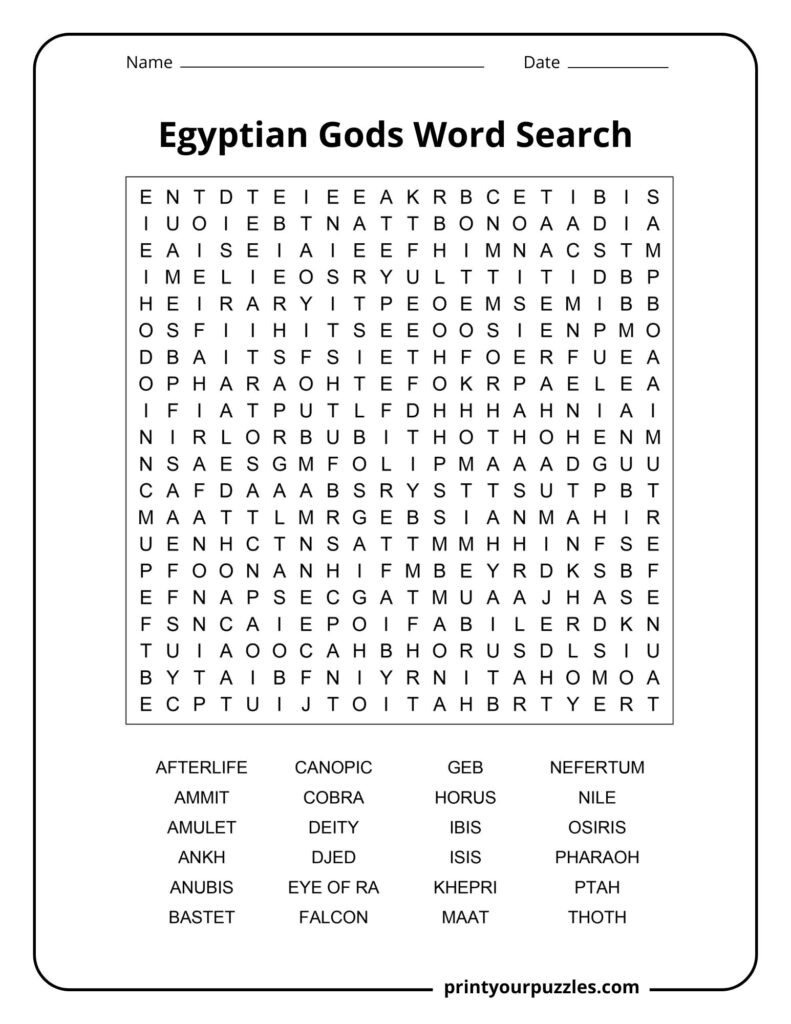
AFTERLIFE, AMMIT, AMULET, ANKH, ANUBIS, BASTET, CANOPIC, COBRA, DEITY, DJED, EYE OF RA, FALCON, GEB, HORUS, IBIS, ISIS, KHEPRI, MAAT, NEFERTUM, NILE, OSIRIS, PHARAOH, PTAH, THOTH
Ra, the sun god, was considered supreme deity. He sailed across the sky daily, and many gods like Amun were merged with him to increase their divine power.
Ancient Egyptians worshipped over 2,000 deities throughout their history. Each god governed specific aspects of life, nature and the cosmos, reflecting the complexity of their rich religious beliefs.
Animal heads symbolized each god’s specific powers and characteristics. The jackal represented Anubis’s role guiding the dead, while the falcon embodied Horus’s connection to the sky and kingship.
Gods influenced every aspect of daily life, from farming to childbirth. Egyptians prayed, wore amulets and visited temples regularly to seek divine protection, guidance and blessings from their deities.
Yes, Egyptian mythology featured dramatic divine conflicts. The most famous was Osiris being murdered by his brother Seth, and Horus later battling Seth to avenge his father’s death.
Egyptian Mythology: A Guide to the Gods, Goddesses, and Traditions of Ancient Egypt by Geraldine Pinch. Oxford Egyptologist Pinch masterfully weaves hieroglyphic sources, temple inscriptions, and papyri into a lucid, richly contextualized guide — making the dazzling, complex world of Egyptian gods genuinely accessible to every reader.
Certain deities like Nit were worshipped as both male and female. This divine fluidity reflected Egyptian belief that gods transcended human limitations, embodying all aspects of creation simultaneously.
Killing a cat in ancient Egypt was punishable by death. Bastet’s association with felines made them holy creatures, and thousands were mummified as sacred offerings to honor this beloved goddess.
Every pharaoh was considered the earthly incarnation of Horus during their reign. Upon death, they transformed into Osiris, eternally joining the divine realm and ruling the sacred underworld.
Ancient Egyptians credited Thoth with creating hieroglyphics and all forms of writing. This made him guardian of all human knowledge, divine records and the sacred secrets of the universe.
Priests combined gods to create powerful hybrid deities like Amun-Ra. This theological practice called syncretism allowed Egyptian religion to evolve and absorb new divine concepts throughout centuries of worship.