
The Inca Empire was the largest empire in the Americas before the arrival of Europeans. It developed in the Andes and reached its greatest size during the fifteenth and early sixteenth centuries. At its height, it stretched across much of present-day Peru, Ecuador, Bolivia, and parts of Chile, Argentina, and Colombia. Its rulers governed millions of people across mountains, valleys, deserts, and high plateaus.
The Inca began as one of several Andean peoples living near Cusco. During the reign of Pachacuti in the fifteenth century, they expanded rapidly and transformed their kingdom into a powerful empire. Cusco became the political, religious, and administrative center, while the ruler, known as the Sapa Inca, governed through regional officials, local leaders, and a carefully organized system of provinces.
The empire depended on an extraordinary network of roads, mountain paths, and suspension bridges. Relay runners called chasquis carried messages across long distances, while armies, officials, and supplies moved through difficult terrain. Storage buildings placed along the roads held food, clothing, weapons, and other goods for times of war, shortage, or emergency.
Farming in the Andes required great skill. The Inca built terraces on steep mountain slopes, constructed irrigation canals, and grew crops at different elevations. Potatoes, maize, quinoa, beans, and peppers were important foods. They also produced chuño, a freeze-dried potato product that could be stored for long periods and is still used in parts of the Andes today.
Instead of relying mainly on money or taxes paid in coins, the empire used the mita labor system. Communities provided workers for farming, road construction, mining, military service, and public projects. Officials recorded population, labor duties, and stored goods with quipu, sets of knotted cords used for accounting and administration.
Religion was closely connected to government and daily life. Inti, the sun god, was one of the most important deities, while Viracocha, sacred mountains, ancestors, temples, festivals, and offerings also held great importance. Inca builders created temples, fortresses, terraces, and cities with precisely fitted stonework. Machu Picchu and Sacsayhuamán remain famous examples of their engineering ability.
The empire weakened because of civil war, disease, internal divisions, and the arrival of Francisco Pizarro. Atahualpa was captured in 1532, and Spanish control expanded soon afterward.
The Inca Empire word search introduces students to the rulers, beliefs, cities, technologies, and traditions that shaped this remarkable Andean civilization. Terms such as Cusco, Pachacuti, Sapa Inca, Inti, quipu, chasquis, terraces, mita labor, Machu Picchu, and Atahualpa help reveal how the Inca governed a vast empire and left a legacy that continues across the Andes today.
Related Word Searches:
Mayan Civilization | Ancient Egypt | Ancient Mesopotamia | Ancient China | Silk Road | Decolonization Era
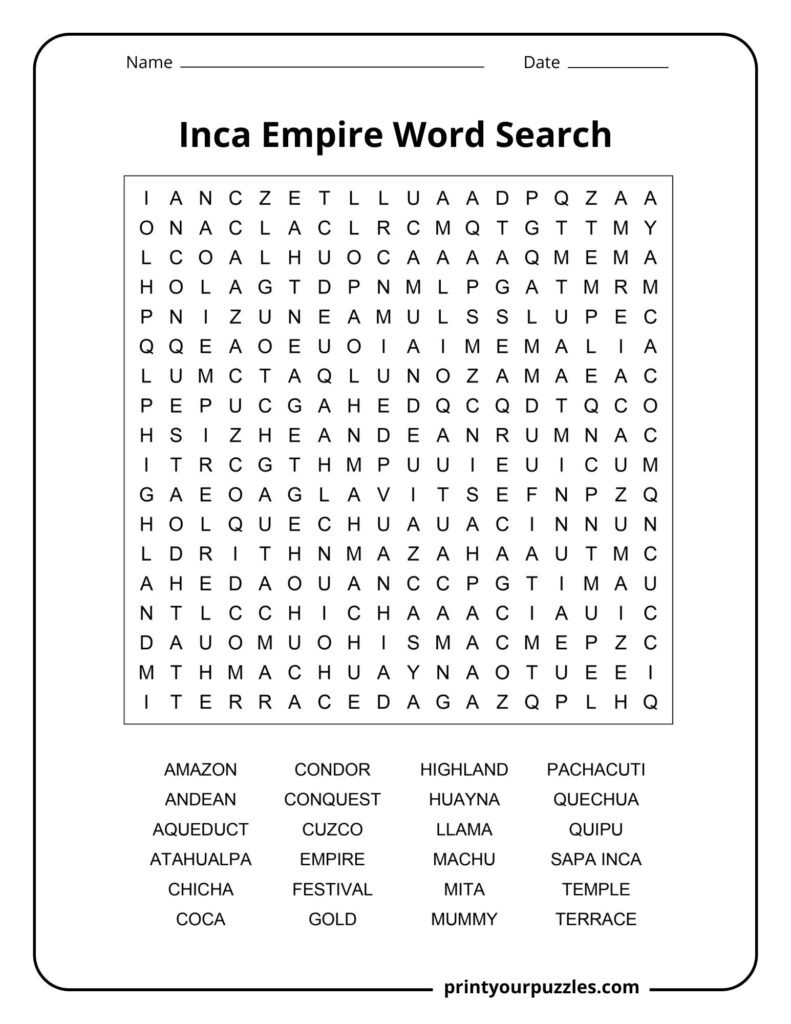
AMAZON, ANDEAN, AQUEDUCT, ATAHUALPA, CHICHA, COCA, CONDOR, CONQUEST, CUZCO, EMPIRE, FESTIVAL, GOLD, HIGHLAND, HUAYNA, LLAMA, MACHU, MITA, MUMMY, PACHACUTI, QUECHUA, QUIPU, SAPA INCA, TEMPLE, TERRACE
AMAZON – Vast river and rainforest region bordering the Inca Empire to the east, home to diverse indigenous peoples and considered a wild, unconquered frontier by the Incas.
ANDEAN – Relating to the Andes mountain range, the geographical backbone of the Inca Empire, where most cities, roads, and agricultural terraces were built at high altitude.
AQUEDUCT – Sophisticated stone channels engineered by the Incas to transport fresh water from mountain sources into cities, temples, and farmlands across the empire.
ATAHUALPA – Last ruling Sapa Inca before the Spanish conquest, captured by Francisco Pizarro in 1532 at Cajamarca and executed despite paying an enormous ransom in gold and silver.
CHICHA – Traditional fermented beverage made from maize, consumed during religious ceremonies, festivals, and daily life throughout the Inca Empire as an offering to the gods.
COCA – Sacred leaf chewed by Inca priests, warriors, and workers for energy and altitude sickness relief, also used in religious rituals and offered to the sun god Inti.
CONDOR – Majestic Andean bird considered sacred and powerful by the Incas, symbolizing the upper world and the heavens, often associated with the sun god and divine power.
CONQUEST – The Spanish military takeover of the Inca Empire beginning in 1532, led by Francisco Pizarro, resulting in the collapse of one of history’s largest and most sophisticated empires.
CUZCO – Sacred capital city of the Inca Empire, located in present-day Peru, believed to be the center of the world and home to the most important temples and royal palaces.
EMPIRE – The vast Inca state known as Tawantinsuyu, stretching over 4,000 kilometers along South America’s western coast, governing millions of people across diverse climates and territories.
FESTIVAL – Grand religious and agricultural celebrations held throughout the Inca calendar, involving music, dancing, feasting, offerings, and ceremonies honoring gods, ancestors, and natural forces.
GOLD – Precious metal considered the sweat of the sun god Inti, used exclusively for sacred objects, temple decorations, and royal ornaments rather than as everyday currency.
HIGHLAND – High-altitude Andean plateau regions where the Incas built their greatest cities and farms, developing unique agricultural techniques to survive the cold and challenging mountain environment.
HUAYNA – Referring to Huayna Capac, powerful Sapa Inca who expanded the empire to its greatest size before dying of smallpox, whose death triggered a devastating civil war between his sons.
LLAMA – Essential domesticated Andean animal used by the Incas for transporting goods along mountain roads, providing wool for textiles, and serving as sacrificial offerings in religious ceremonies.
MACHU – Referring to Machu Picchu, the iconic Inca citadel built high in the Andes, likely a royal estate or religious sanctuary, rediscovered by the Western world in 1911.
MITA – Mandatory labor tax system requiring all Inca subjects to contribute work to the state, building roads, temples, and terraces in exchange for food, tools, and protection.
MUMMY – Preserved bodies of deceased Inca rulers treated as living ancestors, dressed in fine clothing, consulted on important matters, and paraded during religious festivals and ceremonies.
PACHACUTI – Greatest and most transformative Inca emperor, who dramatically expanded the empire through military campaigns, built Machu Picchu, and reorganized Inca society, religion, and government.
QUECHUA – Primary language of the Inca Empire, spoken by millions across the Andes today, used by the Inca rulers to unify diverse conquered peoples under a single administrative tongue.
QUIPU – Unique Inca recording system using knotted strings of different colors and lengths to store numerical data, census information, and possibly historical narratives without written text.
SAPA INCA – Title meaning “Unique Ruler,” held by the divine emperor of the Inca Empire, believed to be the son of the sun god Inti and supreme authority over all lands and peoples.
TEMPLE – Sacred stone structures built throughout the empire to honor gods like Inti the sun god, featuring elaborate golden decorations, ritual spaces, and areas for priests and offerings.
TERRACE – Flat agricultural platforms carved into steep Andean hillsides by Inca engineers, allowing farming at high altitudes by preventing erosion and creating ideal growing conditions for crops.
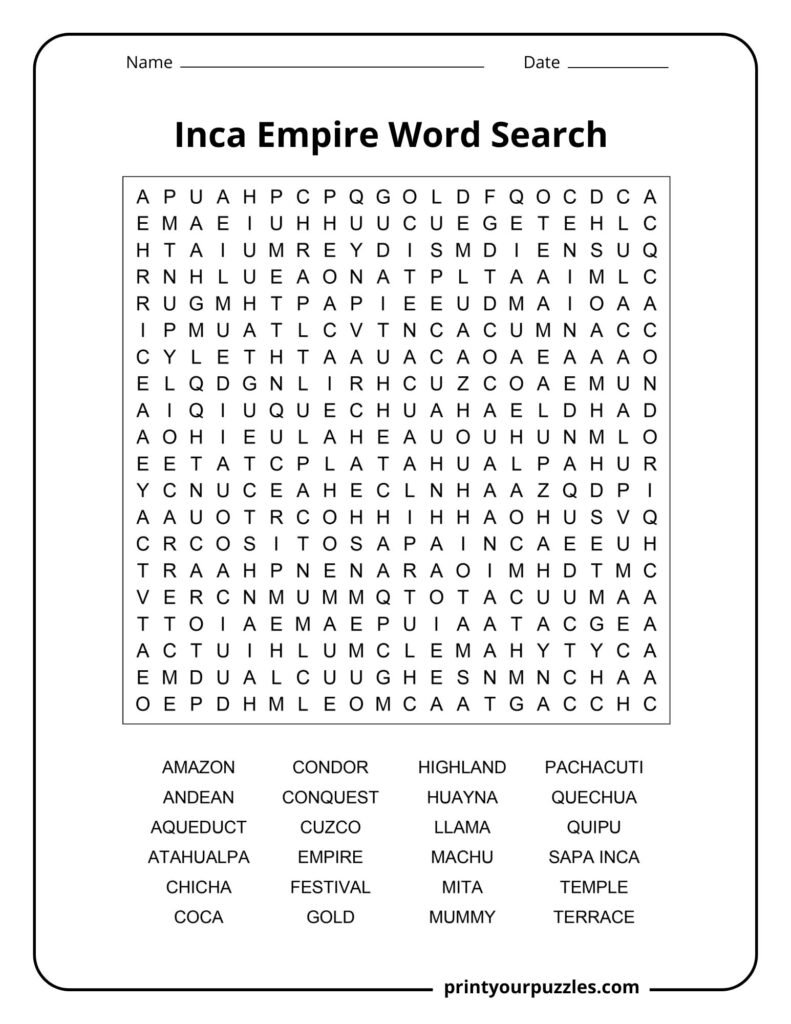
AMAZON, ANDEAN, AQUEDUCT, ATAHUALPA, CHICHA, COCA, CONDOR, CONQUEST, CUZCO, EMPIRE, FESTIVAL, GOLD, HIGHLAND, HUAYNA, LLAMA, MACHU, MITA, MUMMY, PACHACUTI, QUECHUA, QUIPU, SAPA INCA, TEMPLE, TERRACE
The Inca Empire flourished from around 1438 to 1533 AD, beginning with Emperor Pachacuti’s expansions and ending with the Spanish conquest led by Francisco Pizarro.
At its peak, the empire stretched over 4,000 kilometers along South America’s western coast, covering modern Peru, Ecuador, Bolivia, Chile, Argentina, and Colombia, making it history’s largest pre-Columbian state.
The Incas used the quipu, a sophisticated system of knotted colored strings, to record numerical data, census information, and important historical records across their vast territory.
A deadly combination of Spanish military invasion, smallpox epidemics, internal civil war between rival princes Atahualpa and Huascar, and political instability rapidly destroyed the empire after 1532.
Their extraordinary road network, spanning over 40,000 kilometers through extreme mountain terrain, connected the entire empire and enabled efficient communication, trade, military movement, and administrative control.
The Conquest of the Incas by John Hemming. Oxford-trained explorer-historian Hemming, drawing on rediscovered archives and firsthand Andean knowledge, transforms the Inca Empire’s annihilation into a scrupulously researched, breathtakingly vivid narrative — equally praised by Nobel laureates and leading archaeologists.
Ancient Inca physicians successfully performed trepanation, drilling holes into human skulls to treat head injuries, with remarkable survival rates that amazed modern medical researchers studying recovered skeletal remains.
The Incas constructed their iconic mountain citadel using a technique called ashlar, fitting massive stone blocks together so precisely that no cement or mortar was ever needed.
The Inca trail network stretched over 40,000 kilometers through mountains, deserts, and jungles, exceeding the famous Roman road system and connecting every corner of their enormous empire.
Sapa Inca rulers dressed in brand new royal garments every single day, with used clothing immediately burned to prevent anyone else from touching their sacred and divine belongings.
Using the freezing Andean nights and intense daytime sun, Inca farmers naturally dehydrated potatoes and meat, creating preserved foods called chuño that could last for many years.