
The Silk Road was a vast network of land and sea routes that connected East Asia, Central Asia, the Middle East, North Africa, and Europe. It was not one continuous road, but a series of paths linking cities, deserts, mountain passes, ports, and trading centers. Its principal overland routes extended for more than 4,000 miles, although the complete network was much larger because it contained numerous branches. The system expanded greatly during the Han dynasty, especially from around the second century BCE, and remained important for many centuries.
Its name comes from Chinese silk, one of the most valuable goods carried westward. However, merchants also traded spices, tea, porcelain, paper, horses, glassware, gold, silver, textiles, medicines, gemstones, and many other products. Most traders traveled only part of the route, exchanging goods at important centers such as Chang’an, Kashgar, Samarkand, Merv, and Constantinople.
Travel was difficult and often dangerous. Caravans crossed deserts, mountains, and remote valleys using camels, horses, and other pack animals. Merchants faced extreme weather, bandits, political conflict, and long periods away from home. Caravanserais offered places to rest, feed animals, store goods, and exchange news with travelers from other regions.
The Silk Road carried much more than merchandise. Buddhism spread from India into Central Asia and China, while Islam, Christianity, Zoroastrianism, and other beliefs also moved along the routes. Languages, music, artistic styles, stories, scientific knowledge, and customs traveled between distant cultures, creating new forms of cultural exchange.
Important technologies and inventions also crossed Eurasia. Paper, printing techniques, gunpowder, the compass, silk production, metalworking, irrigation methods, glassmaking knowledge, and medical ideas spread from one society to another and were adapted in different ways. These exchanges helped shape communication, warfare, navigation, agriculture, learning, and craftsmanship.
During the thirteenth and fourteenth centuries, the Mongol Empire brought large areas of Eurasia under one political system. This period, often called the Pax Mongolica, made many routes safer and encouraged trade, diplomacy, travel, and the movement of information. At the same time, the same connections that carried goods and ideas also helped diseases spread, including the plague associated with the Black Death.
Political changes, warfare, and the growth of maritime trade eventually reduced the importance of many overland routes. Even so, the Silk Road left a lasting legacy as an early system of global exchange.
Related Word Searches:
Ancient China | Ancient Mesopotamia | Ancient Rome | Ancient Greece | Ancient Japan | Carolingian Empire
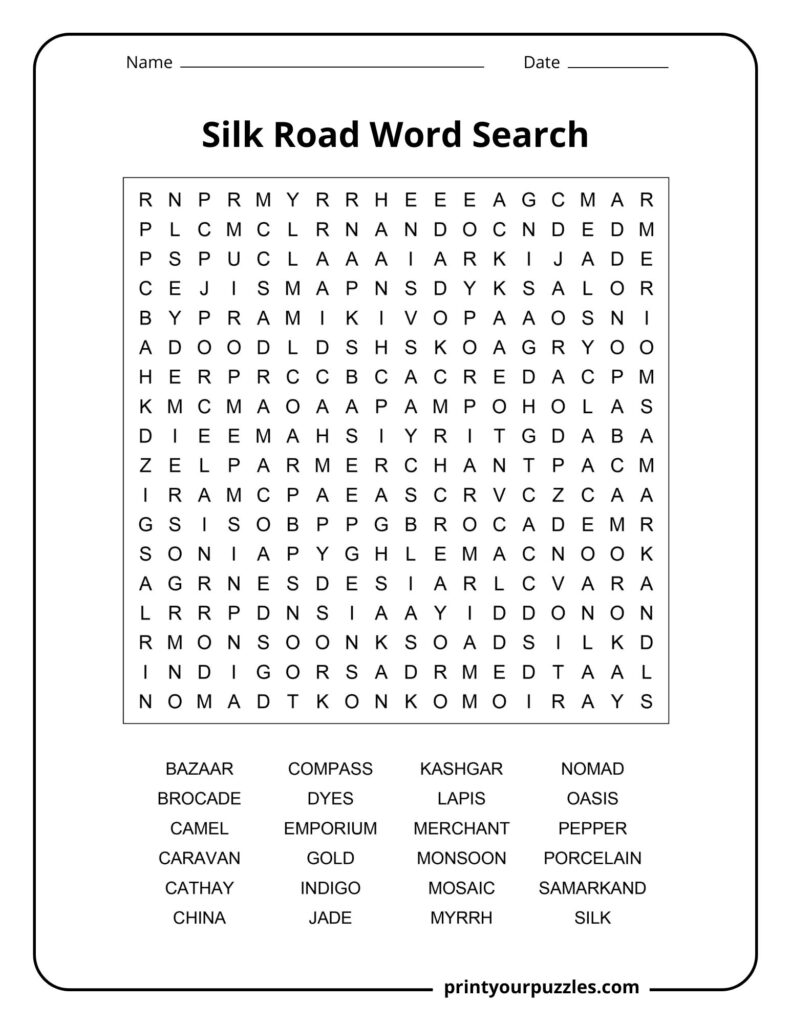
BAZAAR, BROCADE, CAMEL, CARAVAN, CATHAY, CHINA, COMPASS, DYES, EMPORIUM, GOLD, INDIGO, JADE, KASHGAR, LAPIS, MERCHANT, MONSOON, MOSAIC, MYRRH, NOMAD, OASIS, PEPPER, PORCELAIN, SAMARKAND, SILK
BAZAAR – A bustling oriental marketplace where merchants gathered to trade goods ranging from spices and textiles to jewelry and exotic animals along the Silk Road.
BROCADE – A richly decorative woven fabric with raised patterns, often made of silk and interwoven with gold or silver threads, highly prized across Asia and Europe.
CAMEL – The essential pack animal of desert trade routes, capable of carrying heavy loads across vast arid landscapes for days without water, nicknamed the “ship of the desert.”
CARAVAN – A organized group of merchants and travelers journeying together across dangerous desert and mountain routes for mutual protection, trade, and companionship over long distances.
CATHAY – The medieval European name for northern China, derived from the Khitan people, used by Marco Polo and other travelers to describe this distant and fabled land.
CHINA – The eastern origin point of the Silk Road, a vast empire that produced silk, porcelain, and tea, exporting its culture and goods westward across the entire known world.
COMPASS – A navigational instrument invented in China that uses a magnetized needle to indicate north, revolutionizing travel and trade by enabling more reliable long-distance journeys.
DYES – Vivid coloring substances derived from plants, minerals, and insects, including indigo, saffron, and kermes, that were highly valuable trade commodities along the Silk Road.
EMPORIUM – A major commercial center or large trading hub where merchants from many nations converged to exchange goods, ideas, and cultures at key points along trade routes.
GOLD – The most universally valued precious metal, used as currency, jewelry, and artistic decoration, traded extensively along the Silk Road between empires of East and West.
INDIGO – A deep blue dye extracted from the Indigofera plant, one of the most valuable and widely traded commodities of the ancient world, prized by dyers and textile merchants.
JADE – A hard, beautiful gemstone deeply revered in Chinese culture, carved into ornaments, tools, and ceremonial objects, symbolizing virtue, purity, and immortality across Asian civilizations.
KASHGAR – A historic oasis city in western China that served as a critical crossroads where northern and southern Silk Road branches converged, making it a vital trading hub.
LAPIS – A vivid deep-blue semiprecious stone mined primarily in Afghanistan, used for pigments, jewelry, and decoration, and traded across the ancient world from Egypt to China.
MERCHANT – A professional trader who traveled dangerous routes carrying goods between distant civilizations, serving as cultural ambassadors who spread religions, technologies, and ideas alongside their traded commodities.
MONSOON – The seasonal wind system of Asia and the Indian Ocean that dictated maritime trading schedules, bringing reliable winds that enabled sailors to navigate predictably between distant ports.
MOSAIC – An artistic technique creating images from small colored tiles or stones, spread along trade routes from Rome to Persia, decorating temples, palaces, and wealthy merchants’ homes.
MYRRH – A fragrant resin harvested from thorny trees in Arabia and East Africa, valued for perfume, medicine, and religious ceremonies, traded widely across ancient civilizations for millennia.
NOMAD – A member of a mobile pastoral people who moved seasonally with their herds across Central Asian steppes, both threatening and facilitating trade between settled civilizations along the routes.
OASIS – A fertile area with water sources in the midst of arid desert, providing essential rest, resupply, and shelter for caravans, often growing into significant trading settlements over time.
PEPPER – One of the most sought-after spices in history, native to South Asia, so valuable in medieval Europe that it was used as currency and drove much early exploration.
PORCELAIN – A refined white ceramic developed in China, prized for its translucency and durability, so exclusively associated with its origin that the material became universally known as “china.”
SAMARKAND – A magnificent ancient city in modern Uzbekistan that served as one of the greatest cultural and commercial centers of the Silk Road under Timur’s powerful empire.
SILK – The lustrous, lightweight fabric produced from silkworm cocoons, originating in China and kept secret for centuries, so valuable it gave the entire network of trade routes its name.
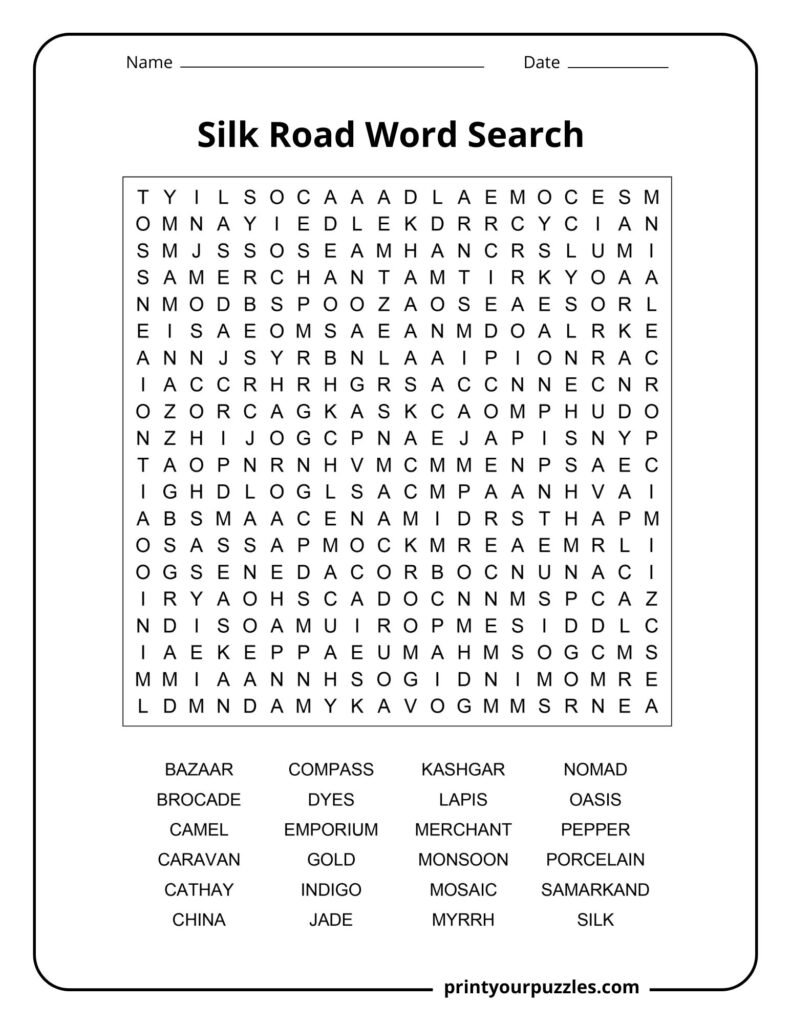
BAZAAR, BROCADE, CAMEL, CARAVAN, CATHAY, CHINA, COMPASS, DYES, EMPORIUM, GOLD, INDIGO, JADE, KASHGAR, LAPIS, MERCHANT, MONSOON, MOSAIC, MYRRH, NOMAD, OASIS, PEPPER, PORCELAIN, SAMARKAND, SILK
A vast ancient network of trade routes connecting China to the Mediterranean, spanning over 7,000 kilometers, facilitating the exchange of goods, cultures, religions, and ideas for centuries.
German geographer Ferdinand von Richthofen coined the term in 1877, highlighting silk as the most iconic traded commodity, though spices, gold, glassware, and countless other goods also traveled these routes.
Merchants, diplomats, pilgrims, monks, and explorers from Chinese, Persian, Arab, Indian, Roman, and Central Asian civilizations all traveled these routes, making it a truly multicultural global highway.
Buddhism, Islam, Christianity, and Zoroastrianism spread through traveler interactions, alongside technologies like papermaking, gunpowder, and the compass, plus artistic styles, languages, and devastating diseases like the plague.
The fall of the Mongol Empire in the 14th century, combined with the rise of safer and cheaper maritime trade routes discovered by European explorers, gradually made overland routes economically unviable.
The Silk Roads: A New History of the World by Peter Frankopan. Oxford Byzantine historian Frankopan recentres world history away from Europe onto the Silk Roads, weaving two millennia of trade, religion, and empire into a thrillingly researched, paradigm-shifting narrative.
Revealing silkworm cultivation methods was punishable by death in ancient China, until Byzantine monks famously smuggled silkworm eggs hidden inside hollow walking sticks around 550 AD.
It was a sprawling web of shifting routes crossing deserts, mountains, and steppes, constantly changing depending on political situations, seasonal conditions, and the specific destinations of traveling merchant caravans.
The devastating plague that killed one third of Europe’s population in the 14th century is believed to have originated in Central Asia and spread rapidly through Silk Road trading networks.
Carrying heavy metal coins across thousands of kilometers was dangerously impractical, prompting Chinese merchants to develop lightweight paper certificates of value, a revolutionary concept that transformed global economics forever.
Indian mathematicians developed the concept of zero, which Arab traders carried westward through Silk Road networks, eventually reaching Europe and fundamentally transforming mathematics, science, and modern civilization as we know it.