
The Carolingian Empire was one of the most important powers in early medieval Europe. It developed during the eighth and ninth centuries under a Frankish dynasty that ruled large parts of Western and Central Europe. At its height, the empire included much of present-day France, Germany, Belgium, the Netherlands, Switzerland, Austria, and northern Italy. Its most famous ruler was Charlemagne, whose reign helped reshape European politics, Christianity, education, and culture.
The Carolingian dynasty rose after the decline of the earlier Merovingian kings. Charles Martel strengthened Frankish power, and his son Pepin the Short became king with the support of the pope. Pepin’s son Charlemagne inherited the kingdom in 768 and expanded it through military campaigns against the Saxons, Lombards, and other neighboring peoples. His conquests created the largest Western European empire since the fall of Rome.
On Christmas Day in 800 CE, Pope Leo III crowned Charlemagne emperor in Rome. This coronation connected his rule with the Christian Church and revived the idea of imperial authority in Western Europe. Charlemagne presented himself as both a military ruler and a protector of Christianity, while the papacy gained a powerful political ally.
Governing such a vast territory required careful organization. Charlemagne relied on counts, bishops, local officials, royal estates, and written laws. He also sent traveling inspectors called *missi dominici* to check that regional leaders obeyed royal commands. Although he moved frequently around the empire, Aachen became his principal residence and political center. Its palace complex and Palatine Chapel reflected both Roman influence and Christian authority.
The Carolingian period also produced an important revival of learning known as the Carolingian Renaissance. Charlemagne invited scholars such as Alcuin of York to improve schools, train clergy, copy manuscripts, and standardize Latin. Monasteries became major centers of education, book production, administration, and the preservation of ancient texts.
Several Carolingian achievements continue to influence modern life. Carolingian minuscule, a clear and readable handwriting style, helped shape the lowercase letters still used today. Scholars also improved punctuation, spelling, manuscript organization, school systems, libraries, and official record keeping. These reforms made written communication more consistent across the empire and helped preserve classical and Christian knowledge for later generations.
After Charlemagne’s death in 814, the empire weakened because of internal conflict and rival claims to power. The Treaty of Verdun in 843 divided it among his grandsons, creating regions that influenced the later development of France and Germany.
Through this Carolingian Empire Word Search, students can explore vocabulary connected to Charlemagne, the Franks, Aachen, emperors, monasteries, manuscripts, education, government, and the Carolingian Renaissance.
Related Word Searches:
Feudalism | Viking Age | Ancient Rome | Silk Road | Stone Age | Neolithic Revolution
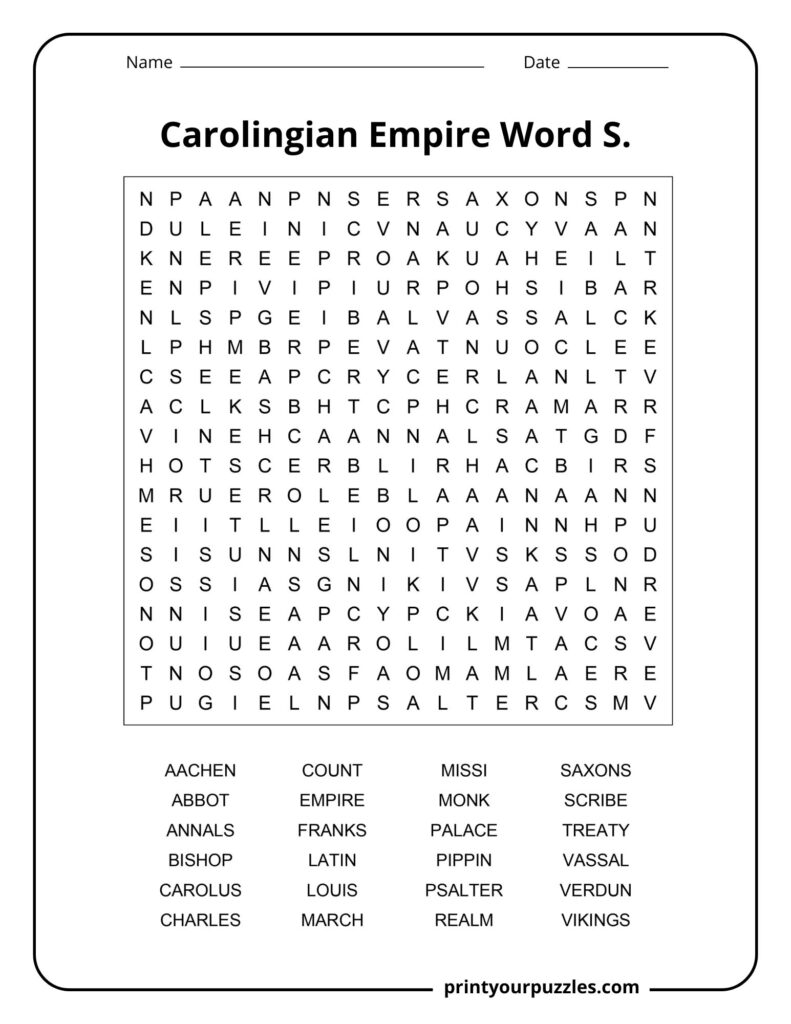
AACHEN, ABBOT, ANNALS, BISHOP, CAROLUS, CHARLES, COUNT, EMPIRE, FRANKS, LATIN, LOUIS, MARCH, MISSI, MONK, PALACE, PIPPIN, PSALTER, REALM, SAXONS, SCRIBE, TREATY, VASSAL, VERDUN, VIKINGS
AACHEN – Capital city favored by Carolingian Empire ruler Charlemagne, known for its royal palace, cathedral, learning center, and importance as the empire’s political and cultural heart.
ABBOT – Religious leader supervising a monastery during the Carolingian period, responsible for guiding monks, managing lands, preserving manuscripts, and supporting education throughout the empire.
ANNALS – Yearly historical records written by monks and scholars, documenting important battles, royal events, political changes, and religious developments within the Carolingian world.
BISHOP – Senior church official overseeing dioceses, spreading Christianity, advising rulers, and strengthening the connection between religious authority and political leadership across the empire.
CAROLUS – Latin name commonly used for Charlemagne in official documents, coins, and manuscripts produced during the height of Carolingian rule and influence.
CHARLES – Name referring to Charlemagne, the powerful Frankish ruler who united much of Western Europe and encouraged learning, administration, and Christian expansion.
COUNT – Noble appointed by Carolingian rulers to govern territories, collect taxes, maintain order, supervise courts, and lead local military forces on behalf of the emperor.
EMPIRE – Vast political territory ruled by a single emperor, uniting many regions, peoples, and cultures under Carolingian authority during the early medieval period in Europe.
FRANKS – Germanic people who created the Carolingian Empire, expanded across Western Europe, and established strong military, political, and religious influence during the Middle Ages.
LATIN – Main written language of administration, religion, education, and scholarship throughout the Carolingian Empire, helping preserve classical knowledge and improve communication across territories.
LOUIS – Refers to Louis the Pious, son of Charlemagne, who inherited the empire and struggled to maintain unity among competing heirs.
MARCH – Border territory organized for defense against invasions, ruled by military leaders who protected the empire’s outer regions from enemies and rival kingdoms.
MISSI – Royal envoys sent by Carolingian rulers to inspect local officials, enforce laws, gather information, and ensure loyalty throughout distant regions of the empire.
MONK – Religious man living in a monastery, dedicating life to prayer, study, copying manuscripts, teaching, and preserving important classical and Christian writings during medieval times.
PALACE – Royal residence serving as a political and administrative center where Carolingian rulers held assemblies, welcomed nobles, and directed affairs of the empire.
PIPPIN – Refers to Pepin the Short, father of Charlemagne, who strengthened Frankish power and founded the Carolingian dynasty.
PSALTER – Book containing biblical Psalms used for worship, prayer, and education, often beautifully decorated by Carolingian scribes and artists in monastery workshops.
REALM – Kingdom or territory controlled by a ruler, including lands governed by Carolingian kings and emperors during the expansion of their medieval authority.
SAXONS – Germanic people living in northern Europe who fought against Charlemagne before eventually being conquered and converted to Christianity.
SCRIBE – Person trained to copy books, legal documents, and religious texts by hand, preserving knowledge in monasteries and royal centers throughout the empire.
TREATY – Formal agreement between rulers or kingdoms, often used to settle disputes, divide territories, or create peace during the Carolingian and post-Carolingian periods.
VASSAL – Noble who pledged loyalty and military service to a lord or ruler in exchange for land, protection, and privileges within the feudal system.
VERDUN – City associated with the Treaty of Verdun, which divided the empire among Charlemagne’s grandsons after internal conflicts.
VIKINGS – Scandinavian seafarers who raided Carolingian territories, attacking monasteries, towns, and riverside settlements during the ninth century across Western Europe.
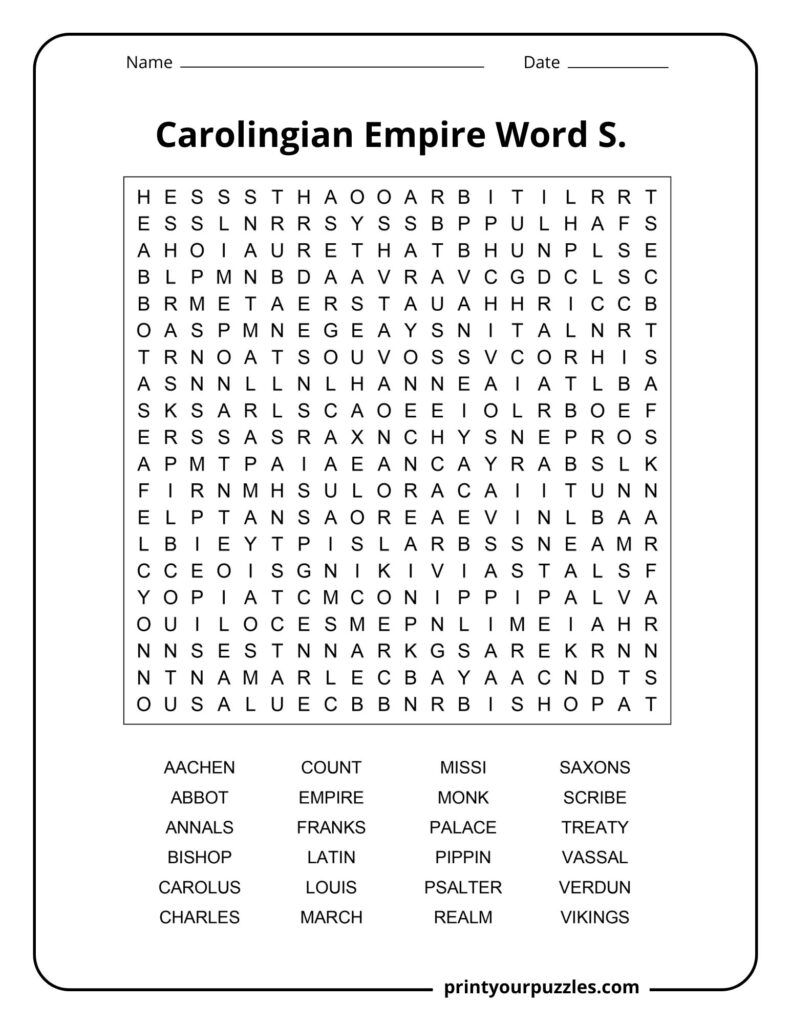
AACHEN, ABBOT, ANNALS, BISHOP, CAROLUS, CHARLES, COUNT, EMPIRE, FRANKS, LATIN, LOUIS, MARCH, MISSI, MONK, PALACE, PIPPIN, PSALTER, REALM, SAXONS, SCRIBE, TREATY, VASSAL, VERDUN, VIKINGS
The Carolingian Empire was a powerful medieval empire in Western Europe ruled by the Carolingian dynasty, uniting large territories under Christian leadership during the eighth and ninth centuries.
Charlemagne was the most famous Carolingian ruler, known for expanding the empire, encouraging education, strengthening Christianity, and being crowned emperor by the pope in 800.
Aachen served as Charlemagne’s main residence and political center, becoming a symbol of royal authority, learning, religious influence, and Carolingian cultural achievements.
Internal conflicts between heirs, invasions by Vikings and other groups, weak leadership, and territorial divisions gradually weakened the empire after the death of Charlemagne’s successors.
The Treaty of Verdun divided the empire among Charlemagne’s grandsons, creating separate kingdoms that later influenced the development of modern European nations.
Charlemagne by Johannes Fried. Germany’s most eminent medievalist Fried strips away 12 centuries of myth from Charlemagne — deploying exhaustive Carolingian source analysis to reveal a deeply human Christian king who reshaped European civilisation.
Monks in Carolingian monasteries carefully copied Roman and Christian texts by hand, saving many important writings that might otherwise have disappeared forever during the Middle Ages.
Although Charlemagne promoted schools and education throughout Europe, historians believe he struggled with writing and practiced secretly during adulthood.
Vikings sailed along rivers to raid monasteries, towns, and trade centers, forcing Carolingian rulers to strengthen defenses across the empire.
Aachen featured a magnificent palace and cathedral where scholars, nobles, and clergy gathered under Charlemagne’s rule and cultural reforms.
The Treaty of Verdun divided territories that later evolved into regions connected with modern France, Germany, and neighboring European countries.