
The Viking Age lasted roughly from 793 to 1066 CE and became one of the most dynamic periods in European history. It began around the time of the Viking raid on the monastery at Lindisfarne and ended as stronger kingdoms, Christianity, and changing military systems transformed Scandinavia. The period centered on present-day Norway, Denmark, and Sweden, but Viking voyages reached far beyond northern Europe.
The Vikings were not only raiders. They were also farmers, traders, sailors, craftspeople, explorers, warriors, and settlers. The word “Viking” originally referred more closely to taking part in an overseas expedition than to an entire people. Most Norse families lived in rural communities, worked the land, raised animals, fished, and produced goods for local use and trade.
Viking longships made their expansion possible. These vessels were fast, flexible, and capable of crossing open seas while also traveling along shallow rivers. Sails, oars, steering oars, and advanced knowledge of winds, stars, coastlines, and currents allowed Norse crews to navigate great distances. Their clinker-built hulls influenced shipbuilding for centuries.
Raids brought Vikings to Britain, Ireland, Francia, and many coastal regions, where monasteries and towns became targets. However, trade was equally important. Norse merchants exchanged silver, furs, amber, iron, textiles, glass, luxury goods, and enslaved people across Europe, the Byzantine Empire, the Islamic world, and Central Asia.
Viking settlers established communities in Iceland, Greenland, Ireland, Normandy, and parts of Britain and Eastern Europe. Around 1000 CE, Leif Erikson and other Norse explorers reached North America. Viking society also included local assemblies called “things”, where free men discussed laws, disputes, and community decisions.
Religion and mythology shaped Norse culture. People worshipped gods such as Odin, Thor, Freyja, and Loki, and believed in places such as Valhalla. Runes were used for short inscriptions, memorials, and communication. Over time, Christianity spread across Scandinavia and gradually replaced many traditional beliefs.
Viking achievements still influence modern life. Their advances in shipbuilding, navigation, ironworking, weaving, skis, sleds, and public assemblies left a lasting legacy.
Related Word Searches:
Carolingian Empire | Feudalism | Ancient Rome | Ancient Japan | Silk Road | Renaissance
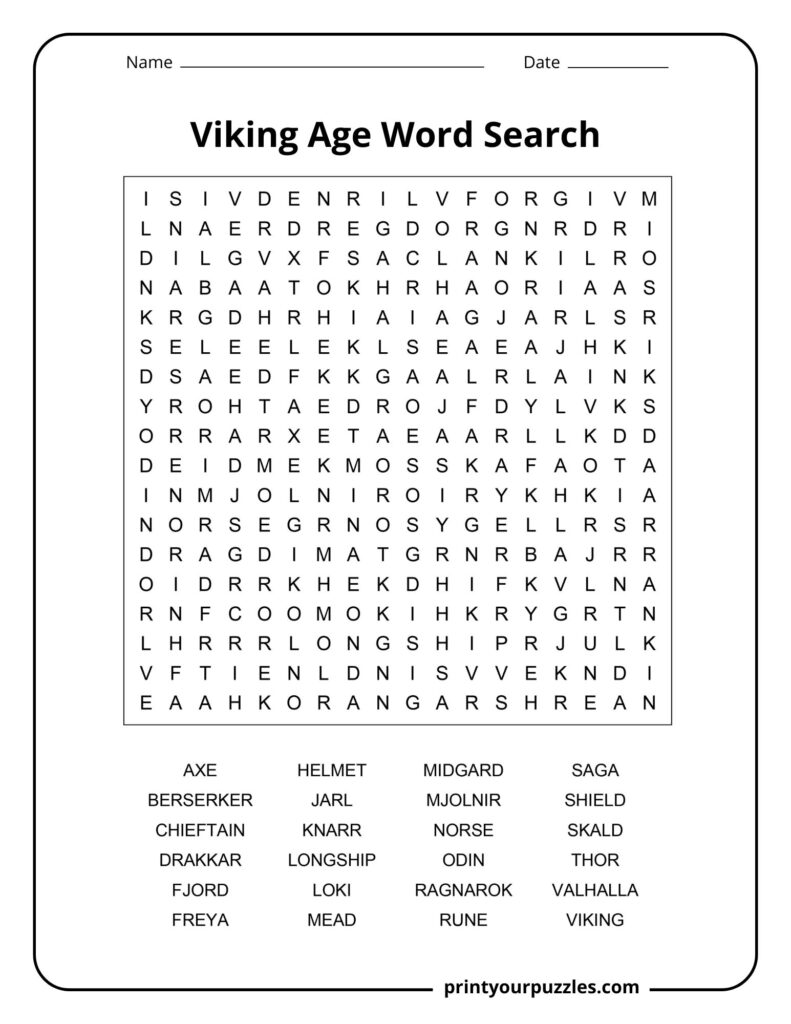
AXE, BERSERKER, CHIEFTAIN, DRAKKAR, FJORD, FREYA, HELMET, JARL, KNARR, LONGSHIP, LOKI, MEAD, MIDGARD, MJOLNIR NORSE, ODIN, RAGNAROK, RUNE, SAGA, SHIELD, SKALD THOR, VALHALLA, VIKING
AXE – A powerful hand weapon and essential tool of the Viking Age, used both in battle and daily life. Norse warriors favored the broad-bladed dane axe for its devastating reach and cutting power.
BERSERKER – Elite Viking warriors who entered a fierce, trance-like battle fury before combat. Feared across Europe, they fought with extraordinary strength and recklessness, seemingly impervious to pain and wounds.
CHIEFTAIN – A powerful Norse leader who commanded loyalty through strength, generosity and wisdom. Chieftains ruled territories, led raids, settled disputes and rewarded followers with treasure and land.
DRAKKAR – The iconic Viking longship, featuring a fearsome carved dragon head at its prow. Swift, flexible and shallow-drafted, it could navigate both open seas and narrow inland rivers with ease.
FJORD – A deep, dramatic coastal inlet carved by ancient glaciers along Scandinavian shores. These sheltered natural harbors were vital to Viking communities, providing safe anchorage and rich fishing grounds.
FREYA – The beloved Norse goddess of love, fertility, beauty and war. She rode a chariot pulled by giant cats, received half of all battle-slain warriors and practiced powerful seiðr magic.
HELMET – Protective Viking headgear typically crafted from iron or leather. Contrary to popular myth, authentic Norse helmets featured no horns, instead having practical nose guards and sometimes chain mail neck protection.
JARL – A high-ranking Norse nobleman sitting just below royalty in Viking society. Jarls controlled vast lands, commanded warriors, collected tribute and wielded considerable political power within their regions.
KNARR – A sturdy, broad-beamed Viking merchant vessel designed for carrying heavy cargo across open oceans. Knarrs were essential for Norse trade, colonization voyages and transporting livestock to distant settlements.
LONGSHIP – The legendary warship that made Viking expansion possible. Long, narrow and remarkably fast under both sail and oar, it carried Norse warriors to raids across Europe, the Mediterranean and beyond.
LOKI – The cunning and unpredictable Norse trickster god, known for shapeshifting and causing mischief. Initially an ally to the gods, Loki eventually became their greatest enemy, orchestrating the death of Baldr.
MEAD – A beloved alcoholic beverage brewed from fermented honey and water. Shared in feasting halls among warriors, mead symbolized community, honor and celebration, and featured prominently in Norse mythology and poetry.
MIDGARD – The realm of humans in Norse cosmology, encircled by a vast ocean. According to mythology, the great serpent Jörmungandr lay coiled around its boundaries, holding the entire world in its grip.
MJOLNIR – The mighty hammer of the thunder god Thor, one of the most powerful weapons in Norse mythology. Capable of leveling mountains and returning after each throw, it symbolized protection and divine strength.
NORSE – Relating to the medieval Scandinavian peoples, their language, culture and mythology. The Norse civilization produced extraordinary seafarers, craftsmen, poets and warriors whose legacy continues to shape modern Western culture.
ODIN – The supreme ruler of Asgard and chief of the Norse gods. Odin sacrificed his eye for cosmic wisdom, commanded ravens and wolves and welcomed chosen warriors to feast eternally in Valhalla.
RAGNAROK – The prophesied apocalyptic final battle in Norse mythology, foretelling the death of major gods. Following immense destruction, the world would sink into the sea before rising again, reborn and renewed.
RUNE – A character from the ancient Norse alphabetic system used for writing, divination and magic. Carved into stone, wood and metal, runes carried deep symbolic power and were believed to hold mystical forces.
SAGA – A long Norse prose narrative recounting the dramatic deeds of legendary heroes, kings and explorers. Composed in Iceland during the 12th and 13th centuries, sagas remain among history’s greatest literary achievements.
SHIELD – Essential Viking defensive equipment, typically crafted from wooden planks with an iron boss. Warriors locked shields together in the famous shield wall formation, creating an almost impenetrable barrier in battle.
SKALD – A highly respected Norse court poet who composed and performed elaborate praise poetry for rulers. Skalds preserved historical events through complex verse, serving as both entertainers and living chroniclers of Viking society.
THOR – The immensely popular Norse god of thunder, storms and strength. Son of Odin and protector of humanity, Thor wielded Mjolnir against giants and monsters, and was widely worshipped by Viking warriors and farmers.
VALHALLA – Odin’s magnificent hall in Asgard where brave warriors slain in battle were welcomed. The chosen dead, known as Einherjar, feasted and trained daily, preparing for their ultimate role fighting at Ragnarok.
VIKING – A Norse seafarer from Scandinavia who raided, traded and settled across Europe between the 8th and 11th centuries. The term originally meant a pirate raid, later describing the remarkable civilization behind it.
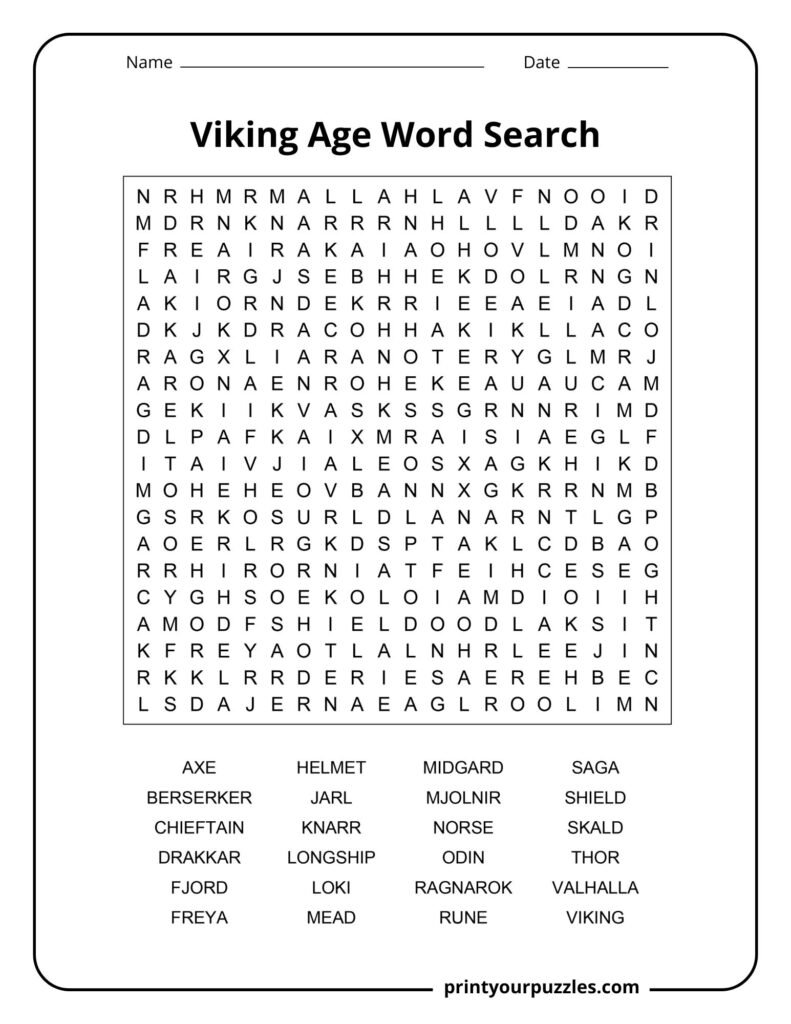
AXE, BERSERKER, CHIEFTAIN, DRAKKAR, FJORD, FREYA, HELMET, JARL, KNARR, LONGSHIP, LOKI, MEAD, MIDGARD, MJOLNIR NORSE, ODIN, RAGNAROK, RUNE, SAGA, SHIELD, SKALD THOR, VALHALLA, VIKING
The Viking Age is generally considered to span from 793 AD, marked by the Lindisfarne raid, to 1066 AD, ending with the Norman Conquest of England.
No. This is a popular myth. Archaeological evidence shows Vikings wore simple iron or leather helmets with nose guards. The horned helmet stereotype originated from 19th-century romantic illustrations.
Vikings originated from Scandinavia, primarily modern-day Norway, Sweden and Denmark. Each region had distinct roles, with Norwegians exploring westward, Danes raiding England and Swedes trading eastward toward Russia.
Absolutely not. Vikings were also skilled traders, explorers, farmers and craftsmen. They established thriving trade routes, founded cities like Dublin, and even reached North America centuries before Christopher Columbus.
The Viking Age ended due to the gradual Christianization of Scandinavia, stronger European kingdoms better able to defend themselves, and Norse settlers assimilating into local cultures across their conquered and colonized territories.
Children of Ash and Elm: A History of the Vikings by Neil Price. Uppsala University’s pre-eminent Viking archaeologist Price, drawing on thirty-five years of fieldwork and the latest DNA science, strips away a millennium of myth to reveal the real Vikings in blazingly vivid, novelistic detail.
Vikings established one of history’s earliest democratic assemblies called the Thing, where free men gathered regularly to settle disputes, create laws and make important community decisions together.
Vikings likely navigated cloudy seas using Iceland spar crystals called sunstones, which could detect the sun’s position even through thick clouds and fog, enabling remarkably accurate open-ocean navigation.
Norse explorer Leif Erikson established a settlement at L’Anse aux Meadows in Newfoundland, Canada, around 1000 AD, making Europeans’ first confirmed contact with the American continent centuries before Columbus arrived.
Archaeological finds reveal Vikings carried combs, razors and ear cleaners regularly. They bathed weekly, which was considered unusually hygienic compared to many other medieval European cultures of that same period.
Norse women could own property, request divorce, and manage households and businesses independently. Widows held particular authority and respect within their communities, enjoying freedoms rarely seen elsewhere in medieval European societies.