Introduction to the Cuban Revolution Word Search
The Cuban Revolution was a major political and social movement that transformed Cuba and reshaped relations across the Americas. It developed during the 1950s and reached its decisive moment on January 1, 1959, when the government of Fulgencio Batista collapsed. The revolution brought Fidel Castro and his allies to power, ended one authoritarian regime, and eventually created a socialist state closely aligned with the Soviet Union.
Batista had returned to power through a military coup in 1952. His government was associated with censorship, corruption, political repression, and strong ties to wealthy business interests. Although Cuba had profitable sugar, tourism, and entertainment industries, economic inequality remained severe. Many rural families had limited access to land, education, healthcare, and steady employment.
Fidel Castro, a young lawyer and political activist, became one of Batista’s leading opponents. On July 26, 1953, Castro and his supporters attacked the Moncada Barracks in Santiago de Cuba. The assault failed, and many rebels were killed or imprisoned. Castro was later released and went into exile in Mexico, where he organized the July 26 Movement with figures including Raúl Castro and Ernesto “Che” Guevara.
In December 1956, 82 revolutionaries sailed from Mexico aboard the yacht *Granma* and landed in Cuba. Most were quickly killed or captured, but a small group escaped into the Sierra Maestra mountains. From there, the rebels carried out guerrilla attacks, built local support, and challenged government forces. Resistance also grew in Cuban cities through students, workers, underground organizers, and political opponents.
Communication played a crucial role in the conflict. Radio Rebelde broadcast revolutionary news and messages from the mountains, while newspapers, photography, television, political posters, and portable communications helped shape public opinion. These technologies allowed the rebels to present themselves as a growing national movement and anticipated the importance of independent media, livestreaming, and social networks in modern political struggles.
Batista gradually lost public, military, and international support. Rebel victories, strikes, desertions, and political pressure weakened his government until he fled Cuba on January 1, 1959. The new revolutionary government introduced land reform, nationalized industries, expanded literacy and healthcare programs, and restricted political opposition. Cuba soon moved toward socialism and developed a close alliance with the Soviet Union.
The revolution’s legacy remains deeply debated. Supporters emphasize advances in education, literacy, healthcare, and national independence, while critics point to censorship, political imprisonment, one-party rule, exile, and economic hardship.
Related Word Searches:
Cuban Missile Crisis | John F. Kennedy | Cold War | Russian Revolution | Chinese Revolution | Truman Doctrine
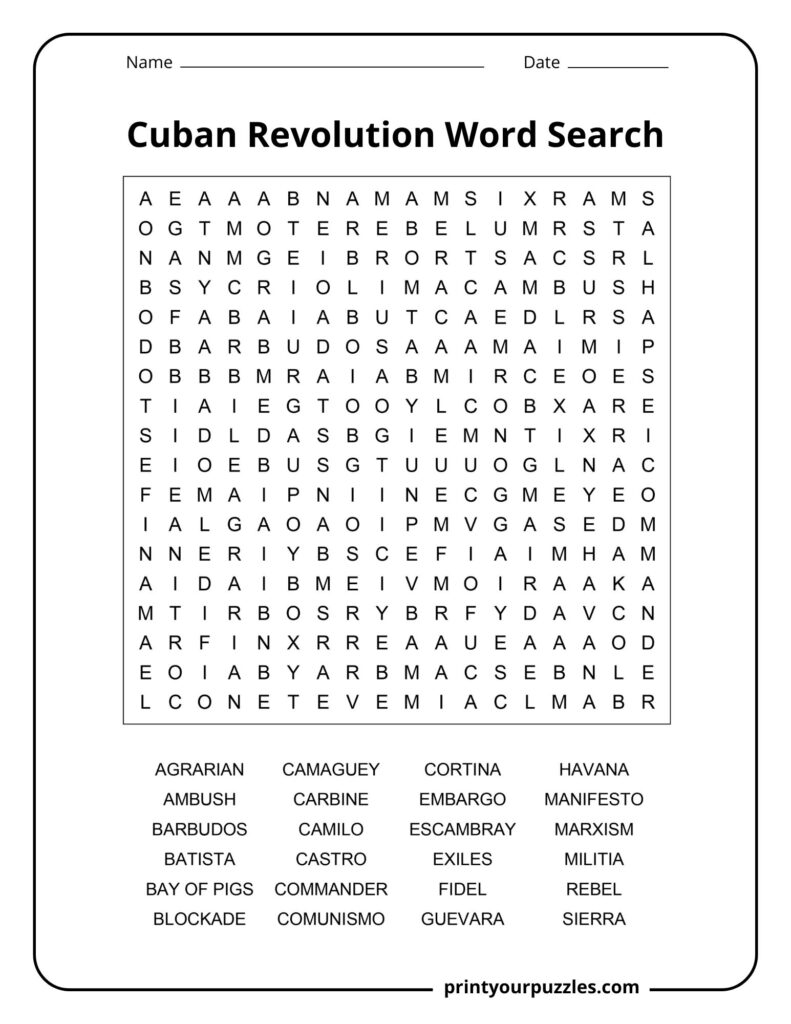
Medium Difficulty Word Search
Words to Find
AGRARIAN, AMBUSH, BARBUDOS, BATISTA, BAY OF PIGS, BLOCKADE, CAMAGUEY, CAMILO, CARBINE, CASTRO, COMMANDER, COMUNISMO, CORTINA, EMBARGO, ESCAMBRAY, EXILES, FIDEL, GUEVARA, HAVANA, MANIFESTO, MARXISM, MILITIA, REBEL, SIERRA
All Words Defined
AGRARIAN – Relating to land reform policies implemented by Castro’s government, redistributing large private estates and foreign-owned plantations to Cuban peasants and the revolutionary state after 1959.
AMBUSH – Surprise attack tactic frequently used by Castro’s rebel forces against Batista’s army in rural Cuba, allowing smaller guerrilla units to defeat larger, better-equipped government military columns.
BARBUDOS – Nickname meaning “bearded ones” given to Castro’s revolutionary fighters in the Sierra Maestra mountains, whose beards became a powerful symbol of rebellion and defiance against Batista’s regime.
BATISTA – Fulgencio Batista, Cuban military dictator whose corrupt and repressive government was overthrown by Castro’s revolutionary movement on January 1, 1959, forcing him into permanent exile abroad.
BAY OF PIGS – Failed 1961 CIA-sponsored invasion by Cuban exiles attempting to overthrow Castro’s government, ending in complete military defeat and becoming a major embarrassment for the Kennedy administration.
BLOCKADE – United States naval blockade imposed during the 1962 Cuban Missile Crisis, preventing Soviet ships from delivering nuclear weapons to Cuba and bringing the world dangerously close to nuclear war.
CAMAGUEY – Central Cuban province and historically significant city that played an important role during the revolution, serving as a strategic location for rebel operations and anti-Batista underground resistance networks.
CAMILO – Camilo Cienfuegos, beloved Cuban revolutionary commander who fought alongside Castro and Guevara, tragically disappearing in a mysterious plane crash in October 1959, just months after victory.
CARBINE – Lightweight rifle widely carried by Castro’s guerrilla fighters throughout the Cuban countryside, becoming an iconic weapon of the revolution alongside the more famous Soviet-made assault rifles used later.
CASTRO – Fidel Castro, lawyer-turned-revolutionary leader who led the Cuban Revolution, defeated Batista’s dictatorship, and ruled Cuba as its communist leader for nearly five decades until 2008.
COMMANDER – Leadership title held by senior revolutionary figures within Castro’s guerrilla army, with Fidel Castro holding the supreme rank of Comandante en Jefe, meaning Commander in Chief of all forces.
COMUNISMO – Communist ideology that became the official political and economic foundation of revolutionary Cuba, shaping its single-party government, nationalized economy, and decades-long confrontational relationship with the United States.
CORTINA – Reference to the Iron Curtain dividing communist and capitalist worlds during the Cold War, with Cuba becoming the only nation in the Western Hemisphere firmly positioned behind this ideological barrier.
EMBARGO – United States economic embargo imposed on Cuba beginning in 1962, restricting trade and financial transactions for decades, severely impacting the Cuban economy and becoming a lasting symbol of Cold War tensions.
ESCAMBRAY – Mountain range in central Cuba where guerrilla fighters operated during the revolution and where anti-Castro rebels later mounted significant armed resistance against the new revolutionary government throughout the early 1960s.
EXILES – Hundreds of thousands of Cubans who fled the island after Castro’s takeover, settling primarily in Miami, forming a powerful diaspora community that strongly opposed the revolutionary government for generations.
FIDEL – First name of Fidel Castro, which became universally recognized worldwide as a symbol of Latin American revolutionary socialism, anti-imperialism, and defiance against United States political and economic dominance in the region.
GUEVARA – Ernesto “Che” Guevara, Argentine-born Marxist revolutionary and Castro’s most famous comrade, who became a globally iconic symbol of rebellion after his capture and execution in Bolivia in 1967.
HAVANA – Cuban capital city that served as the political and cultural heart of the revolution, where Castro’s triumphant forces marched victoriously in January 1959 after Batista fled the country overnight.
MANIFESTO – Revolutionary political document outlining the goals and ideology of Castro’s movement, inspired by Marxist principles and calling for social justice, national sovereignty, and liberation from American economic and political influence.
MARXISM – Political and economic philosophy of Karl Marx that profoundly influenced Cuba’s revolutionary ideology, justifying the nationalization of industries, elimination of class distinctions, and establishment of a socialist one-party state.
MILITIA – Armed civilian defense forces organized by Castro’s government after the revolution to defend Cuba against potential invasion, trained and mobilized across the island during the tense Bay of Pigs period.
REBEL – Term describing the dedicated fighters of Castro’s July 26th Movement who took up arms against Batista’s dictatorship, enduring years of hardship in the mountains before achieving their historic revolutionary victory.
SIERRA – Short reference to Sierra Maestra, the rugged southeastern mountain range where Castro’s small guerrilla force survived, grew, and launched the revolutionary campaign that ultimately toppled Batista’s powerful military government.
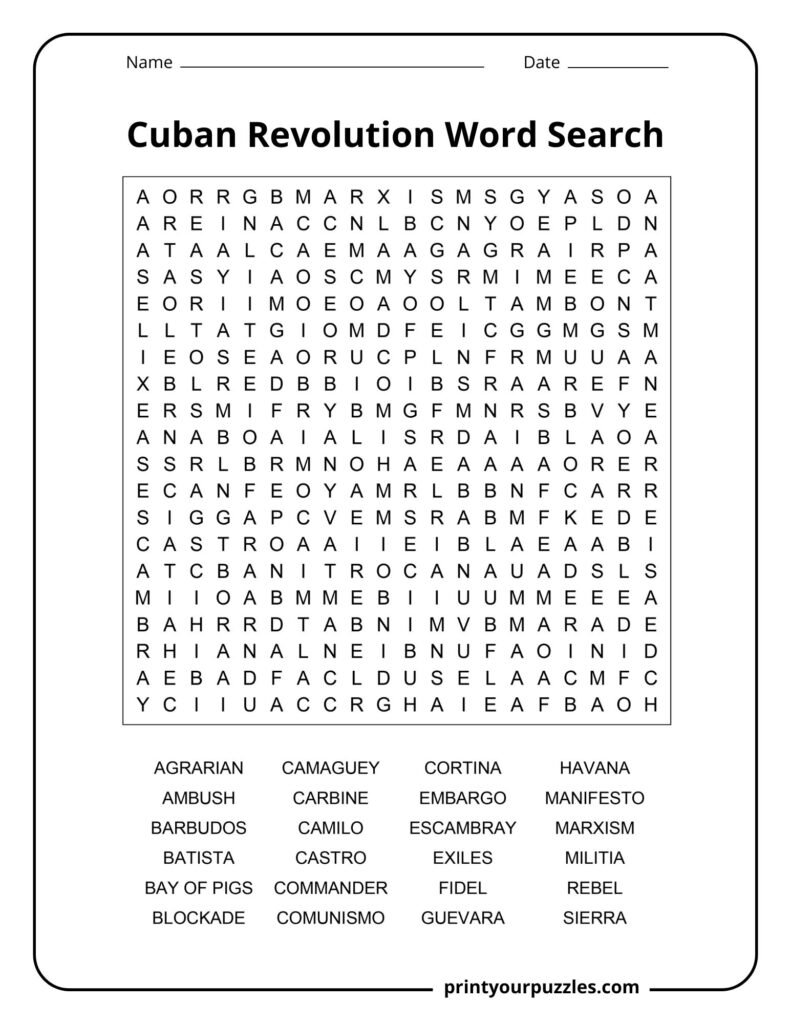
Hard Difficulty Word Search
Words to Find
AGRARIAN, AMBUSH, BARBUDOS, BATISTA, BAY OF PIGS, BLOCKADE, CAMAGUEY, CAMILO, CARBINE, CASTRO, COMMANDER, COMUNISMO, CORTINA, EMBARGO, ESCAMBRAY, EXILES, FIDEL, GUEVARA, HAVANA, MANIFESTO, MARXISM, MILITIA, REBEL, SIERRA
6 Key FAQs About the Cuban Revolution
5 Curious "Did You Know?" Facts About the Cuban Revolution