Introduction to the Richard Nixon Word Search
Richard Nixon’s (1969–1974) presidency is often remembered through one word: Watergate. Yet his time in office was more than a political scandal. Nixon was a complex president who reshaped foreign policy, appealed to voters tired of the unrest of the 1960s, expanded some areas of government, and then became the only U.S. president to resign from office. The Richard Nixon word search gives students a way to study a presidency filled with achievement, conflict, secrecy, and constitutional crisis.
Nixon had spent many years in national politics before reaching the White House. He represented California in Congress, became a senator, served as vice president under Dwight D. Eisenhower, lost the presidential election of 1960 to John F. Kennedy, and then returned to win the election of 1968. His comeback was remarkable, especially in a country divided by the Vietnam War, civil rights struggles, protests, and concerns about crime and social change.
Foreign policy became one of the most important parts of Nixon’s presidency. He pursued détente, a strategy designed to reduce tensions with the Soviet Union. He also made a historic visit to China in 1972, opening a new relationship between the United States and the People’s Republic of China. These moves changed Cold War diplomacy and showed Nixon’s skill in global strategy.
At home, Nixon appealed to what he called the “silent majority,” Americans who wanted order and stability after years of unrest. His administration created the Environmental Protection Agency, supported important environmental laws, and oversaw policies connected with school desegregation, economic controls, and federal authority. These actions make his domestic record more varied than many people expect.
The Vietnam War remained a major challenge. Nixon promised “peace with honor” and gradually withdrew American troops, but the war expanded into Cambodia, leading to more protests. The conflict finally ended for the United States with the Paris Peace Accords in 1973, although Vietnam remained a painful subject in American life.
Watergate destroyed Nixon’s presidency. After a break-in at Democratic Party offices and a cover-up by members of his administration, investigations revealed abuse of power and secret recordings. Facing almost certain impeachment, Nixon resigned in 1974. This Richard Nixon word search examines foreign policy breakthroughs, Vietnam, environmental policy, public distrust, Watergate, and the limits of presidential power.
Keep learning about the Vietnam and Watergate period with our Lyndon B. Johnson word search, Gerald Ford word search, John F. Kennedy word search, and the full US Presidents Word Searches collection.
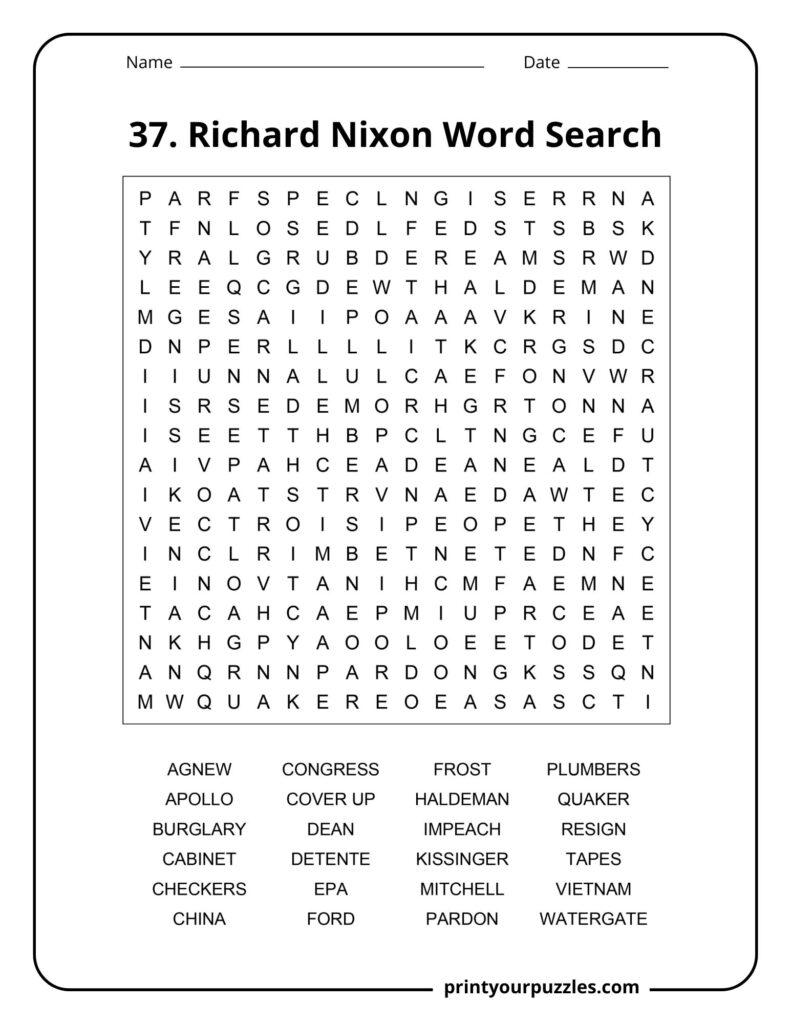
Medium Difficulty Word Search
Words to Find:
AGNEW, APOLLO, BURGLARY, CABINET, CHECKERS, CHINA, CONGRESS, COVER UP, DEAN, DETENTE, EPA, FORD, FROST, HALDEMAN, IMPEACH, KISSINGER, MITCHELL, PARDON, PLUMBERS, QUAKER, RESIGN, TAPES, VIETNAM, WATERGATE
All Words Defined
AGNEW – Spiro Agnew served as Nixon’s Vice President from 1969-1973. He resigned due to tax evasion charges, becoming the second VP in history to resign from office.
APOLLO – The Apollo space program achieved Nixon’s goal of lunar exploration. He spoke with Apollo 11 astronauts on the moon and oversaw multiple successful missions during his presidency.
BURGLARY – The 1972 Watergate break-in where Nixon’s associates burglarized Democratic National Committee headquarters. This criminal act initiated the scandal that ultimately ended Nixon’s presidency through forced resignation.
CABINET – Nixon’s Cabinet included influential figures like Henry Kissinger and John Mitchell. Several members became implicated in Watergate, leading to resignations, convictions, and a major administrative crisis.
CHECKERS – Nixon’s famous 1952 speech defending himself against corruption allegations. Named after his family dog Checkers, this televised address saved his vice-presidential candidacy under Eisenhower.
CHINA – Nixon’s 1972 visit to China opened diplomatic relations with the Communist nation. This historic trip fundamentally transformed international relations and ended decades of hostility between nations.
CONGRESS – Congress investigated Watergate extensively through Senate hearings. The House Judiciary Committee approved impeachment articles against Nixon, forcing his resignation before the full House voted on removal.
COVER-UP – Nixon orchestrated efforts to conceal Watergate involvement through lies, bribery, and obstruction. The cover-up proved more damaging than the original crime, becoming grounds for his impeachment.
DEAN – John Dean served as White House Counsel who participated in Watergate’s cover-up. His testimony against Nixon during Senate hearings provided crucial evidence of presidential involvement in obstruction.
DETENTE – Nixon’s foreign policy strategy reduced Cold War tensions with the Soviet Union. This approach emphasized negotiation over confrontation, leading to arms control agreements and improved relations.
EPA – Nixon established the Environmental Protection Agency in 1970. This federal agency protects human health and environment through regulation, representing a major expansion of governmental environmental oversight.
FORD – Gerald Ford replaced Agnew as Vice President, then succeeded Nixon as President. Ford controversially pardoned Nixon for any crimes committed during his presidency, ending potential prosecution.
FROST – David Frost conducted revealing 1977 interviews with Nixon after his resignation. These televised conversations drew massive audiences and contained Nixon’s closest admission of wrongdoing regarding Watergate.
HALDEMAN – H.R. Haldeman was Nixon’s Chief of Staff and trusted confidant. He was convicted of conspiracy and obstruction related to Watergate, serving eighteen months in federal prison.
IMPEACH – The House Judiciary Committee voted to impeach Nixon on obstruction, abuse of power, and contempt charges. Nixon resigned before the full House could vote on these articles.
KISSINGER – Henry Kissinger served as National Security Advisor and Secretary of State. He shaped Nixon’s foreign policy, negotiating détente with Soviets and opening relations with China through diplomacy.
MITCHELL – John Mitchell served as Attorney General and directed Nixon’s re-election campaign. He was convicted of conspiracy, obstruction, and perjury related to Watergate, serving nineteen months imprisoned.
PARDON – President Ford granted Nixon a complete presidential pardon in September 1974. This controversial decision prevented any criminal prosecution for Watergate-related offenses, generating significant public backlash.
PLUMBERS – The White House Plumbers were Nixon’s secret unit created to stop information leaks. This group conducted illegal activities including the Watergate break-in and burglarizing Daniel Ellsberg’s psychiatrist.
QUAKER – Nixon was raised in the Quaker religious tradition, known for pacifism and simplicity. His religious background influenced his character and provided moral framework, though contrasted with Watergate’s ethical violations.
RESIGN – Nixon resigned the presidency on August 9, 1974, becoming America’s only president to resign. Facing certain impeachment and removal, resignation allowed him to leave office with remaining dignity.
TAPES – Secret White House recording tapes documented Nixon’s conversations and proved his Watergate involvement. The Supreme Court ordered their release; the “smoking gun” tape confirmed obstruction, ending his presidency.
VIETNAM – Nixon inherited the Vietnam War and implemented “Vietnamization” to gradually withdraw American troops. Despite promising peace, the war continued throughout his presidency until 1973 Paris Peace Accords.
WATERGATE – The Watergate scandal involved illegal activities by Nixon’s administration, including break-ins, cover-ups, and abuse of power. This constitutional crisis led to Nixon’s resignation and reshaped American politics.
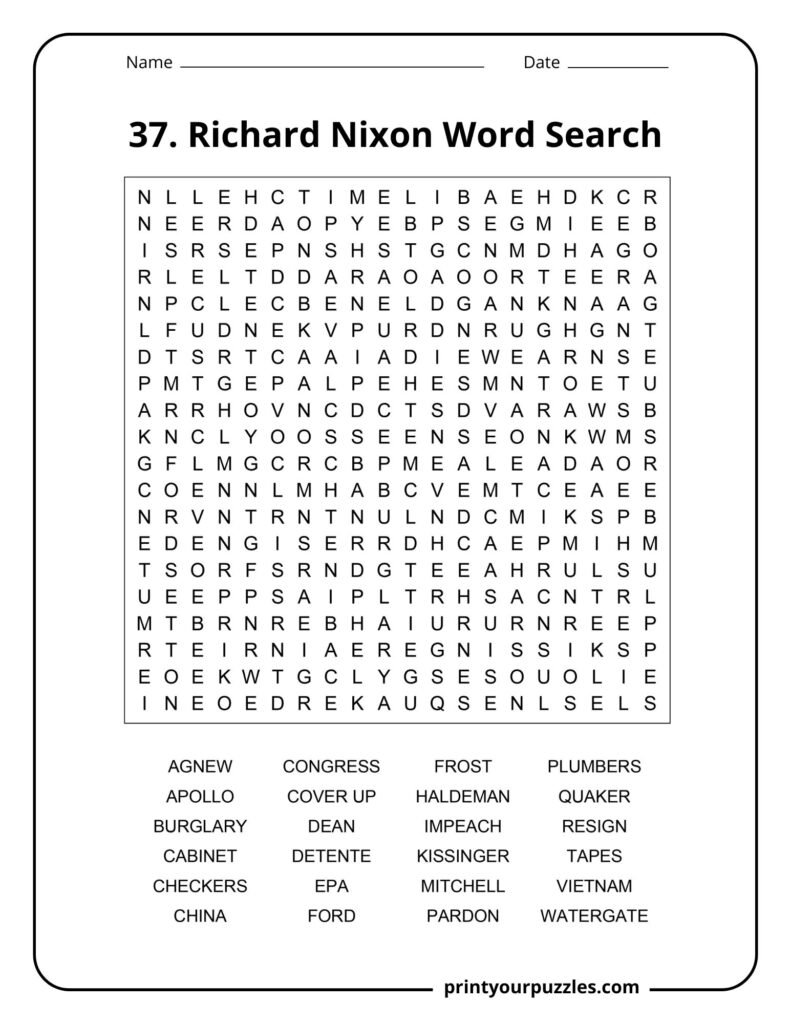
Hard Difficulty Word Search
Words to Find:
AGNEW, APOLLO, BURGLARY, CABINET, CHECKERS, CHINA, CONGRESS, COVER UP, DEAN, DETENTE, EPA, FORD, FROST, HALDEMAN, IMPEACH, KISSINGER, MITCHELL, PARDON, PLUMBERS, QUAKER, RESIGN, TAPES, VIETNAM, WATERGATE
7 Key FAQs About Richard Nixon
5 Curious "Did You Know?" Facts About Richard Nixon