
The Dust Bowl was one of the most severe environmental and agricultural disasters in United States history. During the 1930s, enormous dust storms swept across the Great Plains, damaging farms, destroying crops, and forcing thousands of families to leave their homes. The disaster affected parts of Texas, Oklahoma, Kansas, Colorado, New Mexico, and other nearby states, changing both the landscape and the lives of the people who depended on farming.
Several factors combined to create the Dust Bowl. During the 1920s, farmers had plowed large areas of native grassland to grow wheat and other crops. These grasses had deep roots that helped hold the soil in place. When a long period of drought began in the early 1930s, crops failed and the exposed soil became extremely dry. Strong winds then lifted the loose topsoil into the air, creating massive clouds of dust that could travel hundreds of miles.
Some dust storms were so large and dark that they blocked sunlight during the day. One of the most famous occurred on April 14, 1935, a day that became known as “Black Sunday.” Dust entered houses through doors and windows, damaged machinery, harmed livestock, and caused breathing problems for many people. Farming families faced another difficulty at the same time: the Great Depression had caused falling crop prices, unemployment, and widespread financial hardship.
Many families eventually abandoned their farms and traveled west in search of work. Oklahoma migrants were often called “Okies,” although the term was sometimes used for migrants from several Great Plains states. Large numbers moved toward California, where they hoped to find jobs on farms and in growing communities.
The federal government responded with programs designed to help farmers and protect the soil. New farming methods encouraged crop rotation, contour plowing, shelterbelts of trees, and other conservation practices that reduced erosion.
A Dust Bowl word search can introduce important people, places, environmental conditions, and historical terms connected with this difficult period. Learning about the Dust Bowl also shows how climate, farming practices, economics, and government policy can interact, making it an important chapter in both American and environmental history.
Related Word Searches:
Great Depression | New Deal | Franklin D. Roosevelt | 1929 Stock Market Crash | Herbert Hoover | Roaring Twenties
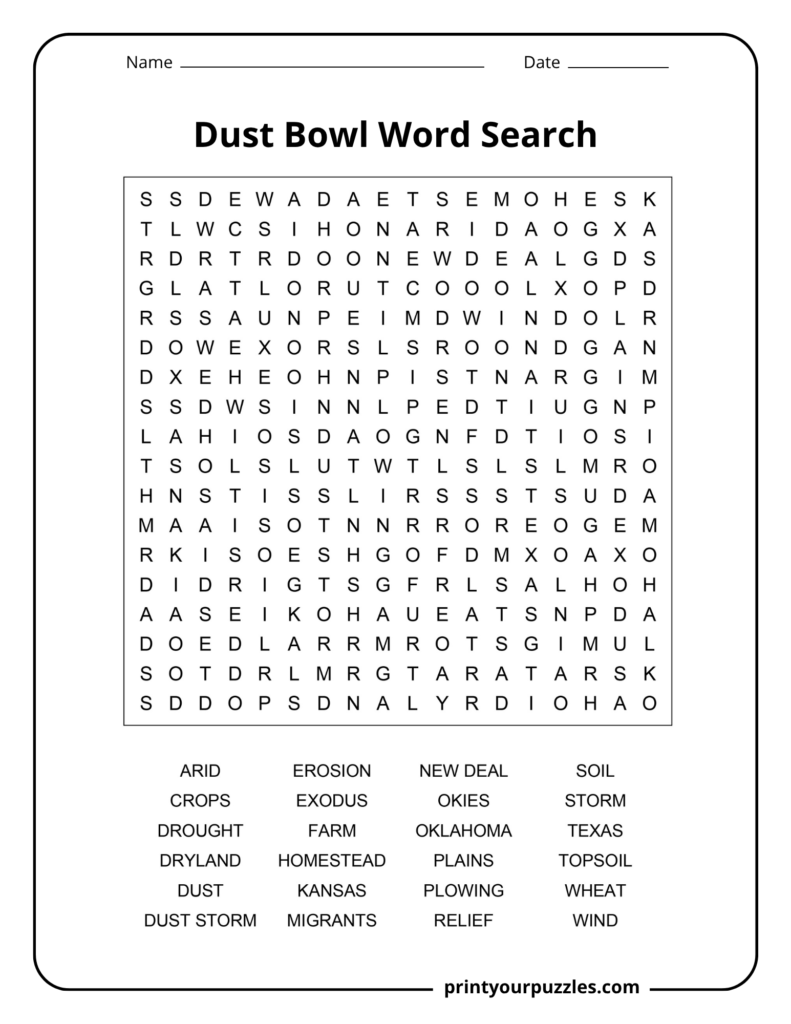
ARID, CROPS, DROUGHT, DRYLAND, DUST, DUST STORM, EROSION, EXODUS, FARM, HOMESTEAD, KANSAS, MIGRANTS, NEW DEAL, OKIES, OKLAHOMA, PLAINS, PLOWING, RELIEF, SOIL, STORM, TEXAS, TOPSOIL, WHEAT, WIND
ARID – Extremely dry conditions with very little rainfall. Arid weather across the Great Plains contributed to drought, crop failures, exposed soil, and severe Dust Bowl erosion.
CROPS – Plants grown by farmers for food or sale. During the Dust Bowl, wheat and other crops failed because of drought, damaged soil, and powerful dust storms.
DROUGHT – A long period with unusually little rainfall. Severe drought during the 1930s dried Great Plains farmland, destroyed crops, and helped create enormous clouds of blowing dust.
DRYLAND – Farmland where crops depend mainly on natural rainfall instead of irrigation. Dryland farming became especially vulnerable when prolonged drought struck the Great Plains during the 1930s.
DUST – Fine, dry particles of soil carried through the air. During the Dust Bowl, enormous amounts of dust covered farms, homes, roads, machinery, and entire communities.
DUST STORM – A powerful weather event in which strong winds lift large amounts of dry soil into the air, sometimes darkening the sky and reducing visibility dramatically.
EROSION – The wearing away and movement of soil by wind or water. Wind erosion became extremely severe during the Dust Bowl because drought left farmland dry and exposed.
EXODUS – A large departure of people from a particular place. The Dust Bowl caused an exodus of farming families who left the Great Plains seeking work elsewhere.
FARM – Land used to grow crops or raise animals. Thousands of farms across the Great Plains struggled during the Dust Bowl because drought and erosion destroyed productive soil.
HOMESTEAD – A home and surrounding farmland occupied by a farming family. Many Dust Bowl homesteads were abandoned when drought, debt, and repeated crop failures became impossible to overcome.
KANSAS – Great Plains state severely affected by drought, wind erosion, and dust storms during the 1930s. Kansas farmers experienced major crop losses and difficult economic conditions.
MIGRANTS – People who move from one region to another, often seeking work or better living conditions. Dust Bowl migrants frequently traveled west, especially toward California.
NEW DEAL – Collection of federal programs introduced by President Franklin D. Roosevelt during the Great Depression, including measures that helped farmers, supported rural communities, and encouraged soil conservation.
OKIES – Informal name commonly given to Dust Bowl migrants from Oklahoma, and sometimes other Great Plains states, who traveled west seeking agricultural jobs and improved living conditions.
OKLAHOMA – Great Plains state strongly associated with the Dust Bowl. Drought, soil erosion, failed farms, and migration affected many Oklahoma communities throughout the difficult 1930s.
PLAINS – Broad, mostly flat grasslands covering much of central North America. The Great Plains became the main region affected by Dust Bowl drought, erosion, and destructive storms.
PLOWING – The process of turning and preparing soil for planting. Extensive plowing removed native grasses whose deep roots had previously helped protect Great Plains soil from wind erosion.
RELIEF – Government assistance provided to people experiencing economic hardship. During the Great Depression and Dust Bowl, federal relief programs supported struggling farmers, workers, and displaced families.
SOIL – The upper layer of earth where plants grow. During the Dust Bowl, dry and unprotected soil was easily carried away by strong winds across the Great Plains.
STORM – A period of severe weather involving strong winds or other dangerous conditions. Dust Bowl storms carried enormous clouds of loose soil across farms, towns, and roads.
TEXAS – Southern Great Plains state whose Panhandle region suffered severely during the Dust Bowl, experiencing intense drought, crop failures, wind erosion, and repeated destructive dust storms.
TOPSOIL – The fertile uppermost layer of soil containing nutrients needed by plants. Dust Bowl winds removed huge quantities of topsoil, reducing farmland productivity and damaging agricultural communities.
WHEAT – Important grain crop widely grown across the Great Plains. Large areas were planted with wheat before the Dust Bowl, but drought later caused widespread crop failures.
WIND – Moving air that became a destructive force during the Dust Bowl. Powerful winds lifted exposed topsoil, created dust storms, damaged farms, and carried soil great distances.
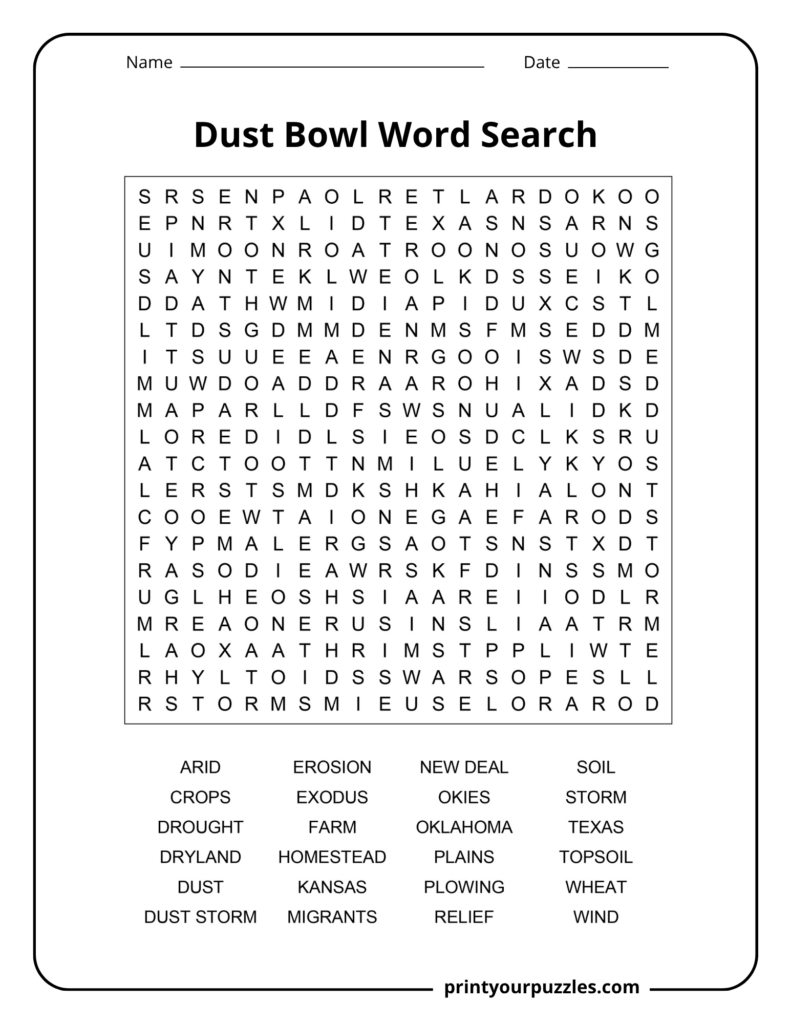
ARID, CROPS, DROUGHT, DRYLAND, DUST, DUST STORM, EROSION, EXODUS, FARM, HOMESTEAD, KANSAS, MIGRANTS, NEW DEAL, OKIES, OKLAHOMA, PLAINS, PLOWING, RELIEF, SOIL, STORM, TEXAS, TOPSOIL, WHEAT, WIND
The Dust Bowl was a 1930s environmental disaster in the Great Plains, where drought, poor farming practices, and strong winds created severe soil erosion and dust storms.
The Dust Bowl resulted from prolonged drought, extensive plowing of native grasslands, exposed topsoil, and powerful winds that carried dry soil across large areas.
Oklahoma, Texas, Kansas, Colorado, and New Mexico were among the states most severely affected, especially areas located within the southern Great Plains region.
Many families migrated because crops failed, farms became unproductive, debts increased, and employment opportunities disappeared, leading thousands to search for work elsewhere.
The federal government introduced conservation programs, financial assistance, improved farming techniques, and tree-planting projects designed to reduce erosion and protect damaged agricultural land.
On April 14, 1935, a massive dust storm swept across the Great Plains, darkening skies and becoming one of the Dust Bowl’s most famous events.
Powerful winds carried enormous amounts of loose topsoil far beyond farming areas, spreading dust across towns and cities located many miles from the Great Plains.
Thousands of families left Oklahoma and other Plains states hoping to find agricultural jobs, better living conditions, and new opportunities in California during the 1930s.
Before extensive plowing, deep-rooted prairie grasses held soil firmly in place, reducing erosion and helping the land withstand periods of dry and windy weather.
The disaster encouraged farmers and government agencies to adopt soil conservation methods, including contour plowing, crop rotation, shelterbelts, and other techniques designed to reduce erosion.