Introduction to the Constitution Day Word Search
Constitution Day is observed in the United States on September 17 to commemorate the signing of the U.S. Constitution in 1787. The document established the basic structure of the federal government and created a system designed to divide political power among different institutions. It remains one of the most important documents in American history because it explains how the government operates and protects many fundamental principles of national life.
The Constitution was written during the Constitutional Convention in Philadelphia. Delegates from twelve states met to improve the country’s existing system of government, which had been organized under the Articles of Confederation. After months of discussion and debate, thirty-nine delegates signed the new Constitution on September 17. The document then had to be approved, or ratified, by the states before it could take effect.
One of the Constitution’s central ideas is the separation of powers. The federal government is divided into three branches: legislative, executive, and judicial. Congress makes laws, the president carries them out, and the courts interpret them. A system of checks and balances allows each branch to limit certain actions of the others, helping prevent too much authority from being concentrated in one place.
The Constitution also describes the relationship between the federal government and the states. Its first ten amendments, known as the Bill of Rights, protect freedoms such as speech, religion, assembly, and due process. Additional amendments have expanded voting rights, ended slavery, and addressed other important national issues. Because the Constitution can be amended, it has changed over time while preserving its basic framework.
Constitution Day is not generally celebrated with large parades or fireworks. Instead, schools, libraries, museums, government institutions, and civic organizations often mark the occasion with lessons, public readings, discussions, exhibitions, and educational activities. Many programs explore the work of the Founding Fathers, the compromises made during the convention, and the rights and responsibilities connected with citizenship.
The day encourages Americans to learn how their government works and to consider how constitutional principles continue to influence laws, elections, public debates, and everyday life.
Explore the people, ideas, institutions, and freedoms connected with America’s founding document through this printable Constitution Day word search puzzle, featuring vocabulary inspired by the branches of government, the Bill of Rights, citizenship, amendments, delegates, and the Constitutional Convention.
Related Word Searches:
4th of July | Independence Day | Presidents’ Day | Memorial Day | Veterans Day
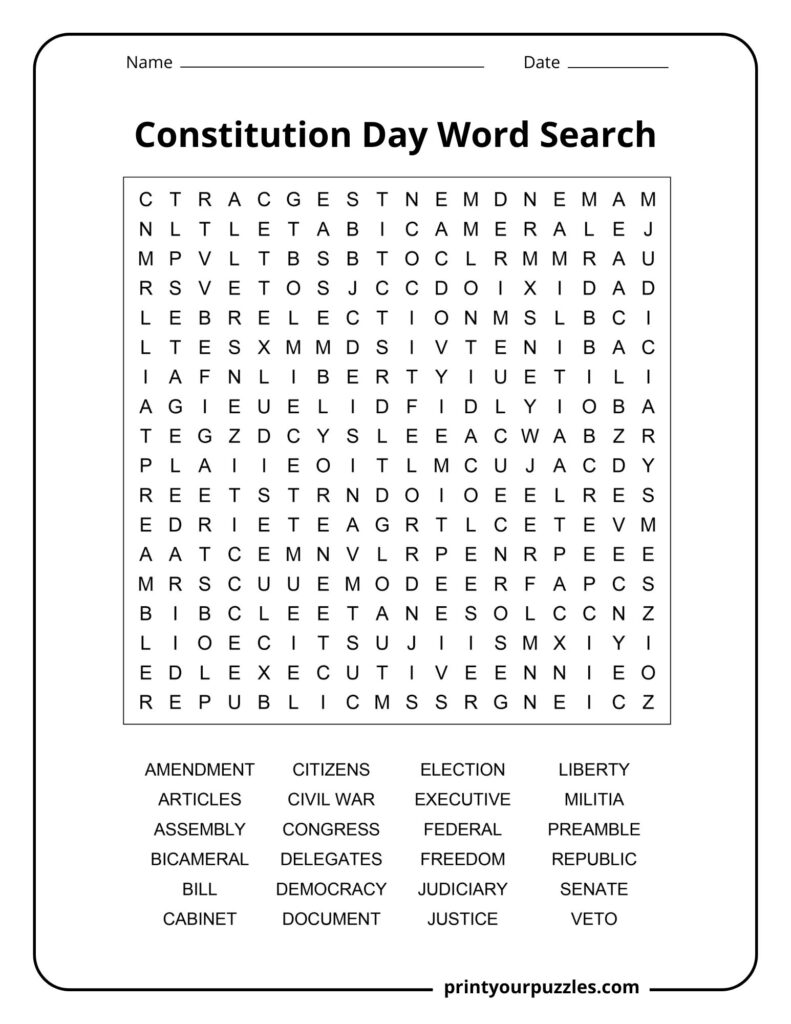
Medium Difficulty Word Search
Words to Find
AMENDMENT, ARTICLES, ASSEMBLY, BICAMERAL, BILL, CABINET, CITIZENS, CIVIL WAR, CONGRESS, DELEGATES, DEMOCRACY, DOCUMENT, ELECTION, EXECUTIVE, FEDERAL, FREEDOM, JUDICIARY, JUSTICE, LIBERTY, MILITIA, PREAMBLE, REPUBLIC, SENATE, VETO
All Words Defined
AMENDMENT – A formal change or addition made to the Constitution, allowing the document to be updated to reflect the evolving needs and values of American society over time.
ARTICLES – The seven main sections of the Constitution that establish the structure, powers, and limitations of the federal government, including the legislative, executive, and judicial branches.
ASSEMBLY – The fundamental right of citizens to gather peacefully in groups to express opinions, protest government actions, or organize for political and social causes without government interference.
BICAMERAL – A legislature divided into two separate chambers, specifically the Senate and the House of Representatives, designed to balance representation between large and small states.
BILL – A proposed law formally introduced in Congress that must pass both chambers and receive presidential approval before becoming an official law of the United States.
CABINET – A group of senior advisors and department heads appointed by the President to help manage the executive branch and provide counsel on important national and international matters.
CITIZENS – Individuals who are legally recognized members of the United States, entitled to constitutional rights and protections while also bearing responsibilities toward their country and community.
CIVIL WAR – The devastating armed conflict fought from 1861 to 1865 between the Union and Confederate states, ultimately leading to constitutional amendments abolishing slavery and redefining national citizenship.
CONGRESS – The bicameral legislative body of the federal government, composed of the Senate and House of Representatives, responsible for creating laws and overseeing the executive branch.
DELEGATES – Representatives chosen to attend the 1787 Constitutional Convention in Philadelphia, where they debated and drafted the foundational document that governs the United States today.
DEMOCRACY – A system of government in which power is held by the people, exercised directly or through freely elected representatives, ensuring equal participation and protection of individual rights.
DOCUMENT – The written text of the Constitution itself, a landmark legal instrument that serves as the supreme law of the land, outlining governmental structure and protecting fundamental rights.
ELECTION – The democratic process by which citizens vote to choose their government representatives, ensuring that political power remains accountable to the people through regular, free, and fair contests.
EXECUTIVE – The branch of the federal government headed by the President, responsible for enforcing and implementing laws, managing foreign policy, and commanding the nation’s armed forces.
FEDERAL – Relating to the system of government that divides power between a central national authority and individual state governments, as established and protected by the Constitution.
FREEDOM – The constitutionally protected liberties guaranteed to all citizens, including freedom of speech, religion, press, and assembly, ensuring individuals can live without unnecessary government interference.
JUDICIARY – The branch of government composed of federal courts, including the Supreme Court, responsible for interpreting laws, resolving legal disputes, and ensuring legislation aligns with the Constitution.
JUSTICE – The principle of fairness and equal treatment under the law, enshrined in the Constitution to ensure all citizens receive impartial legal proceedings and protection of their rights.
LIBERTY – The state of being free from oppressive restrictions, protected by the Constitution through various amendments that safeguard individual rights against excessive government control or interference.
MILITIA – A civilian military force referenced in the Second Amendment, historically composed of ordinary citizens called upon to defend their communities, colonies, and later the emerging nation.
PREAMBLE – The introductory statement of the Constitution beginning with “We the People,” which outlines the document’s six fundamental purposes and establishes the source of governmental authority.
REPUBLIC – A form of government in which citizens elect representatives to make decisions on their behalf, ensuring that political power derives from the people rather than hereditary rulers.
SENATE – The upper chamber of Congress, composed of two senators from each state regardless of population, designed to provide equal representation and deliberate carefully on national legislation.
VETO – The constitutional power of the President to reject legislation passed by Congress, serving as a critical check on legislative authority, though Congress may override it with a two-thirds vote.
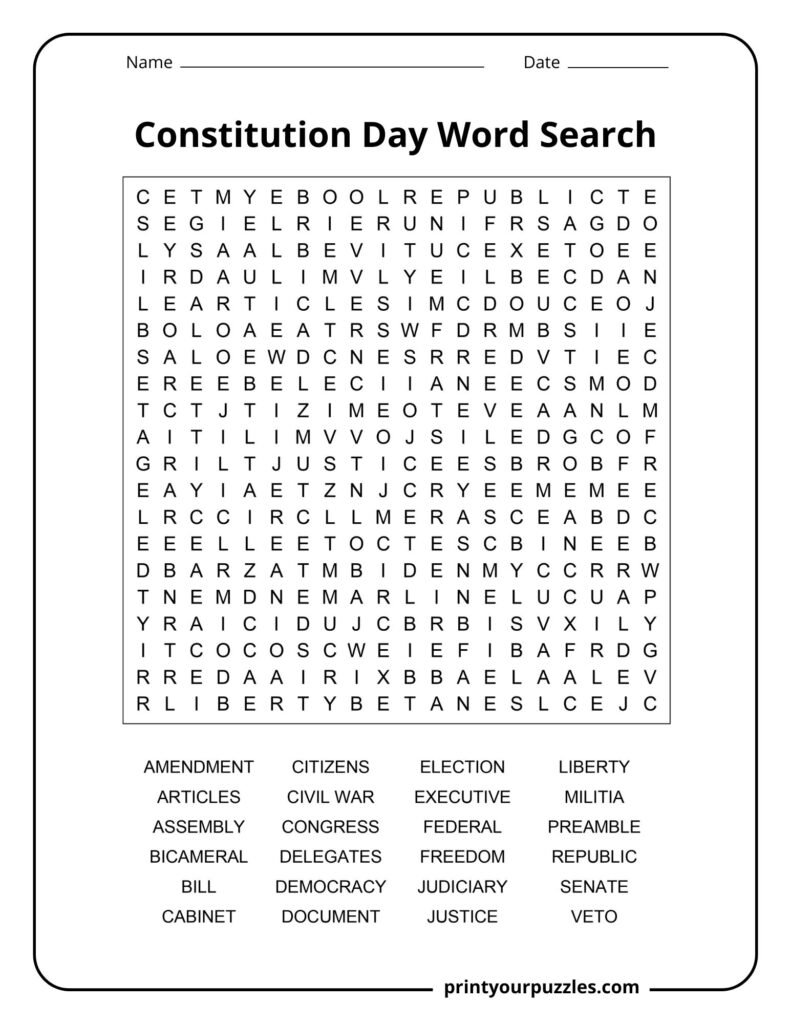
Hard Difficulty Word Search
Words to Find
AMENDMENT, ARTICLES, ASSEMBLY, BICAMERAL, BILL, CABINET, CITIZENS, CIVIL WAR, CONGRESS, DELEGATES, DEMOCRACY, DOCUMENT, ELECTION, EXECUTIVE, FEDERAL, FREEDOM, JUDICIARY, JUSTICE, LIBERTY, MILITIA, PREAMBLE, REPUBLIC, SENATE, VETO
5 Key FAQs About Constitution Day
5 Curious "Did You Know?" Facts About Constitution Day