
Christmas is one of the most widely celebrated occasions of the year, bringing together religious meaning, family traditions, festive decorations, music, food, and gift-giving. It is observed on December 25 by many Christians as the celebration of the birth of Jesus Christ. Over time, Christmas has also developed into a major cultural holiday enjoyed by people with many different beliefs and backgrounds.
Preparations often begin several weeks before Christmas Day. Homes, streets, stores, and public spaces may be decorated with lights, wreaths, stars, garlands, and Christmas trees. Families often place ornaments on the tree and add a star or angel at the top. Nativity scenes, which represent the birth of Jesus in Bethlehem, remain an important religious symbol in many homes, churches, and communities.
Gift-giving is another familiar part of Christmas. The tradition is connected with generosity, kindness, and the gifts presented to Jesus by the Wise Men. Children in many countries look forward to a visit from Santa Claus, Father Christmas, or another traditional gift-bringing figure. Although customs vary, gifts are often exchanged among relatives, friends, classmates, and coworkers.
Christmas food also differs from one region to another. Families may prepare roast turkey, ham, potatoes, vegetables, seafood, pies, cookies, or special desserts. Gingerbread, candy canes, hot chocolate, and fruitcake are strongly associated with the season in some places. Sharing a festive meal gives relatives and friends an opportunity to spend time together and continue family traditions.
Music helps create the joyful atmosphere of Christmas. Traditional carols, modern holiday songs, school concerts, church services, and community performances are common throughout December. Other popular activities include sending greeting cards, watching Christmas movies, visiting seasonal markets, decorating cookies, and helping charities. Some people volunteer, donate food or toys, or support neighbors who may need assistance.
Christmas celebrations can be lively and colorful, but the season also encourages peaceful reflection. For many people, its central themes include hope, love, gratitude, faith, generosity, and togetherness.
Celebrate the warmth and traditions of the season with this Christmas word search, featuring vocabulary inspired by decorations, gifts, festive foods, music, family gatherings, winter activities, and familiar Christmas symbols. It offers an enjoyable printable challenge for classrooms, holiday parties, quiet afternoons, or family time during the festive season.
Related Word Searches:
December | Boxing Day | Winter | New Year’s Day | Thanksgiving
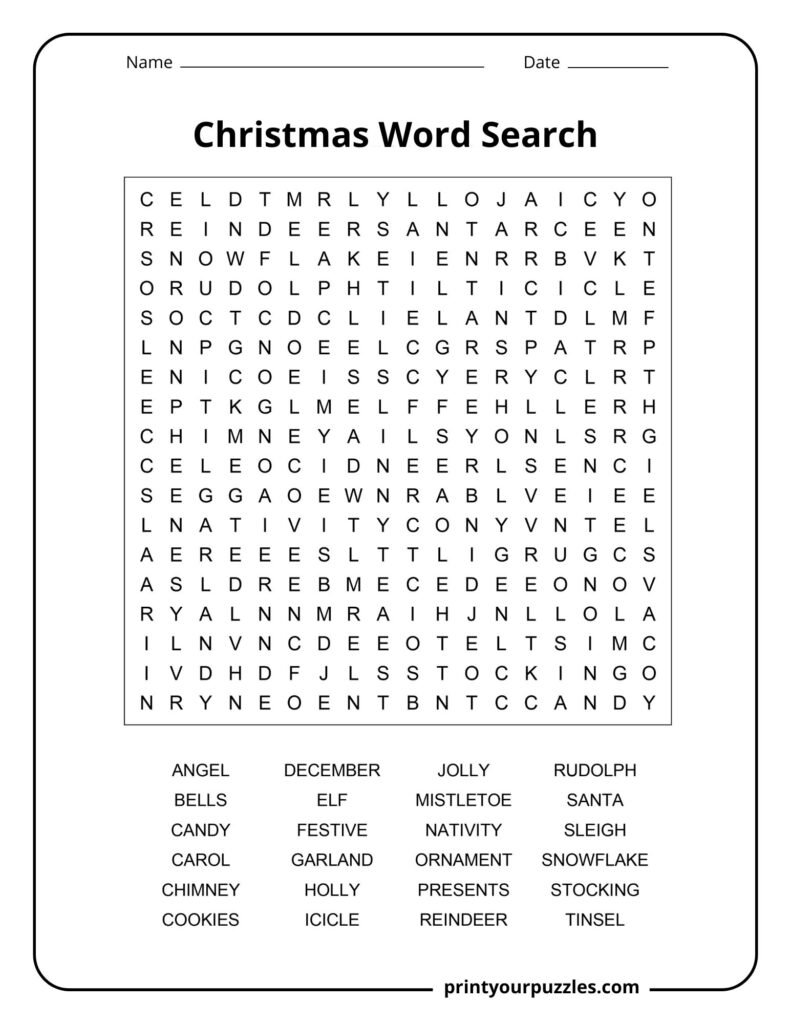
ANGEL, BELLS, CANDY, CAROL, CHIMNEY, COOKIES, DECEMBER, ELF, FESTIVE, GARLAND, HOLLY, ICICLE, JOLLY, MISTLETOE, NATIVITY, ORNAMENT, PRESENTS, REINDEER, RUDOLPH, SANTA, SLEIGH, SNOWFLAKE, STOCKING, TINSEL
ANGEL – A heavenly spiritual being often depicted on top of Christmas trees or in nativity scenes, representing the angels who announced Jesus’s birth to shepherds.
BELLS – Musical instruments that ring joyfully during Christmas, featured in songs like “Jingle Bells” and used as decorative ornaments throughout the holiday season celebrations.
CANDY – Sweet confections enjoyed during Christmas, especially candy canes with red and white stripes that symbolize purity and Christ’s sacrifice during this festive season.
CAROL – Traditional Christmas songs sung by groups of people going door-to-door or in churches, celebrating the birth of Jesus and spreading holiday cheer worldwide.
CHIMNEY – The vertical structure on rooftops through which Santa Claus traditionally enters homes to deliver presents to children sleeping peacefully on Christmas Eve night.
COOKIES – Baked sweet treats, often decorated with icing and sprinkles, prepared during Christmas and traditionally left out with milk for Santa Claus on Christmas Eve.
DECEMBER – The twelfth and final month of the year when Christmas is celebrated on the twenty-fifth, marking the end of the calendar year festivities.
ELF – Santa’s magical helpers who work in the North Pole workshop, making toys and preparing gifts for children around the world throughout the entire year.
FESTIVE – An adjective describing the joyful, celebratory, and merry atmosphere that characterizes Christmas time with decorations, gatherings, music, and special foods throughout the season.
GARLAND – Decorative strands made from evergreen branches, tinsel, or artificial materials draped around homes, fireplaces, staircases, and Christmas trees during the holiday season.
HOLLY – An evergreen plant with distinctive spiky dark green leaves and bright red berries, used as traditional Christmas decoration symbolizing eternal life and protection.
ICICLE – Frozen formations of water hanging from roofs and trees during winter, also referring to shimmering decorative strands hung on Christmas trees for sparkle.
JOLLY – A cheerful and merry adjective commonly used to describe Santa Claus’s disposition, representing the joyful spirit and happiness that defines the Christmas season.
MISTLETOE – A parasitic plant with white berries hung in doorways during Christmas, under which people traditionally kiss, symbolizing love, friendship, and goodwill toward others.
NATIVITY – The birth of Jesus Christ in Bethlehem, often depicted in scenes with Mary, Joseph, baby Jesus, shepherds, wise men, and animals in a stable.
ORNAMENT – Decorative objects hung on Christmas trees, including glass balls, figurines, and handmade crafts that beautify homes and commemorate special memories and traditions.
PRESENTS – Wrapped gifts exchanged between family and friends during Christmas, symbolizing love, generosity, and the gifts the wise men brought to baby Jesus.
REINDEER – Arctic animals with antlers that, according to legend, pull Santa’s sleigh through the sky on Christmas Eve, delivering presents to children around the world.
RUDOLPH – The famous fictional reindeer with a glowing red nose who guides Santa’s sleigh through foggy weather, featured in the beloved Christmas song and story.
SANTA – The jolly, white-bearded man in a red suit who delivers presents to children worldwide on Christmas Eve, also known as Saint Nicholas or Father Christmas.
SLEIGH – A vehicle designed to glide over snow, traditionally pulled by reindeer, used by Santa Claus to travel across the sky delivering gifts on Christmas Eve.
SNOWFLAKE – Unique ice crystals that fall from the sky during winter, each with intricate symmetrical patterns, symbolizing the beauty and wonder of the Christmas season.
STOCKING – A large decorative sock hung by the fireplace or bedpost on Christmas Eve, filled by Santa with small gifts, candy, and treats for children.
TINSEL – Shiny metallic strands used to decorate Christmas trees, creating a sparkling, shimmering effect that reflects lights and adds glamour to holiday decorations.
ANGEL, BELLS, CANDY, CAROL, CHIMNEY, COOKIES, DECEMBER, ELF, FESTIVE, GARLAND, HOLLY, ICICLE, JOLLY, MISTLETOE, NATIVITY, ORNAMENT, PRESENTS, REINDEER, RUDOLPH, SANTA, SLEIGH, SNOWFLAKE, STOCKING, TINSEL
Christmas Day is celebrated annually on December 25th by Christians worldwide, commemorating the birth of Jesus Christ. It’s a public holiday in many countries across the globe.
Gift-giving honors the Three Wise Men who brought gold, frankincense, and myrrh to baby Jesus. It symbolizes love, generosity, and the spirit of giving to others.
Santa Claus evolved from Saint Nicholas, a fourth-century Christian bishop known for his generosity to children and the poor. Dutch settlers brought this tradition to America.
Christmas trees symbolize eternal life through evergreen branches. The tradition originated in Germany during the sixteenth century and spread globally, representing hope and celebration during winter.
Traditional Christmas foods vary by culture but often include roasted turkey or ham, stuffing, mashed potatoes, Christmas pudding, cookies, and eggnog, bringing families together for feasting.
Composed by James Lord Pierpont in 1857, “Jingle Bells” was originally written for Thanksgiving. It became associated with Christmas later due to its wintery sleigh-riding theme.
While Santa wore various colors historically, Coca-Cola‘s 1930s advertising campaigns featuring Santa in red and white significantly established the modern image we recognize today worldwide.
Oliver Cromwell banned Christmas celebrations from 1647 to 1660, considering them immoral and un-Christian. People caught celebrating faced penalties, making festivities illegal during Puritan rule.
Created in Italy in 2011, this gigantic stocking was longer than a football field. It took enormous effort to construct and filled with thousands of presents.
Since the 1970s, eating Kentucky Fried Chicken has become a beloved Christmas tradition in Japan. Families pre-order their meals weeks in advance for this special celebration.