Earth Day is observed every year on April 22 as a worldwide occasion dedicated to protecting the environment and encouraging people to care for the planet. It brings attention to issues such as pollution, climate change, deforestation, wildlife conservation, clean energy, and the responsible use of natural resources. Schools, families, communities, businesses, and environmental organizations take part through educational programs and practical activities.
The first Earth Day was held in the United States in 1970. It developed during a period of growing concern about air and water pollution, oil spills, pesticides, and damage to natural habitats. Millions of people joined public events, demonstrations, and community projects, helping environmental protection become a major national issue. Over time, Earth Day expanded beyond the United States and became an international movement involving countries around the world.
One of the main goals of Earth Day is to show that individual actions can make a difference. People may plant trees, clean parks or beaches, recycle household materials, reduce plastic use, conserve water, or walk and cycle instead of driving. Families can also save energy by switching off unnecessary lights, using efficient appliances, and choosing reusable products rather than disposable ones.
Schools often celebrate Earth Day with science lessons, art projects, gardening activities, nature walks, and discussions about ecosystems. Students may learn how forests produce oxygen, why oceans are important, how animals depend on healthy habitats, and what happens when waste enters rivers or seas. These activities help connect environmental ideas with everyday life.
Earth Day also encourages larger changes. Governments, companies, and communities may announce conservation programs, renewable-energy projects, recycling campaigns, or plans to protect land and wildlife. The occasion reminds people that environmental problems often require cooperation between individuals, organizations, and nations.
The planet provides clean air, fresh water, food, energy, and habitats for countless living things. Protecting these resources helps both present and future generations. Earth Day is therefore not only about one date in April, but also about developing habits that can continue throughout the year.
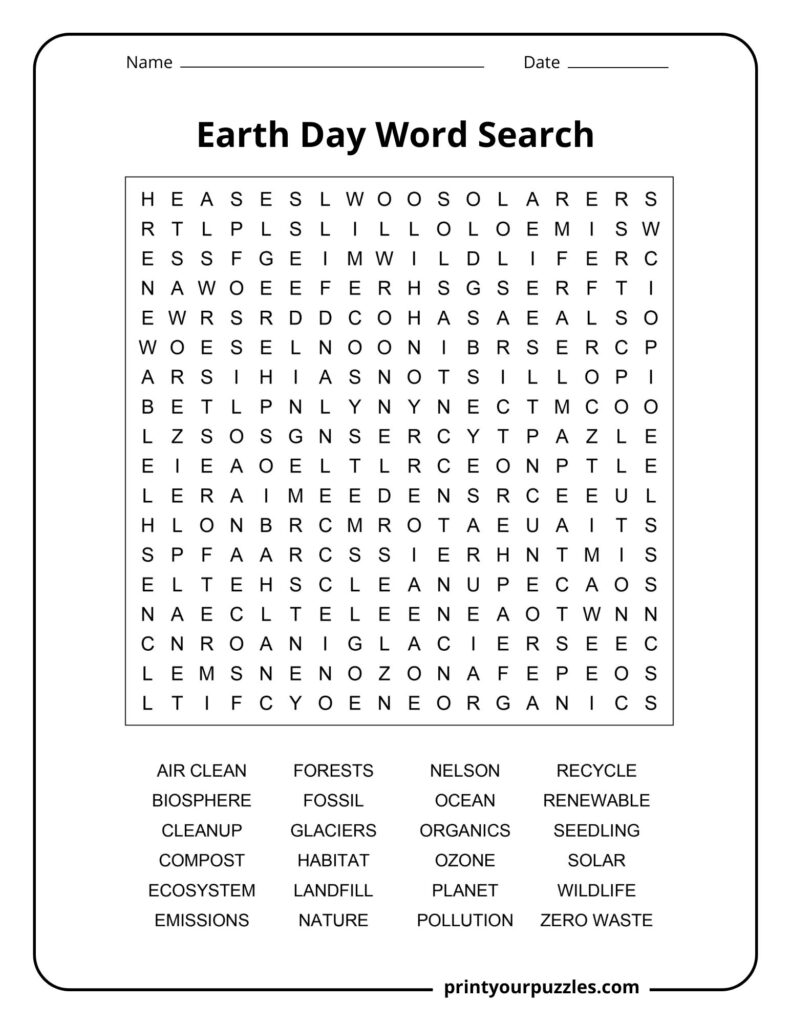
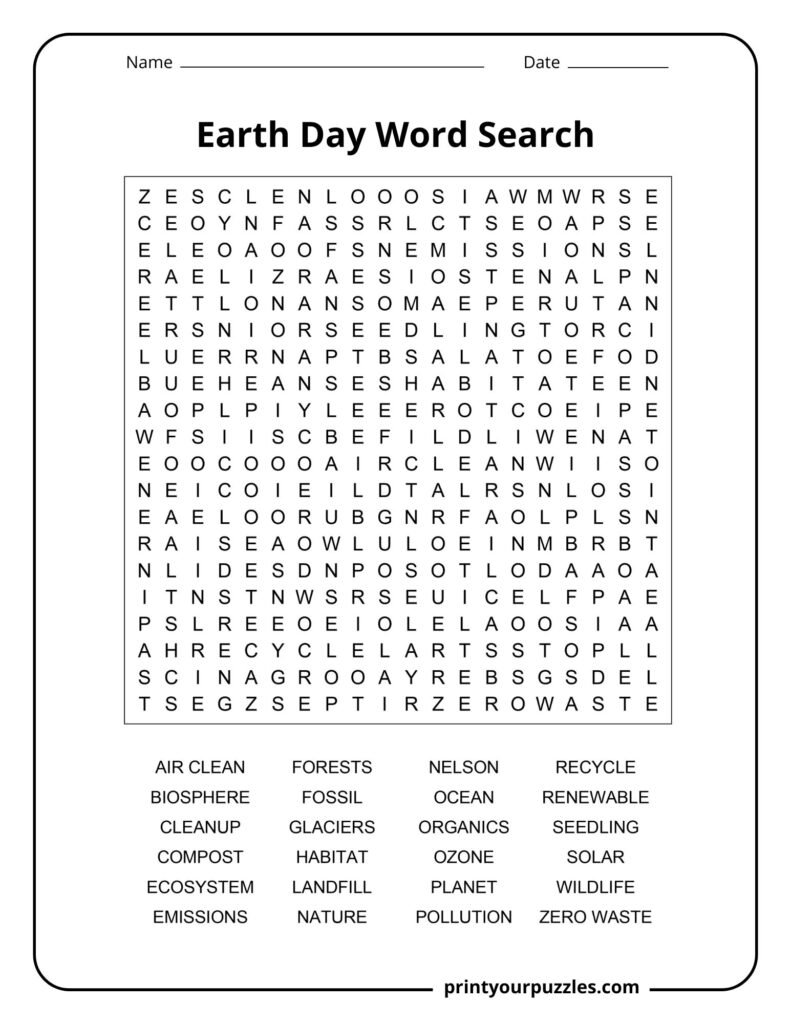
Explore the plants, animals, resources, environmental challenges, and positive actions connected with our planet through this Earth Day word search, featuring vocabulary inspired by recycling, conservation, clean energy, nature, wildlife, and caring for the Earth.
Related Word Searches:
Arbor Day | April | Spring | May | Summer
AIR CLEAN – The quality of air free from pollutants and harmful substances. Clean air is essential for human health, animal life, and the overall balance of Earth’s ecosystems.
BIOSPHERE – The global ecological system integrating all living beings and their relationships, including interactions with the elements of the lithosphere, hydrosphere, and atmosphere of Earth.
CLEANUP – The process of removing waste, pollutants, and harmful materials from natural environments such as beaches, rivers, forests, and urban areas to restore ecological balance and biodiversity.
COMPOST – Organic matter that has been decomposed and recycled as a fertilizer and soil amendment. Composting reduces landfill waste and enriches soil with nutrients that support healthy plant growth.
ECOSYSTEM – A complex network of living organisms, their physical environment, and the interactions between them. Healthy ecosystems provide essential services like clean water, air purification, and climate regulation.
EMISSIONS – Gases and particles released into the atmosphere from human activities such as burning fossil fuels, industrial processes, and deforestation. Reducing emissions is critical to slowing global climate change.
FORESTS – Large areas covered with trees and undergrowth that serve as vital carbon sinks, biodiversity hotspots, and water regulators. Forests are home to over 80% of the world’s terrestrial species.
FOSSIL – Remains or traces of ancient organisms preserved in rock. Fossil fuels like coal, oil, and gas formed from prehistoric life are major contributors to greenhouse gas emissions and climate change.
GLACIERS – Massive bodies of slow-moving ice formed from compacted snow over centuries. Glaciers regulate freshwater supply and sea levels, and their rapid melting signals the severe impact of global warming.
HABITAT – The natural environment where a species lives, feeds, and reproduces. Habitat destruction from deforestation, urbanization, and pollution is one of the leading causes of species extinction worldwide.
LANDFILL – A site where waste materials are buried in the ground. Landfills produce methane, a potent greenhouse gas, and can contaminate soil and groundwater, making waste reduction and recycling critically important.
NATURE – The physical world and all living things not made or significantly altered by humans. Nature provides essential resources, inspiration, and well-being, making its preservation a fundamental responsibility for all people.
NELSON – Gaylord Nelson, U.S. Senator from Wisconsin, founded Earth Day in 1970, transforming environmental awareness into a powerful global movement that continues inspiring millions of people worldwide today.
OCEAN – The vast body of salt water covering over 70% of Earth’s surface. Oceans regulate climate, produce oxygen, support marine biodiversity, and absorb large amounts of carbon dioxide from the atmosphere.
ORGANICS – Materials derived from living organisms, including organic food, waste, and farming practices. Organic agriculture avoids synthetic chemicals, promoting healthier soils, cleaner water, and more sustainable food production systems.
OZONE – A molecule composed of three oxygen atoms forming a protective layer in Earth’s stratosphere. The ozone layer shields life from harmful ultraviolet radiation, and its depletion poses serious health and environmental risks.
PLANET – Earth, our home in the solar system, is a unique and fragile world teeming with life. Protecting the planet means preserving its atmosphere, water, biodiversity, and natural resources for future generations.
POLLUTION – The introduction of harmful substances or contaminants into the natural environment. Air, water, and soil pollution damage ecosystems, threaten human health, and disrupt the delicate balance of life on Earth.
RECYCLE – The process of converting waste materials into new products to reduce consumption of raw resources. Recycling conserves energy, decreases pollution, and helps minimize the volume of waste sent to landfills.
RENEWABLE – Energy derived from naturally replenishing sources such as sunlight, wind, rain, and geothermal heat. Renewable energy produces little to no greenhouse gas emissions, making it essential for a sustainable future.
SEEDLING – A young plant grown from a seed, representing the beginning of new life and forest regeneration. Planting seedlings is a powerful act of environmental restoration that combats deforestation and supports biodiversity.
SOLAR – Energy harnessed from the sun’s radiation using photovoltaic panels or solar thermal systems. Solar power is one of the cleanest and most abundant renewable energy sources available to reduce carbon emissions.
WILDLIFE – All non-domesticated animals, plants, and organisms living in their natural habitats. Wildlife plays a crucial role in maintaining ecological balance, and protecting it requires preserving habitats and reducing human interference.
ZERO WASTE – A philosophy and lifestyle goal that aims to eliminate all waste sent to landfills or incinerators by rethinking product design, consumption habits, reuse, and recycling at every stage of a product’s life.