
Kwanzaa is a cultural celebration honoring African heritage, family, community, and shared values. It is observed each year from December 26 through January 1, mainly in the United States and among people of African descent in other countries. Kwanzaa is not a religious holiday, so families may celebrate it alongside Christmas, another faith tradition, or no religious observance at all.
The celebration was created in 1966 by Dr. Maulana Karenga, a professor and activist, during a period of renewed interest in African American history and cultural identity. Its name comes from the Swahili phrase “matunda ya kwanza”, meaning “first fruits.” This reflects African harvest festivals, which often bring communities together to express gratitude, honor ancestors, and celebrate cooperation.
At the heart of Kwanzaa are seven principles known as the “Nguzo Saba”. Each day focuses on a different principle: unity, self-determination, collective work and responsibility, cooperative economics, purpose, creativity, and faith. Families may discuss how these ideas can strengthen homes, neighborhoods, businesses, and communities.
Several meaningful symbols are used during the celebration. The “kinara” is a candleholder containing seven candles: one black, three red, and three green. These colors represent the people, their struggles, and hope for the future. One candle is lit each day, often followed by conversation, storytelling, music, or reflection. Other symbols include ears of corn, fruits and vegetables, handmade gifts, a unity cup, and a decorative mat on which the objects are placed.
Kwanzaa activities vary among families and communities. People may wear African-inspired clothing, study history, create art, perform dances, listen to music, recite poetry, or support Black-owned businesses. Children may receive meaningful gifts, especially books or handmade items that encourage learning and creativity.
A major gathering called “Karamu” is often held on December 31. This festive meal may include dishes influenced by African, Caribbean, African American, and Southern cooking traditions. Music, speeches, performances, and expressions of gratitude can make the occasion especially memorable.
Celebrate the seven principles and rich cultural traditions of this weeklong observance with this Kwanzaa word search, featuring 24 carefully selected words inspired by unity, heritage, candles, creativity, family, community, and hope for the future.
Related Word Searches:
Christmas | December | Winter | New Year’s Day | Martin Luther King Jr. Day
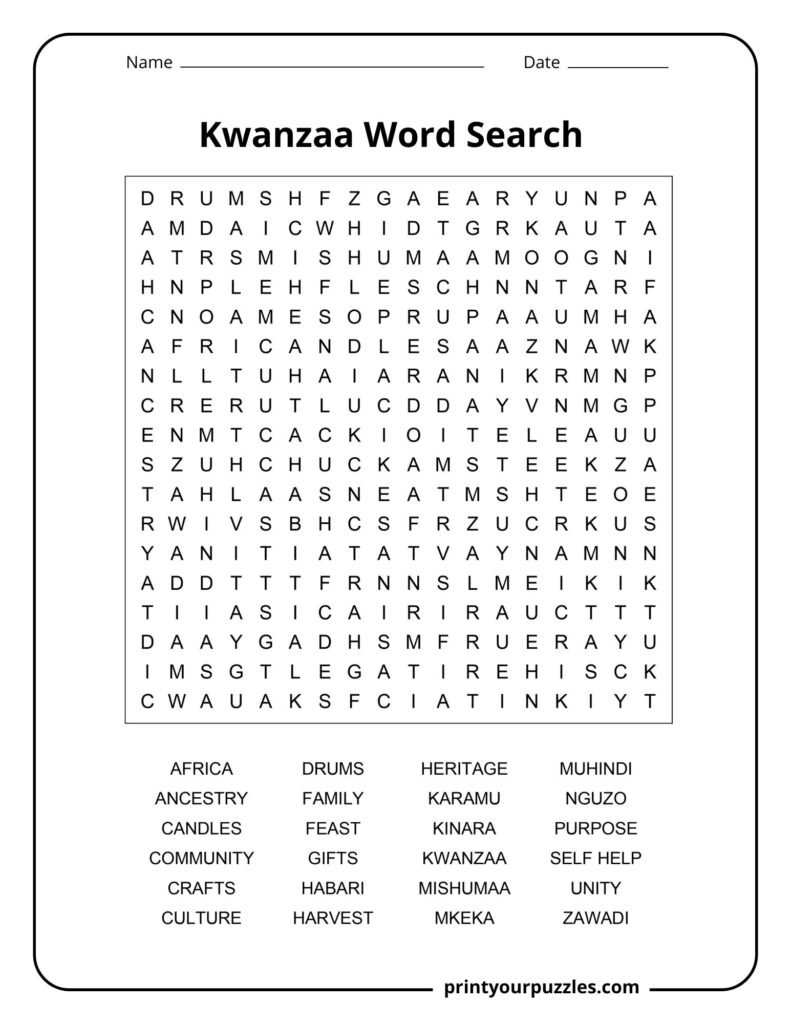
AFRICA, ANCESTRY, CANDLES, COMMUNITY, CRAFTS, CULTURE, DRUMS, FAMILY, FEAST, GIFTS, HABARI, HARVEST, HERITAGE, KARAMU, KINARA, KWANZAA, MISHUMAA, MKEKA, MUHINDI, NGUZO, PURPOSE, SELF HELP, UNITY, ZAWADI
AFRICA – The vast continent considered the ancestral homeland of all people of African descent, rich in diverse cultures, languages, traditions, and history spanning thousands of years.
ANCESTRY – The lineage of family members and ancestors who came before us, whose sacrifices, wisdom, and cultural traditions are honored and remembered during Kwanzaa celebrations.
CANDLES – The seven symbolic flames lit during Kwanzaa, each representing one of the seven core principles, with colors of black, red, and green holding deep cultural meaning.
COMMUNITY – The collective group of people sharing common values, heritage, and goals, working together to build, support, and strengthen bonds through cooperation and mutual responsibility.
CRAFTS – Traditional handmade creations and artistic works that reflect African cultural heritage, often exchanged as meaningful gifts during Kwanzaa to celebrate creativity and skilled craftsmanship.
CULTURE – The shared beliefs, customs, arts, and practices passed down through generations that define African and African American identity, forming the spiritual core of Kwanzaa celebrations.
DRUMS – Sacred and powerful instruments central to African musical tradition, used in ceremonies and celebrations to communicate, honor ancestors, and unite communities through rhythm and sound.
FAMILY – The fundamental unit of the community, including parents, children, grandparents, and extended relatives, whose love and unity form the heart of every Kwanzaa gathering.
FEAST – The joyful communal meal shared on December 31st during Kwanzaa, known as Karamu, where families and friends gather to celebrate with food, music, and reflection.
GIFTS – Meaningful presents exchanged during Kwanzaa, especially for children, emphasizing educational and cultural value over commercial worth, meant to inspire, encourage, and uplift recipients.
HABARI – A Swahili greeting meaning “What is the news?”, used during Kwanzaa as part of the daily question “Habari Gani?”, asking which principle is being celebrated that day.
HARVEST – The gathering of crops and abundance from the earth, symbolizing the fruits of collective labor, gratitude for nature’s gifts, and the importance of sharing resources within communities.
HERITAGE – The cultural legacy of traditions, values, stories, and achievements inherited from African ancestors, preserved and proudly passed down to future generations through celebration and education.
KARAMU – The festive communal feast held on December 31st during Kwanzaa, bringing together family and friends to celebrate with traditional food, music, dance, and heartfelt storytelling.
KINARA – The wooden candle holder central to Kwanzaa celebrations, holding seven candles representing the seven principles, symbolizing the African people and their ancestral roots and foundation.
KWANZAA – A week-long African American cultural celebration held from December 26 to January 1, founded in 1966 by Maulana Karenga to honor African heritage and community values.
MISHUMAA – The seven Kwanzaa candles placed in the kinara, consisting of one black, three red, and three green candles, each lit daily to represent one of the Nguzo Saba principles.
MKEKA – The traditional woven mat placed on the Kwanzaa table as the foundation upon which all other symbols rest, representing African history, culture, and the traditions that ground us.
MUHINDI – Ears of corn placed on the Kwanzaa table representing children and the future of the community, with one ear placed for each child present in the celebrating family.
NGUZO – The seven foundational principles of Kwanzaa, known as the Nguzo Saba, including Unity, Self-determination, Collective Work, Cooperative Economics, Purpose, Creativity, and Faith, guiding African American life.
PURPOSE – The fourth principle of Kwanzaa, known as Nia in Swahili, calling each person to build and develop the community in order to restore African people to their greatest historical traditions.
SELF HELP – The empowering practice of taking personal and collective responsibility for one’s own progress, encouraging African American communities to create solutions, build institutions, and uplift one another independently.
UNITY – The first and most foundational principle of Kwanzaa, known as Umoja in Swahili, striving to maintain togetherness in family, community, nation, and the entire African global family.
ZAWADI – The meaningful gifts exchanged during Kwanzaa, particularly given to children as rewards for commitments made and kept, emphasizing cultural significance, educational value, and personal growth over material excess.
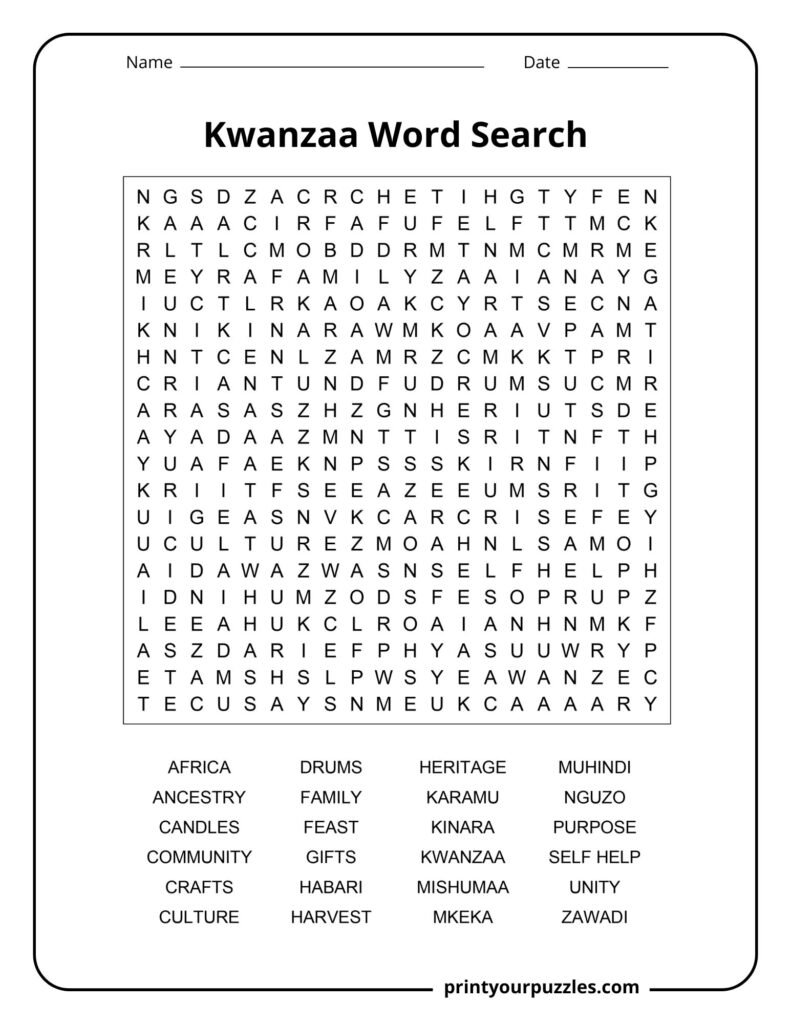
AFRICA, ANCESTRY, CANDLES, COMMUNITY, CRAFTS, CULTURE, DRUMS, FAMILY, FEAST, GIFTS, HABARI, HARVEST, HERITAGE, KARAMU, KINARA, KWANZAA, MISHUMAA, MKEKA, MUHINDI, NGUZO, PURPOSE, SELF HELP, UNITY, ZAWADI
Kwanzaa is a week-long African American cultural celebration held from December 26 to January 1, founded in 1966 by Dr. Maulana Karenga to honor African heritage and values.
The Nguzo Saba consists of Unity, Self-Determination, Collective Work, Cooperative Economics, Purpose, Creativity, and Faith, with one principle celebrated each day throughout the week-long observance.
The black candle symbolizes African people, the three red candles represent the struggle for freedom, and the three green candles stand for hope and the future of the community.
Kwanzaa is not a religious holiday but a cultural celebration open to people of all faiths. It honors African heritage, community values, and collective identity regardless of personal religious beliefs.
Zawadi, or gifts, are exchanged especially with children, emphasizing books, cultural items, and handmade creations over commercial products, rewarding commitments made and encouraging personal growth and African heritage pride.
Kwanzaa was founded in 1966 by Dr. Maulana Karenga during a period of social uprising, inspired by the Watts riots to strengthen African American cultural identity and community solidarity.
The name Kwanzaa derives from the Swahili phrase “matunda ya kwanza,” meaning “first fruits,” drawing inspiration from ancient African harvest celebrations that honored community, gratitude, and the earth’s abundance.
Beyond the United States, Kwanzaa is observed by African diaspora communities across Canada, the Caribbean, Europe, and Africa, making it a truly global celebration of shared cultural heritage and pride.
During Kwanzaa, people greet each other with “Habari Gani,” meaning “What is the news?” in Swahili, with the response being the name of that particular day’s celebrated principle.
Dr. Maulana Karenga designed Kwanzaa as a cultural, not religious, celebration specifically complementing existing holidays, encouraging African Americans to honor their heritage while still observing their personal religious traditions and festivities.