Arbor Day is a special occasion dedicated to planting trees and recognizing the important role they play in the environment and in everyday life. The name comes from the Latin word “arbor”, meaning “tree.” Unlike holidays celebrated on the same date everywhere, Arbor Day is observed at different times depending on the country, region, and local planting season. In the United States, National Arbor Day is celebrated on the last Friday in April, although some states choose another date better suited to their climate.
The modern Arbor Day movement began in Nebraska in 1872. Journalist and public official J. Sterling Morton encouraged residents to plant trees across the largely treeless plains. Trees were needed for shade, wind protection, building materials, fuel, and soil conservation. The first celebration was highly successful, and the idea soon spread to other states and countries. Over time, Arbor Day became both a community tradition and an opportunity to teach people about conservation.
Trees provide many benefits. They absorb carbon dioxide, release oxygen, reduce air pollution, and offer habitats for birds, insects, and other wildlife. Their roots help hold soil in place, while their branches provide shade that can cool homes, streets, parks, and school grounds. Trees also contribute to the beauty and character of neighborhoods, forests, farms, and public spaces.
Arbor Day activities often include planting young trees, caring for existing ones, cleaning parks, and learning how forests support healthy ecosystems. Schools may organize lessons, crafts, outdoor projects, or ceremonies in which students help plant a tree. Communities sometimes distribute seedlings, hold educational events, or invite volunteers to improve green spaces. Participants may also learn how to select the right tree, prepare the soil, protect roots, and provide enough water during the early stages of growth.
The day is not only about planting. It also encourages long-term responsibility. A newly planted tree needs care, and protecting mature trees can be just as valuable as adding new ones. Arbor Day reminds people that small actions can create benefits lasting for decades.
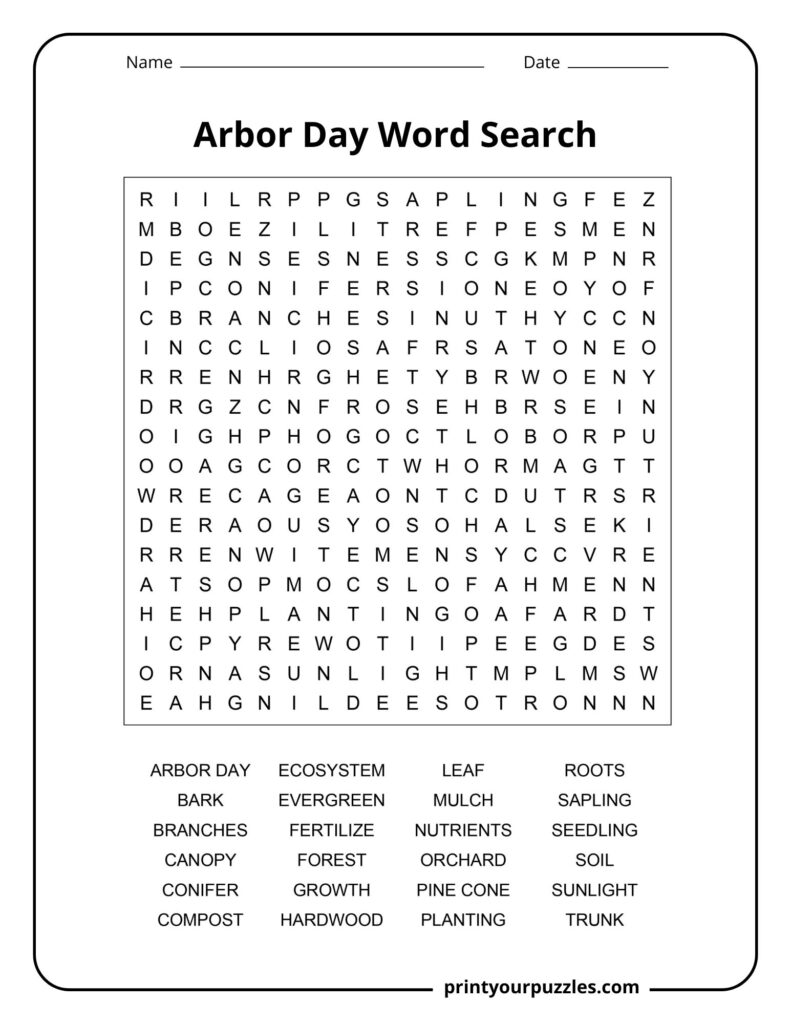
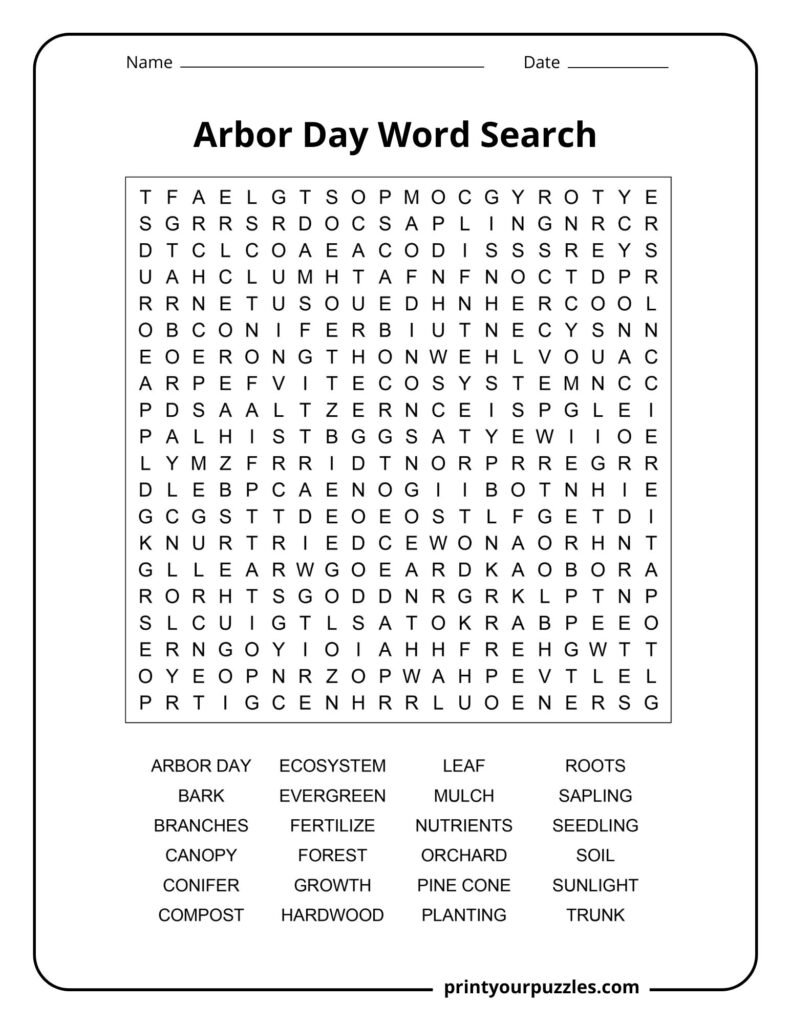
This Arbor Day word search puzzle explores vocabulary connected with trees, forests, planting, wildlife, conservation, and the natural world. It offers an enjoyable activity for classrooms, families, environmental events, or anyone interested in celebrating trees and learning why they matter.
Related Word Searches:
Earth Day | April | Spring | May | Summer
ARBOR DAY – A holiday dedicated to planting and caring for trees, celebrated annually to raise awareness about the importance of forests and environmental conservation worldwide.
BARK – The protective outer layer covering the trunk and branches of a tree, acting as a shield against insects, disease, temperature changes, and physical damage.
BRANCHES – The woody extensions growing outward from a tree’s trunk, supporting leaves, flowers, and fruit while distributing water and nutrients throughout the entire tree.
CANOPY – The uppermost layer of a forest formed by the crowns of tall trees, providing shade, shelter, and habitat for countless birds, insects, and other wildlife.
COMPOST – A nutrient-rich organic material created by decomposing plant waste, food scraps, and leaves, used to enrich soil and promote healthy, strong tree and plant growth.
CONIFER – A tree or shrub that produces cones and typically bears evergreen needle-like leaves, including species such as pine, spruce, and fir, found across forests worldwide.
ECOSYSTEM – A complex community of living organisms, including trees, animals, fungi, and bacteria, interacting together with their physical environment in a balanced, interdependent natural system.
EVERGREEN – A tree or shrub that retains its leaves or needles throughout the entire year, providing year-round greenery, shelter for wildlife, and continuous oxygen production in all seasons.
FERTILIZE – The process of adding natural or synthetic nutrients to soil around trees and plants, encouraging stronger roots, faster growth, healthier foliage, and improved resistance to disease.
FOREST – A large, dense area of land dominated by trees and undergrowth, forming a vital ecosystem that supports biodiversity, regulates climate, filters water, and absorbs carbon dioxide.
GROWTH – The gradual biological process by which a tree increases in height, width, and root depth over time, driven by sunlight, water, nutrients, and favorable environmental conditions.
HARDWOOD – Timber produced from broad-leaved, deciduous trees such as oak, maple, and cherry, known for its density, durability, and wide use in furniture and construction.
LEAF – The flat, green structure attached to tree branches that captures sunlight, performs photosynthesis, regulates water through transpiration, and plays a key role in gas exchange.
MULCH – A layer of organic material such as wood chips, bark, or
straw spread around the base of trees to retain moisture, suppress weeds, and improve soil health.
NUTRIENTS – Essential minerals and chemical compounds found in soil, including nitrogen, phosphorus, and potassium, that trees absorb through their roots to fuel growth, reproduction, and overall health.
ORCHARD – A deliberately planted area of fruit or nut trees cultivated for food production, requiring regular pruning, watering, fertilizing, and care to yield healthy, abundant seasonal harvests.
PINE CONE – The woody, scaled seed-bearing structure produced
by pine and other conifer trees, serving as a protective casing for seeds until conditions are right for dispersal and germination.
PLANTING – The act of placing a young tree, seedling, or seed into prepared soil, giving it the proper depth, space, water, and nutrients needed to establish and thrive.
ROOTS – The underground structures anchoring a tree firmly into the soil while absorbing water and dissolved nutrients, also storing energy and supporting the tree’s overall stability and health.
SAPLING – A young, small tree in its early stage of growth, typically flexible and slender, requiring protection, adequate water, and proper sunlight to develop into a mature, strong tree.
SEEDLING – A very young plant that has recently sprouted from a seed, still in its fragile early stage of development and dependent on consistent moisture, light, and soil nutrients.
SOIL – The upper layer of earth composed of minerals, organic matter, water, and air, forming the foundational growing medium that supplies trees with essential nutrients, stability, and moisture.
SUNLIGHT – The radiant energy emitted by the sun that trees capture through their leaves to drive photosynthesis, fuel growth, regulate seasonal cycles, and sustain virtually all life on Earth.
TRUNK – The central, thick woody stem of a tree that supports its branches and crown, transports water and nutrients between roots and leaves, and provides structural strength and stability.