Canada Day is the national celebration of Canada, observed every year on July 1. It marks the anniversary of Canadian Confederation, when three British colonies—Canada, Nova Scotia, and New Brunswick—were united into a new country in 1867. The Province of Canada was then divided into Ontario and Quebec, creating the first four provinces of the Dominion of Canada.
The holiday was originally known as Dominion Day. For many years, celebrations were relatively modest and varied from place to place. As Canada developed a stronger national identity, July 1 became a more prominent occasion. In 1982, the holiday was officially renamed Canada Day, the same year that Canada gained full authority over its Constitution through the Constitution Act.
Today, Canada Day is celebrated with community events, concerts, ceremonies, parades, and outdoor gatherings. Many people wear red and white, the colors of the Canadian flag, and display maple leaf decorations. Public buildings, streets, parks, and homes may be decorated with flags, banners, and patriotic symbols. Major cities often organize live music and evening fireworks, while smaller communities may hold picnics, fairs, children’s activities, and local performances.
Food is also part of many celebrations. Families and friends may enjoy barbecues, hamburgers, hot dogs, grilled vegetables, and summer desserts. Some gatherings feature Canadian favorites such as poutine, butter tarts, maple-flavored treats, or regional dishes that reflect the country’s cultural diversity. Because the holiday falls during summer, swimming, camping, boating, and visits to parks are also popular.
Canada Day can be both festive and reflective. It offers an opportunity to celebrate the country’s landscapes, achievements, communities, and multicultural character. At the same time, some Canadians use the day to learn about Indigenous history and consider the experiences of First Nations, Inuit, and Métis peoples. This broader perspective encourages thoughtful discussion about Canada’s past and future.
Celebrations take place across the country, but each province, territory, city, and community may add its own traditions. From citizenship ceremonies and musical performances to family meals and fireworks, the day brings people together in many different ways.
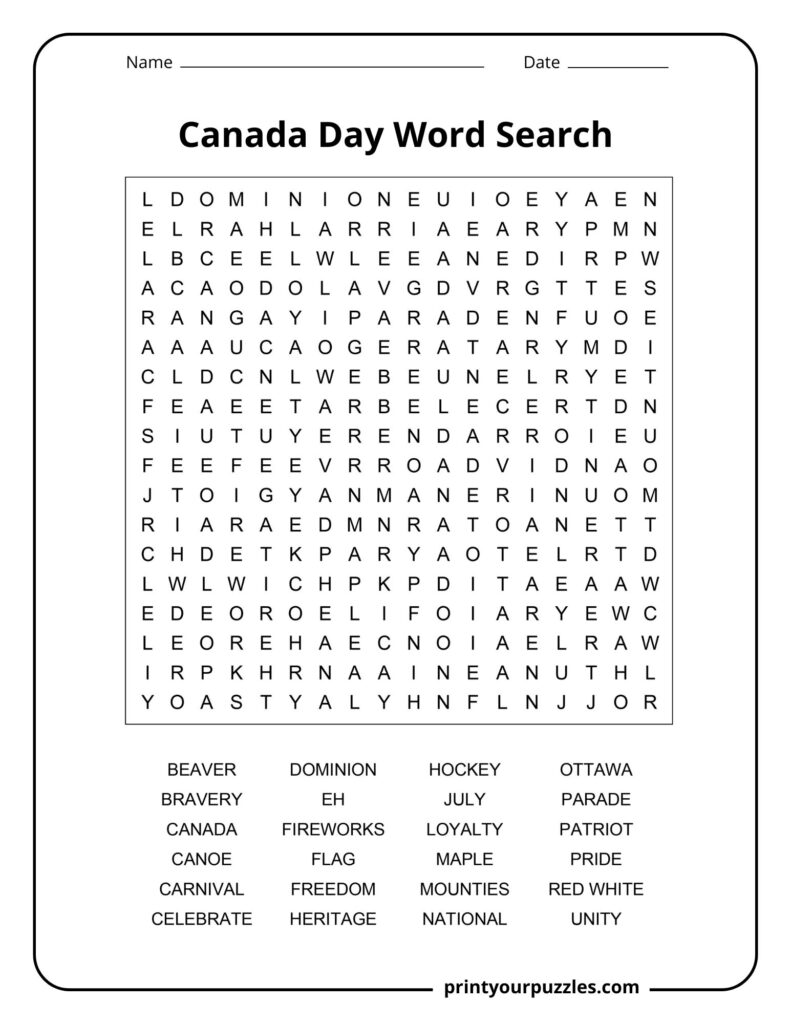
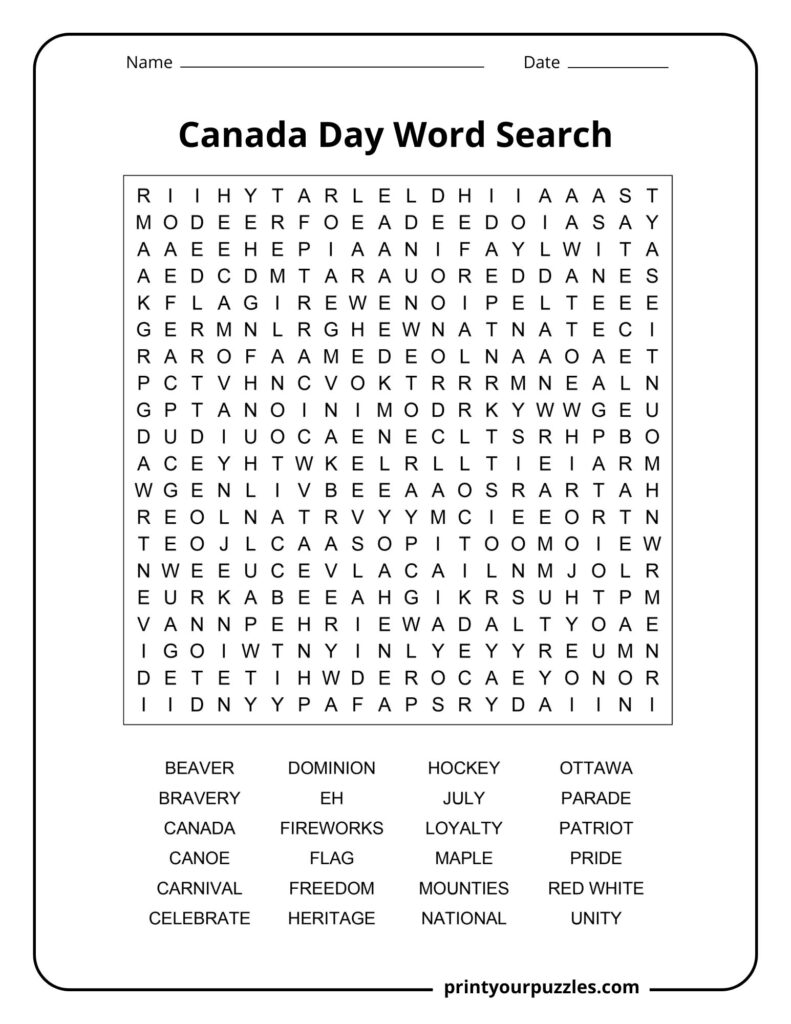
This Canada Day word search printable introduces vocabulary connected with Canadian history, national symbols, summer activities, celebrations, food, and cultural traditions. It offers an entertaining printable activity for classrooms, families, community events, or anyone interested in learning more about July 1.
Related Word Searches:
4th of July | Independence Day | July | Summer | Memorial Day
BEAVER – A large semi-aquatic rodent native to Canada, the beaver is the country’s national animal, symbolizing industry, perseverance, and the important fur trade that shaped Canadian history.
BRAVERY – The courageous quality shown by Canadians throughout history, from soldiers fighting in world wars to everyday heroes, reflecting the nation’s spirit of standing strong in the face of adversity.
CANADA – A vast and diverse nation in North America, officially founded on July 1, 1867, celebrated annually as Canada Day, known for its stunning landscapes, multicultural society, and peaceful values.
CANOE – A lightweight traditional watercraft deeply rooted in Indigenous Canadian culture, used for centuries to navigate the country’s vast network of rivers and lakes across its enormous wilderness.
CARNIVAL – A festive outdoor celebration filled with music, rides, games, and food, commonly held across Canadian cities during Canada Day festivities to bring communities together in joyful summer fun.
CELEBRATE – To honor and rejoice in Canada’s birthday on July 1st through gatherings, fireworks, parades, and festivities shared by Canadians nationwide, expressing pride, gratitude, and joy for their country.
DOMINION – A historic title given to Canada through the Constitution Act of 1867, establishing it as a self-governing dominion within the British Empire, marking the beginning of Canadian national independence.
EH – A uniquely Canadian conversational expression used at the end of sentences to seek agreement, confirm understanding, or invite response, widely recognized worldwide as a charming symbol of Canadian identity.
FIREWORKS – Spectacular bursts of colorful light launched into the night sky to mark Canada Day celebrations, dazzling crowds across the country in a tradition symbolizing national pride and joyful commemoration.
FLAG – Canada’s iconic national flag features a bold red maple leaf centered on a white background with red borders, officially adopted in 1965, representing unity, peace, and Canadian identity.
FREEDOM – A core Canadian value enshrined in the Charter of Rights and Freedoms, guaranteeing citizens the right to speech, religion, and peaceful assembly, forming the foundation of Canadian democratic society.
HERITAGE – The rich cultural, historical, and natural legacy passed down through generations of Canadians, encompassing Indigenous traditions, immigrant stories, historical landmarks, and the diverse customs that shape national identity.
HOCKEY – Canada’s beloved national winter sport, deeply woven into the cultural fabric of the country, played passionately from frozen backyard rinks to professional arenas, uniting Canadians with extraordinary pride and enthusiasm.
JULY – The seventh month of the year holds special significance for Canadians, as July 1st marks Canada Day, the anniversary of Confederation in 1867, celebrated with summer festivities and national pride.
LOYALTY – A deeply valued Canadian trait reflecting dedication to country, community, and fellow citizens, expressed through service, patriotism, and the commitment to upholding the principles of peace, order, and good government.
MAPLE – The maple tree is an enduring symbol of Canada, its distinctive leaf proudly displayed on the national flag, while maple syrup produced from its sap remains one of Canada’s most cherished exports.
MOUNTIES – The Royal Canadian Mounted Police, famously known as Mounties, are Canada’s national police force, recognized worldwide for their iconic red serge uniforms and a proud tradition of law, order, and justice.
NATIONAL – Relating to the whole of Canada as a unified country, the word reflects shared identity, collective pride, and the values, symbols, and institutions that bind all Canadians together as one people.
OTTAWA – The capital city of Canada, located in Ontario near the Quebec border, Ottawa is the political heart of the nation and hosts the largest Canada Day celebrations in the country each year.
PARADE – A festive procession of floats, bands, performers, and community groups marching through city streets on Canada Day, bringing people together in a colorful display of national pride and joyful celebration.
PATRIOT – A person who deeply loves their country and proudly supports Canadian values, history, and culture, expressing devotion to the nation through civic participation, respect for its symbols, and service to community.
PRIDE – The strong sense of honor and joy Canadians feel toward their country’s achievements, diversity, natural beauty, and democratic values, proudly displayed every Canada Day through flags, gatherings, and national celebrations.
RED WHITE – The two official colors of the Canadian flag, red and white, symbolizing valor and peace respectively, forming the bold and recognizable design that represents the nation’s identity across the world.
UNITY – The principle of togetherness that binds Canada’s diverse population of many cultures, languages, and backgrounds into one nation, celebrated every Canada Day as a reminder that strength comes from working together.