
January is the first month of the year and a time commonly associated with fresh beginnings, winter weather, new goals, and a return to everyday routines after the holiday season. It has 31 days and comes before February. In the Northern Hemisphere, January is usually one of the coldest months, while in the Southern Hemisphere it falls during summer and often brings warm temperatures, school vacations, and outdoor activities.
The month takes its name from Janus, the ancient Roman god of beginnings, transitions, doors, and gateways. Janus was often shown with two faces, one looking backward and the other looking forward. This image fits January especially well because the month encourages people to reflect on the year that has ended while preparing for the one ahead.
New Year’s Day on January 1 is the month’s best-known celebration. People may welcome the new year with fireworks, countdowns, music, family gatherings, and special meals. Many also make resolutions connected with health, work, learning, travel, or personal habits. Although resolutions can be difficult to maintain, they reflect January’s strong association with change and self-improvement.
In colder regions, snow, frost, ice, and short daylight hours shape daily life. Popular winter activities include skiing, sledding, skating, building snowmen, and taking walks through snowy landscapes. Others prefer indoor comforts such as reading, baking, crafts, puzzles, warm blankets, and hot drinks. Seasonal foods may include soups, stews, roasted vegetables, citrus fruit, and comforting homemade dishes.
January also includes several important observances. In the United States, Martin Luther King Jr. Day honors the civil rights leader on the third Monday of the month. In some cultures, Epiphany is celebrated on January 6, while Lunar New Year occasionally begins in late January, depending on the traditional calendar.
The month can feel calm after December’s busy celebrations, but it also carries energy and possibility. Schools and workplaces resume their schedules, calendars are opened, and people begin making plans for the months ahead.
Welcome the new year with this printable January word search, featuring 24 carefully selected words inspired by winter weather, fresh starts, resolutions, celebrations, seasonal activities, and the hopeful spirit of a brand-new beginning.
Related Word Searches:
New Year’s Day | Winter | February | Chinese New Year | Martin Luther King Jr. Day
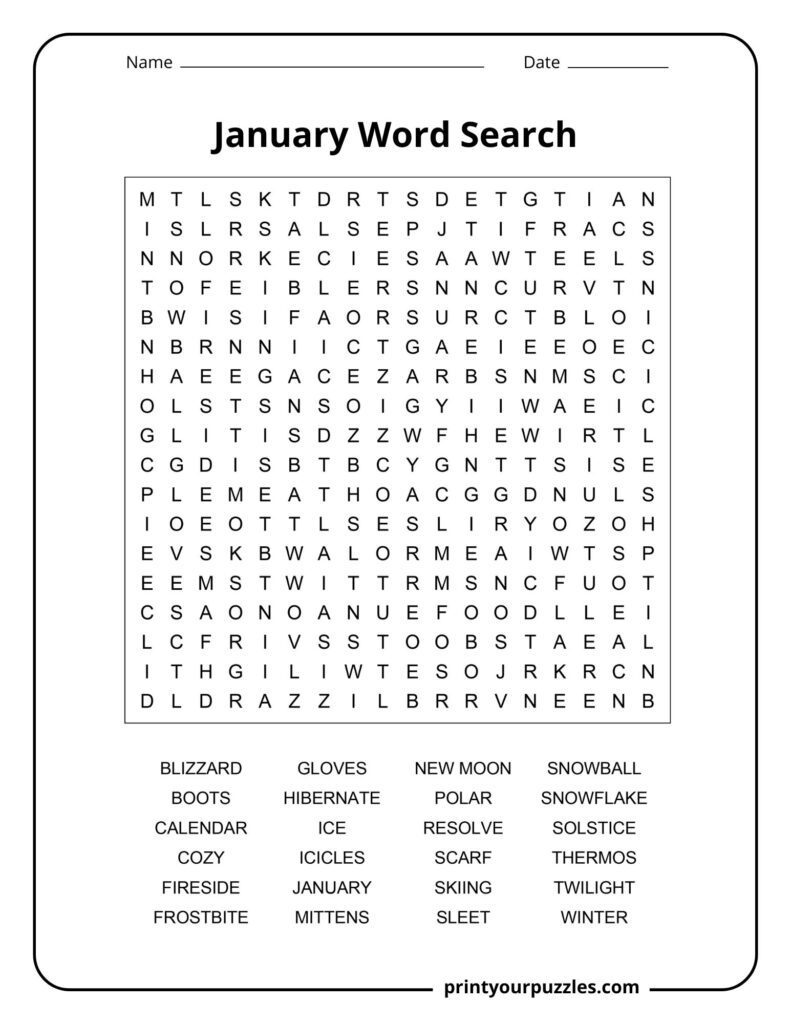
BLIZZARD, BOOTS, CALENDAR, COZY, FIRESIDE, FROSTBITE, GLOVES, HIBERNATE, ICE, ICICLES, JANUARY, MITTENS, NEW MOON, POLAR, RESOLVE, SCARF, SKIING, SLEET, SNOWBALL, SNOWFLAKE, SOLSTICE, THERMOS, TWILIGHT, WINTER
BLIZZARD – A severe snowstorm characterized by strong winds, low temperatures, and heavy snowfall that dramatically reduces visibility, making travel extremely dangerous and disrupting daily life significantly.
BOOTS – Sturdy footwear extending above the ankle, designed to protect feet from cold, snow, and wet conditions, commonly worn during winter months for warmth and practical outdoor use.
CALENDAR – A structured system organizing days, weeks, and months into a yearly framework, helping people plan events and track time, with January marking the fresh beginning of each new year.
COZY – A feeling of warmth, comfort, and contentment, often experienced while wrapped in blankets near a fireplace during cold winter days, creating a sense of snug, peaceful relaxation indoors.
FIRESIDE – The area immediately surrounding a fireplace or hearth, traditionally a beloved gathering spot during winter evenings where families share warmth, stories, hot drinks, and quiet companionship together.
FROSTBITE – A serious medical condition caused by prolonged skin exposure to freezing temperatures, damaging tissue in extremities like fingers, toes, ears, and nose, requiring immediate medical attention to prevent permanent injury.
GLOVES – Fitted hand coverings with individual finger compartments, made from wool, leather, or synthetic materials, worn in cold weather to retain body heat and protect hands from freezing temperatures.
HIBERNATE – A deep, prolonged sleep-like state certain animals enter during winter months, dramatically slowing metabolism and body functions to conserve energy until warmer spring temperatures naturally return again.
ICE – Water frozen into a solid crystalline state at or below zero degrees Celsius, forming on lakes, roads, and surfaces during winter, creating both beautiful natural scenery and hazardous conditions.
ICICLES – Slender, pointed spikes of ice formed by the gradual freezing of dripping water, hanging downward from rooftops, branches, and ledges, creating a distinctive and beautiful winter landscape decoration.
JANUARY – The first month of the Gregorian calendar, named after the Roman god Janus, traditionally associated with new beginnings, resolutions, cold weather, and the hopeful transition into a brand new year.
MITTENS – Simple handwear enclosing all four fingers together in one compartment with a separate thumb, providing excellent warmth in cold weather, commonly worn by children and adults during snowy winter activities.
NEW MOON – The lunar phase when the moon is positioned between Earth and the sun, making it invisible from our planet, marking the beginning of a new monthly lunar cycle in the night sky.
POLAR – Relating to the extreme geographical regions surrounding the North or South Poles, characterized by intense cold, long dark winters, unique wildlife, and dramatic icy landscapes of breathtaking frozen beauty.
RESOLVE – A firm, determined decision or commitment to achieve a specific goal or change a behavior, particularly associated with New Year resolutions people enthusiastically make at the beginning of January each year.
SCARF – A long, flexible piece of fabric worn wrapped around the neck and sometimes the face during cold weather, providing essential warmth and insulation while also serving as a fashionable winter accessory.
SKIING – A popular winter sport involving gliding across snow on long, narrow runners attached to boots, practiced recreationally on mountain slopes or competitively, requiring balance, skill, and physical coordination to master.
SLEET – A wintry precipitation type consisting of partially frozen or refrozen raindrops that create small ice pellets, falling when atmospheric temperatures cause rain to freeze before reaching the ground below.
SNOWBALL – A rounded mass of compacted snow shaped by hand, traditionally thrown playfully during winter outdoor activities, forming the basis of classic childhood games and friendly seasonal battles between participants.
SNOWFLAKE – A uniquely structured ice crystal formed in clouds when water vapor freezes around tiny particles, each possessing a distinct, intricate six-sided symmetrical pattern unlike any other snowflake ever created naturally.
SOLSTICE – An astronomical event occurring twice yearly when the sun reaches its maximum or minimum declination, with the winter solstice marking the shortest day and longest night of the entire year.
THERMOS – An insulated vacuum container designed to maintain the temperature of its liquid contents for extended periods, keeping hot beverages like coffee, tea, or soup warm during cold outdoor winter activities.
TWILIGHT – The soft, diffused natural light present just after sunset or before sunrise, appearing particularly brief and atmospheric during January’s short winter days, casting beautiful bluish hues across snowy landscapes.
WINTER – The coldest season of the year occurring between autumn and spring, characterized by shorter days, longer nights, freezing temperatures, snowfall, and the natural world entering a quiet period of dormancy.
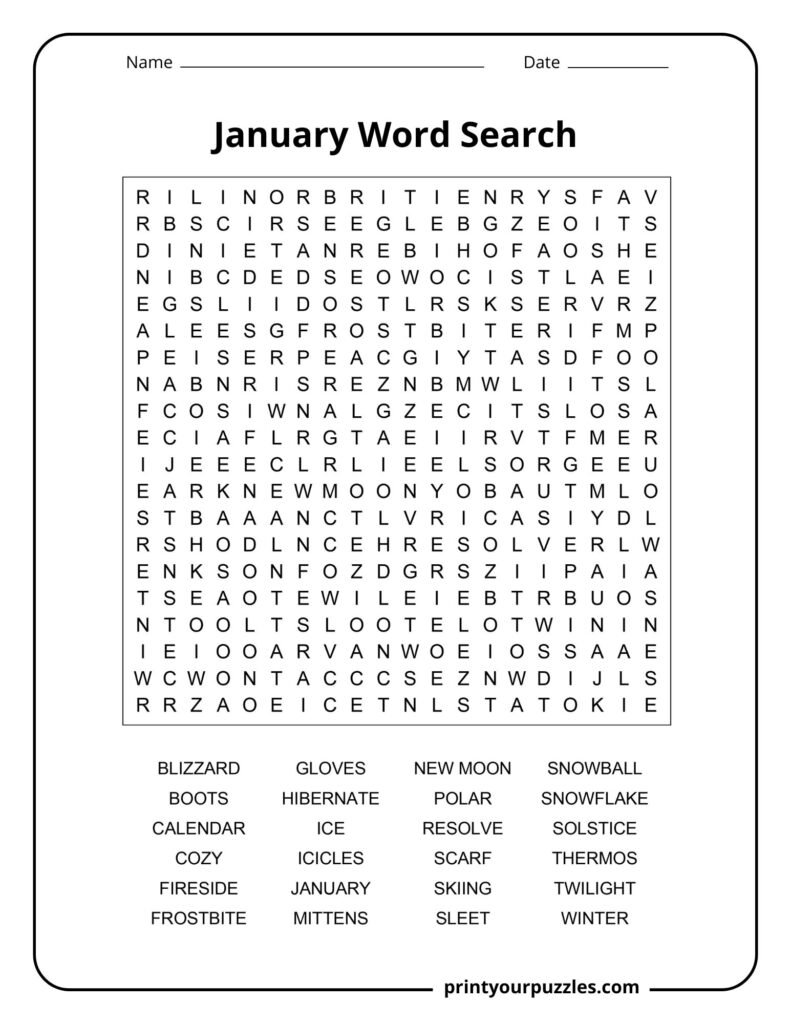
BLIZZARD, BOOTS, CALENDAR, COZY, FIRESIDE, FROSTBITE, GLOVES, HIBERNATE, ICE, ICICLES, JANUARY, MITTENS, NEW MOON, POLAR, RESOLVE, SCARF, SKIING, SLEET, SNOWBALL, SNOWFLAKE, SOLSTICE, THERMOS, TWILIGHT, WINTER
January was established as the year’s first month by Roman consul Julius Caesar in 46 BC, honoring Janus, the two-faced god symbolizing beginnings, transitions, and time’s passage.
Garnet is January’s official birthstone, typically displaying a deep red color and symbolizing friendship, trust, and protection. It has been treasured as a meaningful gemstone for thousands of years.
January represents fresh beginnings, motivating people to reflect on past habits and commit to positive personal changes, a tradition dating back nearly four thousand years to ancient Babylonian civilization.
January typically brings the year’s coldest temperatures across the Northern Hemisphere, with frequent snowfall, freezing rain, frost, and shortened daylight hours characterizing this deeply wintery and often harsh month.
January hosts several significant global celebrations, including New Year’s Day on January 1st, Martin Luther King Jr. Day in America, and various cultural festivals marking winter traditions worldwide.
The world is still. The days are short, the cold is real, and there is nowhere to be but inside — with yourself and a book. These three choices embrace January’s silence, its isolation, and its strange invitation to go deeper.
The Long Winter – Laura Ingalls Wilder. A family trapped by relentless blizzards, surviving on sheer willpower. Raw, cold, and isolating — exactly how January feels.
The Shining – Stephen King. A hotel buried in snow, a man slowly unraveling, madness creeping in. January’s isolation has never felt more terrifying.
Norwegian Wood – Haruki Murakami. A young man lost in grief and memory during a cold Tokyo winter. Melancholy, introspective, and perfectly suited to January’s long, quiet nights.
Originally, the ancient Roman calendar began in March, containing only ten months. January and February were later added around 713 BC by King Numa Pompilius.
Janus, the Roman deity of beginnings and doorways, was depicted with two faces looking simultaneously forward and backward, perfectly symbolizing the transition between the previous year and the exciting new one.
Under the earliest Roman calendar, January had only 29 days. Julius Caesar’s calendar reform in 46 BC officially extended it to 31 days, a standard we continue following today.
Native American tribes traditionally called January’s full moon the “Wolf Moon,” inspired by hungry wolves howling outside villages during the coldest, darkest, and most unforgiving nights of the winter season.
Retailers worldwide experience dramatic post-holiday sales surges in January, with consumers actively seeking discounts, gyms reporting record memberships, and travel bookings peaking as people enthusiastically pursue their ambitious New Year resolutions.